
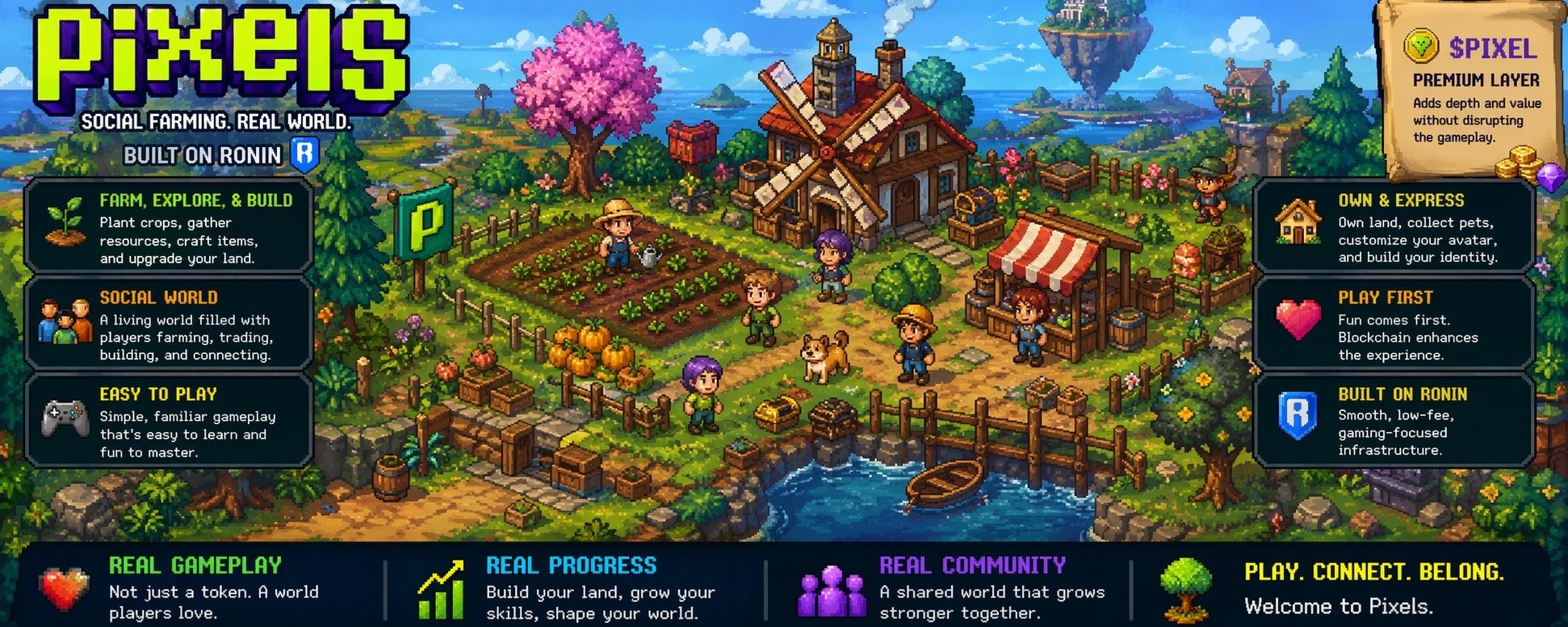

Pixels gets a lot of attention because it does something many Web3 games still struggle to do: it makes the project feel like a real game before it feels like a crypto product. That is a big reason why Pixels stands out. Built as a social casual farming game on Ronin, Pixels pulls people in with a simple idea—farm, explore, build, trade, and connect with other players—but what makes it interesting is how naturally it turns those basic actions into a world players actually want to spend time in.
What makes Pixels work is that the project understands player behavior better than a lot of blockchain games do. Most people do not enter a game because they want to think about tokens, asset structures, or digital ownership. They come for routine, progress, and a world that feels alive. Pixels leans into that. The farming is not there just to fill space. It gives the project its heartbeat. Planting crops, collecting materials, crafting items, upgrading your setup, and improving your land creates a loop that feels easy to understand but still rewarding enough to keep players coming back. That kind of loop matters because it gives the project something stronger than hype. It gives it habit.
Pixels also benefits from being built around a social world instead of a lonely one. A lot of games in this category feel empty even when they have players. Pixels feels more personal because the project is designed around shared space, movement, and visible progress. You are not just clicking through isolated tasks. You are existing in a world where other players are farming, building, trading, and shaping their own place alongside you. That gives the project warmth. It feels more like a living online space and less like a system trying to prove its value through economics alone.
That is where Pixels becomes more interesting than the average Web3 title. The project does not rely on blockchain language to make itself sound important. It relies on gameplay that people already understand. Farming, gathering, upgrading, and exploration are familiar mechanics, and that familiarity works in the project’s favor. Pixels does not waste time making the player feel like they need a guide just to understand the core loop. It feels approachable. That matters because accessibility is one of the hardest things for Web3 games to get right. If players feel confused too early, they leave. Pixels lowers that barrier by making the world readable from the start.
The Ronin side of the project also matters, but mostly because it supports the kind of game Pixels wants to be. A social farming game needs smooth interaction. It needs players to come back often without feeling friction every time they log in or do something simple. Ronin gives Pixels an ecosystem that already understands gaming behavior, and that helps the project feel more natural in its current home. The chain is not supposed to be the star of the experience. It is supposed to support it. Pixels benefits from that because the project feels more focused on flow than on showing off infrastructure.
Another strong point is the way Pixels handles value inside the game. This is where the project shows real restraint. Many Web3 games make the mistake of attaching financial weight to every part of the experience. That usually makes the game feel tense instead of fun. Pixels feels smarter because it creates room for players to enjoy the loop without making every action feel like a market decision. The project has a premium on-chain layer through PIXEL, but it does not let that overwhelm the basic rhythm of playing. That balance is important because it protects the mood of the game. Once every click starts feeling like a transaction, the world stops feeling playful. Pixels avoids that better than most.
The identity side of the project also deserves attention. Pixels is not just about farming for the sake of farming. It is about building a presence inside the world. Land, avatars, pets, items, and player expression all help the project feel more personal. That is important because ownership in Web3 only feels meaningful when it connects to an actual experience. A digital item means very little if it has no life inside the game. Pixels gives those items context. They exist inside a world where players can be seen, recognized, and remembered. That makes the project feel more grounded. Ownership becomes part of the environment instead of a detached feature floating outside of it.
There is also something refreshing about the project’s overall tone. Pixels does not feel desperate to prove that it is revolutionary. That is actually one of its strengths. The project feels more comfortable letting the gameplay speak for itself. In a space where many teams over-explain their importance, that kind of confidence helps. Pixels feels like it knows what it is. It is not trying to be everything at once. It is trying to be a place players enjoy returning to, and that focus gives the project more clarity.
What really gives Pixels an edge is that it understands the emotional side of game design. People stay in games for more than rewards. They stay because the world becomes familiar. They like seeing progress. They like having a routine. They like feeling that their space inside the game slowly reflects the time they put into it. Pixels builds around those feelings. That is why the farming matters. That is why the social layer matters. That is why the project feels stronger than others that may have louder token narratives but weaker game identity.
Pixels still has the same challenge every Web3 game has. The project needs to keep its economy healthy without letting the economy swallow the game. That balance is never easy. But Pixels at least feels like a project that started from the right side of the problem. It is not asking people to care about the token first and figure out the fun later. It is building fun first and letting the deeper value grow around that.
That difference changes everything. It changes how people enter the project, how long they stay, and how seriously they take it. Pixels feels less like a game built to serve a token and more like a project using Web3 in a way that supports the experience instead of distracting from it. In this space, that is rare.
Pixels stands out because it understands something simple but powerful: if the project gives players a world they genuinely enjoy, the rest starts to make sense on its own.