
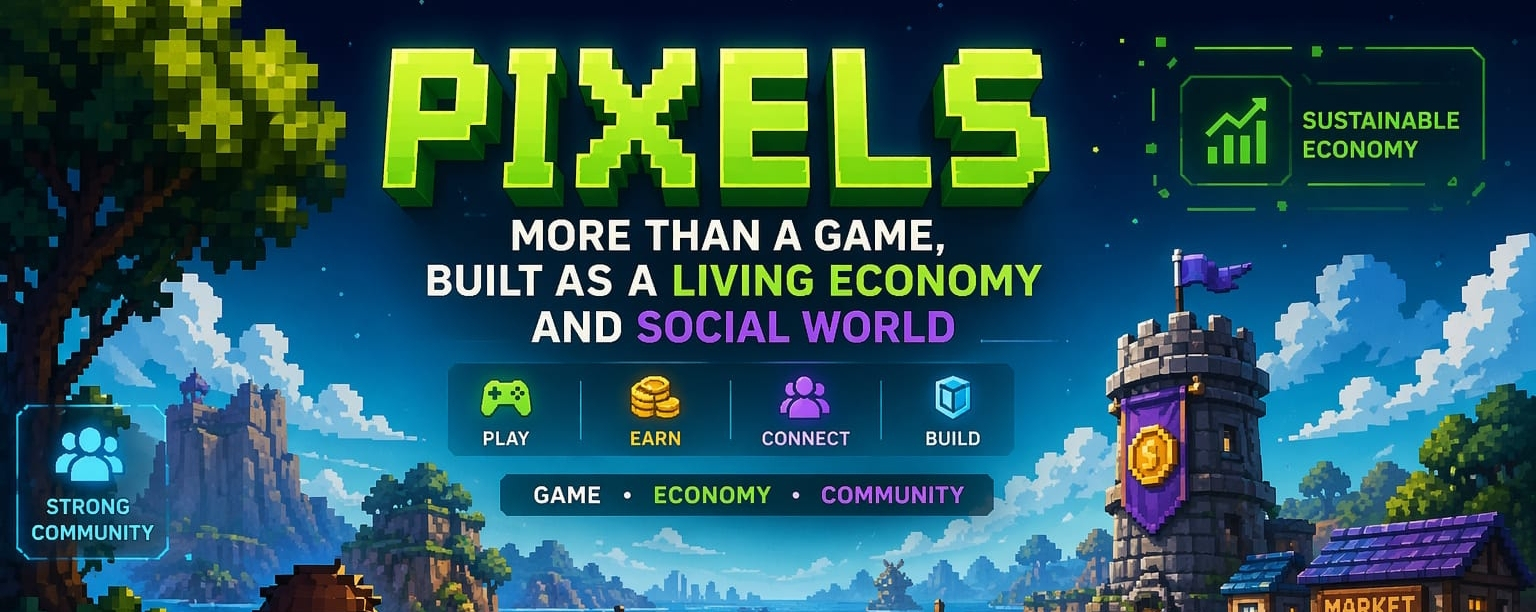
When I think about Pixels, I do not think it fits into only one category. Calling it just a game feels too limited, but calling it only an economy or only a social platform also does not feel right to me. The way I see it, Pixels works because it mixes all three together. It feels like a game when I play it, it works with the rules of an economy, and it keeps people connected like a social platform. That mix is what makes it different for me.
For me, Pixels is still a game first. That is the first thing people notice. You enter the world, farm, collect resources, cook, craft, explore, and slowly grow over time. That basic loop matters a lot. In Web3, I have seen many projects talk about tokens first before proving the game is even fun. Pixels does not really do that. At its heart, it gives players something simple and easy to understand. You do not need to know a lot about crypto to understand how it works. You just start playing, and that easy start makes a big difference.
That is probably one reason Pixels got so much attention. It does not feel like numbers and charts dressed up as a game.
It feels like a world that wants you to stay. Even the fact that it is free to play and easy to access on mobile through a browser tells me the team understands something important. If people cannot enter easily, they will not stay long enough to care about anything else. I always notice that because easy access is very important in blockchain gaming. A lot of projects say they want big growth, but their setup makes it hard for normal people to join. Pixels feels like it really wants everyday players, not only people chasing quick profit.
At the same time, I cannot say Pixels is only about farming and fun.
The economy is too important to ignore. This is where the project becomes more serious for me. I usually judge Web3 games with one simple question. Are players being pushed to really play, or are they just being pushed to take value and leave? That question matters more to me than hype, token price, or social media buzz. In Pixels, I can see that the team has spent real time thinking about this problem.
What I respect is that the project has not acted like every early choice was perfect. It made changes to make the economy healthier, especially around inflation and reward flow. That tells me the team is watching how players act inside the game. And that matters because in games like this, players will always look for the fastest and easiest path. If the system rewards taking value out as fast as possible, that is exactly what players will do. @Pixels seems to understand this, and that is why I see it as more than just a simple farming game with a token added on top.
The economy now feels more planned. Instead of letting rewards grow forever without control, the project has pushed more toward costs, upgrades, limits, and better balance over time.
To me, that is the difference between a weak game economy and a real one. A weak economy keeps giving rewards until everything loses value. A real economy gives players reasons to spend, improve, build again, and keep going. That creates a much better loop. It does not only reward activity. It rewards people who stay and keep taking part.
Then there is the social side, and I honestly think many people do not notice how important it is. Pixels is not social only because players can talk or spend time together. A lot of games have that. What makes Pixels different is that social activity connects to access, trust, and value inside the world. Guilds are a good example. They are not just simple groups for fun. They come with rules, needs, roles, and shared value. That changes the whole feeling of the project. When community becomes tied to ownership and rewards, it is no longer just an extra feature. It becomes part of the main experience.
The reputation system makes that even stronger. I think this part is very important because it shows that Pixels is not only looking at what players own, but also at how they take part. Reputation affects what players can do in the game world, including trading, using the marketplace, and making withdrawals. That tells me Pixels wants to reward players who are truly involved instead of treating every wallet the same way. In my opinion, that is a smart move. In Web3, trust is always a big issue, and many projects talk about it without building real systems around it. Pixels at least tries to make trust and activity part of the gameplay itself.
That is why I think the social platform label also fits.
Not because Pixels looks like a normal social media app, but because the whole system depends on people meeting, building, joining groups, and staying active in ways that go beyond playing alone. It is trying to create a world where progress is not only about grinding by yourself. It is also about being part of something bigger.
What makes Pixels even more interesting to me is that it does not seem like the team wants it to stay only as one farming game forever. The bigger direction feels much larger than that. It feels like the team wants Pixels to become a full ecosystem where game design, economy rules, and community action all support each other. That bigger goal matters. A lot of projects say they want to build an ecosystem, but it often sounds like empty promotion. With Pixels, I can at least see that idea slowly taking shape.
So if I had to answer the question in a simple way, I would say Pixels is a game first, an economy underneath, and a social platform growing through both. I call it a game first because that is where people start and what pulls them in. I call it an economy second because the future of the project depends on how well rewards, costs, and progress stay balanced. And I include social platform because guilds, reputation, and community activity are clearly becoming part of the base of the project.
That is really why I keep coming back to Pixels. It does not feel like a project trying to win only through hype. It feels like it is trying to build a world where playing, earning, and being part of a community all connect with each other. And to me, that is exactly why Pixels cannot be explained with only one simple label.