
One of the oldest mistakes in Web3 gaming is treating ownership like the product. You see it again and again. The NFT comes first, the market comes second, and the actual game is left trying to justify both. That is usually where things fall apart. Players stop thinking about the world, the loop, or the progression. They start thinking about floor prices, rarity, and exit liquidity. At that point, the game is not really a game anymore. It is a trading environment with some mechanics hanging off the side.
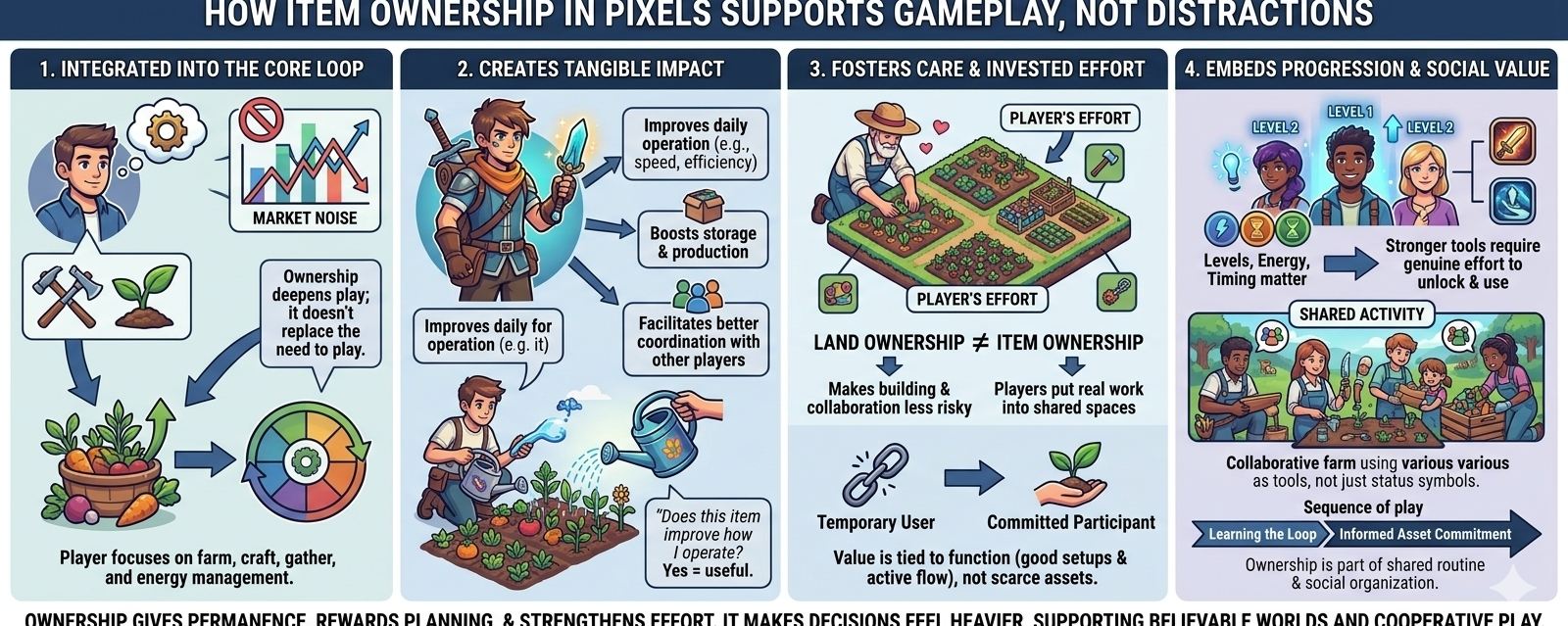
Pixels feels different because ownership is not asked to carry the whole experience. The game already has a rhythm without it. You farm, craft, gather, manage energy, move through tasks, build routines, and slowly improve your position. Ownership comes into that structure as something that deepens play. It does not replace the need to play.
That is the real reason item ownership works here.
What I think Pixels understands better than most projects is that players only care about ownership when it changes their day-to-day experience in a meaningful way. Not in a theoretical way. Not in a whitepaper way. In a real gameplay way. Does this item improve how I operate? Does it help me move faster, store more, produce better, or coordinate more effectively with other players? If the answer is yes, ownership feels useful. If the answer is no, then it just becomes noise.
That is where a lot of Web3 games lose the plot. They confuse ownership with importance. Just because something is tokenized does not mean it matters. A game item only matters when it has a place inside the loop. Pixels, for the most part, gets that.
A big part of that comes down to how the game handles land and placed items. In weaker systems, land ownership tends to become a blunt instrument. Whoever owns the land ends up sitting on all the leverage. Everyone else is basically building on borrowed ground, which kills long-term trust. If players think their effort can be swallowed by someone else’s ownership rights, they stop investing real care into the space. They become temporary users instead of committed participants.
Pixels avoids a lot of that tension by making ownership more specific. Land ownership and item ownership are not treated as the same thing. That may sound like a small technical design choice, but it changes the feel of the whole system. It means players can put real work into a space without automatically losing claim over the assets they bring into it. That makes collaboration less risky. It makes building feel safer. And once people trust the rules around effort and contribution, they are much more willing to engage seriously.
That is where ownership starts helping gameplay. It creates the conditions for people to care.
The same idea shows up in how land creates value in the first place. In Pixels, land is not interesting because it exists as a scarce asset. It is interesting because it can be used well or used badly. That is a much healthier foundation. The value is tied to function. A good farm setup, strong production flow, smart industry choices, useful access management, and active players around the land matter more than simply holding the thing. Ownership gives you a platform, but what you do with that platform is still the main event.
I think that is one of the smartest choices in the game’s structure. It keeps attention on operations rather than symbolism. In a lot of tokenized games, ownership becomes a status display disconnected from actual skill. In Pixels, ownership still has weight, but it is connected to how well you understand the game. You still need to think. You still need to manage. You still need to know what kind of setup actually works. That keeps the asset inside the game instead of floating above it.
Progression matters here too. Pixels does not fully let ownership bypass effort, and that is important. Even if you have access to stronger land or better infrastructure, you still have to deal with the same core logic of the game. Levels matter. Energy matters. Production timing matters. Skill requirements still shape what you can place and how efficiently you can run your operation. That balance is what stops ownership from becoming a shortcut that cheapens the whole experience.
To me, that is the difference between support and distraction.
When ownership supports gameplay, it makes your decisions feel heavier. It gives permanence to your choices. It rewards planning. It makes social coordination more meaningful. When ownership distracts from gameplay, it does the opposite. It pulls your attention away from play and toward speculation. It tells players the smart move is not to learn the system but to position around the asset. Pixels leans much more toward the first model.
There is also a social layer here that deserves more attention. A lot of people talk about NFTs in individual terms, as if ownership is only about personal control. But in Pixels, ownership often becomes part of shared activity. Land roles, permissions, and collaborative setups turn items into tools for organization. The best assets are not just the rare ones. They are the useful ones. The ones that help a group function better, create smoother workflows, or give structure to a productive routine.
That is a much more grounded kind of value.
It also helps that Pixels does not force ownership on the player from day one. That choice matters more than people think. When a game demands asset commitment before the player even understands the world, it creates the wrong relationship from the start. The player enters as a buyer, not as a participant. Pixels lets people come in, learn the loop, and feel the texture of the game first. Only after that does ownership start to matter more. That sequence is healthy because it means the player can judge assets by lived usefulness instead of pure hype.
Honestly, that is rare in this space.
Most Web3 games talk about utility, but a lot of that utility is shallow. It usually means the item unlocks something, boosts something, or grants access to something. Pixels is stronger when it makes ownership part of routine. That is a different level of integration. The item is not just a key. It becomes part of how you play every day. It shapes your route, your storage choices, your resource flow, your land setup, your production priorities, and sometimes even your relationships with other players. That is why it feels less distracting. It has friction, context, and consequence.
And that matters because the best game economies are not built on the idea that players want to own things for the sake of owning them. They are built on the idea that players want their time, choices, and progress to mean something. Ownership only works when it strengthens that feeling. Pixels is not perfect, and like every live economy game it still has to keep balancing incentives carefully, but it is clearly trying to solve the right problem. It is not asking whether items can be owned. That part is easy. It is asking whether ownership can make the world more believable, more cooperative, and more worth investing time into.
That is a much better question.
In the end, item ownership in Pixels works because it stays close to effort. It protects what players build. It gives practical value to planning and coordination. It makes land more than decoration. And it keeps the player focused on the game itself, which is exactly where attention should stay. The ownership layer is there, but it does not scream over the rest of the experience. It just makes the experience feel more personal, more persistent, and more worth taking seriously.
That is why it supports gameplay instead of pulling it apart.