
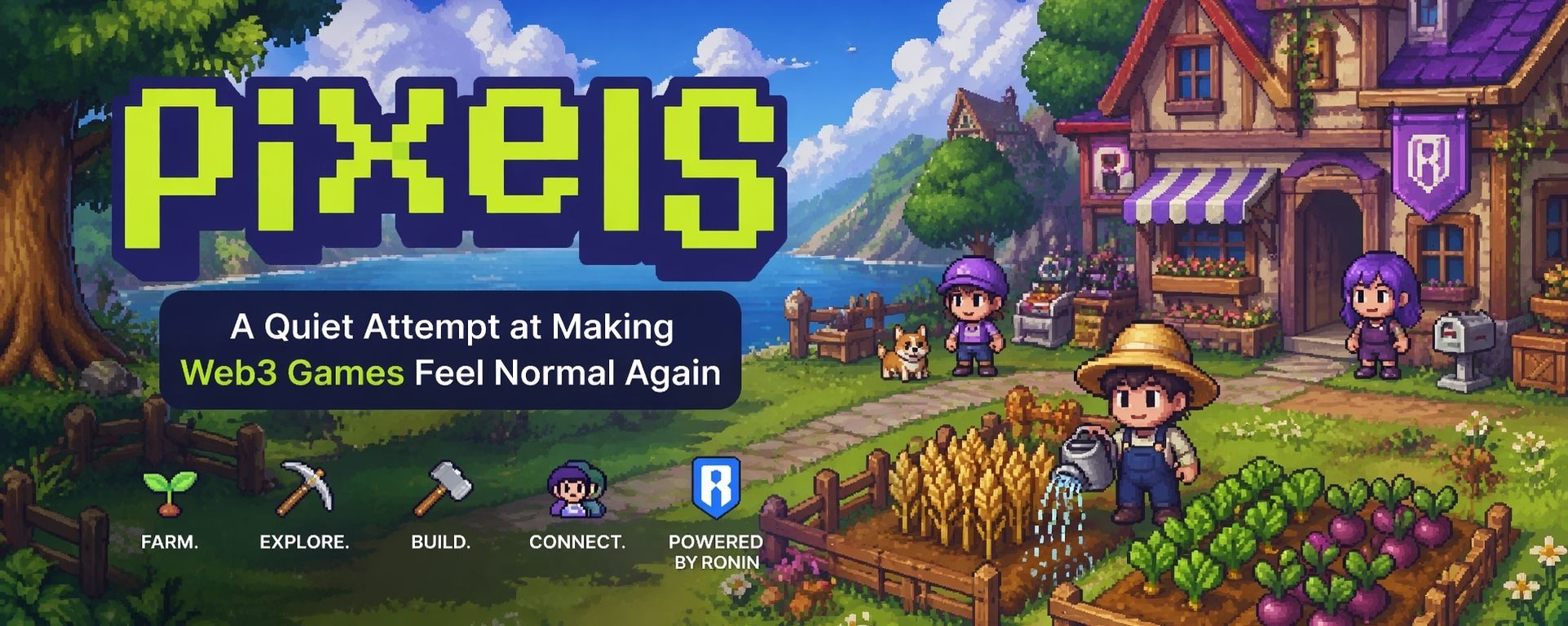

I didn’t think much of Pixels when I first came across it. It felt familiar in a way that made it easy to overlook. A farming game, simple mechanics, a token somewhere in the background—it didn’t ask for much attention, and I didn’t feel the need to give it any.
I’ve seen enough projects like this to know how they usually unfold. They arrive with a clear pitch, attract early interest, and for a while everything feels active. Then something shifts. The activity becomes thinner, the systems start showing their cracks, and slowly people stop returning. Not all at once, just enough that you notice the silence growing.
Pixels didn’t follow that pattern, at least not in the way I expected. It stayed around. Not loudly, not in a way that forces itself into every conversation, but consistently enough that it became harder to ignore over time.
It runs on the Ronin Network, which makes sense for something like this. The game doesn’t want friction. It doesn’t want players thinking about transactions or costs or anything that interrupts the flow. That decision feels less like a feature and more like a quiet necessity. If the experience is meant to feel light, the structure underneath has to stay out of the way.
When I finally spent more time with it, what stood out wasn’t what it offered on the surface, but how little it tried to prove. You plant crops, gather resources, expand your space, move through a shared world. Nothing about it feels complicated. It doesn’t try to surprise you. Within a short time, you understand exactly what it is.
And usually that’s where interest fades. Simplicity can feel shallow if there’s nothing holding it together underneath. But here, it feels intentional, like it’s trying to remove as many reasons as possible for someone to stop playing before they even begin.
What stayed with me wasn’t the gameplay itself, but the way the game avoids pushing its economy to the front. The PIXEL exists, and it matters in certain parts of progression, but it doesn’t dominate the experience. You’re not constantly being reminded that there’s a value layer behind what you’re doing.
That’s a small shift, but it changes the tone completely. In most Web3 games, you feel the system almost immediately. You start thinking about efficiency, about outcomes, about whether what you’re doing is “worth it.” The game turns into something you manage rather than something you move through.
Pixels doesn’t eliminate that feeling, but it softens it. It gives space for the routine to exist without turning everything into a calculation.
And it really is a routine. You log in, you tend to your land, you repeat actions that don’t change much from one session to the next. There’s no rush built into it, no constant push to keep up or fall behind. That rhythm can feel calming, or it can feel empty. I think it depends on what you expect from it.
What I keep coming back to is how it behaves when things aren’t ideal. That’s where most systems start to show what they actually are. When more players arrive, when rewards shift, when people begin to find the most efficient paths instead of the most enjoyable ones—those are the moments that matter.
Pixels doesn’t seem immune to those pressures, but it doesn’t unravel under them either. There’s a sense that changes are made carefully, even if they’re not always perfect. It doesn’t feel like it’s chasing short-term reactions, which is something I’ve learned to pay attention to. Projects that move too quickly to please everyone usually end up losing their shape.
There’s also the shared space, which I didn’t think much about at first. Other players are around, moving through the same environment, but nothing forces interaction. You can engage with others or ignore them completely. That choice gives the world a bit of quiet depth. It doesn’t rely on social features to create meaning, but it leaves room for them to exist.
I still don’t see it as something trying to redefine anything. If anything, it feels like it’s trying to stay grounded in a space that often drifts too far into its own ideas. It doesn’t promise more than it seems capable of delivering, and that alone makes it stand out a little.
But that doesn’t mean it’s solved anything.
The same questions are still there, just less visible. Whether the routine will hold up over time. Whether the economy will stay in the background or slowly move forward again. Whether people will keep returning once the familiarity settles in.
I don’t have a clear answer for any of that. And I don’t think Pixels does either.
For now, it just continues, in its own steady way. And I find myself watching it a bit more closely than I expected, not because it demands attention, but because it doesn’t.