
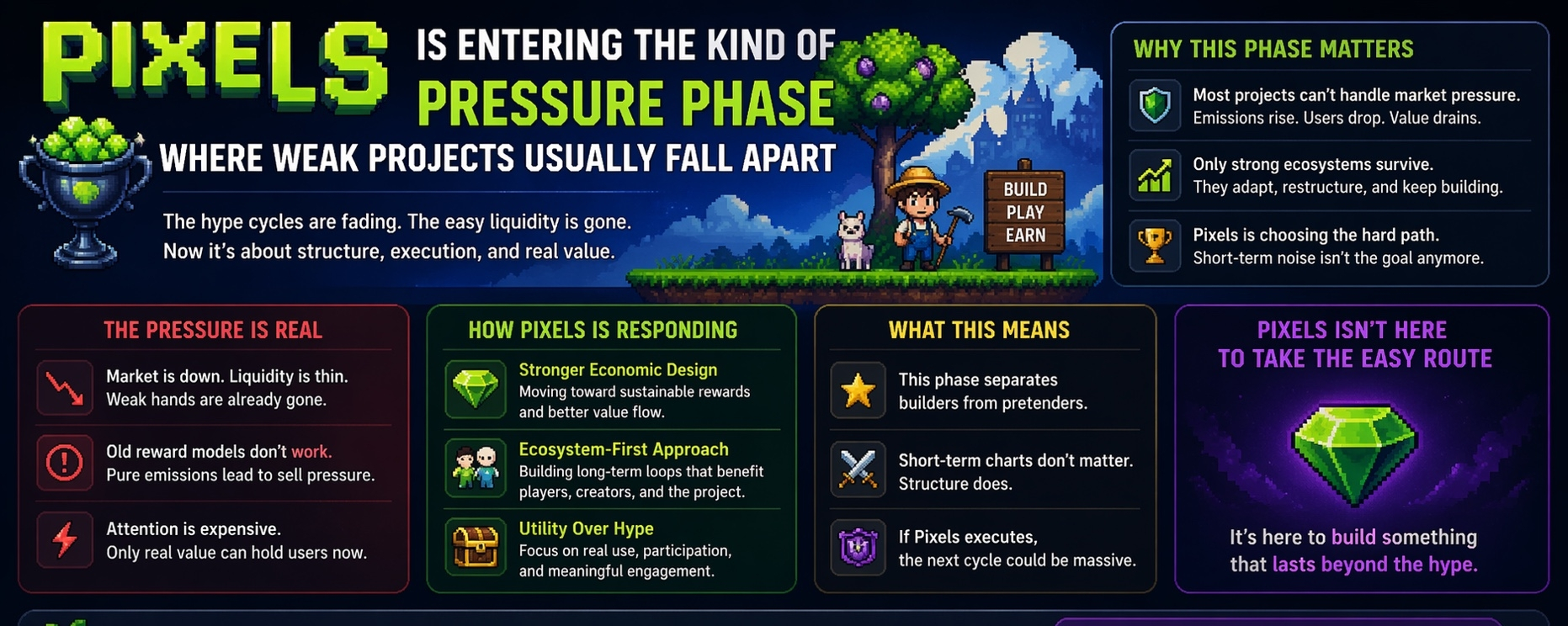
Pixels is entering one of those phases where I stop looking at the event itself and start looking at what kind of pressure the project is actually under.
Because I’ve seen this cycle too many times. A project rolls out a fresh event, people dress it up as momentum, the timeline gets loud for a day or two, and then everything slips back into the same old grind. Same emissions. Same recycled attention. Same slow bleed once the noise clears. Most of these ecosystems do not break because they lacked users for a week. They break because the structure underneath was never built to carry weight in the first place.
That’s why I’m not really interested in the surface layer here.
What has my attention is that Pixels feels like it’s trying to move out of that trap. Not with some dramatic reinvention. Not with the usual “new era” language people throw around when they need exit liquidity. I mean a more practical shift. A tired one, honestly. The kind that comes after a project has already felt friction, already taken damage, already learned what happens when an economy starts working against itself.
And that part matters to me more than the event.
Pixels still has a real identity. That helps. A lot of projects lose themselves the moment things get hard. They start copying whatever narrative is working somewhere else, hoping the market will forget what they were five minutes ago. Pixels doesn’t feel like that to me. It still looks like its own thing. Still has its own rhythm. Still has a community that actually recognizes the project for what it is instead of what it’s pretending to be this week.
But here’s the thing.
Identity alone does nothing if the core loop keeps leaking value. I don’t care how recognizable the brand is if the system underneath keeps feeding the same old extraction cycle. That has killed more projects than bad marketing ever did. People stay for a while, they farm what they can, they leave behind a weaker chart and a weaker mood, and then the whole thing turns into maintenance mode disguised as progress.
That’s the part I’m watching with Pixels now. I’m not looking for a clean success story because this market almost never gives you one. I’m looking for whether the project is finally getting more serious about how participation, retention, and value actually connect. Not just activity for the sake of activity. Not just another spike that looks good on a dashboard and means nothing a month later.
Because if this event is part of a wider shift in the way Pixels handles its ecosystem, then that changes the conversation a bit.
Not all at once. I’m not saying one event fixes old damage. It doesn’t. The scars are still there. The doubt is still there too, and honestly it should be. Crypto has trained people to be skeptical for good reason. Most teams talk about sustainability only after they’ve already burned through the easy version. So when I look at Pixels, I’m not rewarding effort. I’m asking whether this project has actually reached the point where it understands what was dragging it down.
That’s a different question.
And I think that’s why this phase feels more interesting than a normal update cycle. It doesn’t feel like Pixels is just trying to get louder. It feels like it’s trying to get tighter. More controlled. More deliberate. Less dependent on the kind of short-term reward flow that creates excitement upfront and weakness later. If that reading is right, then this is not really about one event at all. It’s about whether the project can create enough internal strength to stop recycling the same old GameFi fatigue.
I’ve watched a lot of projects hit this stage and fail anyway.
Some of them had community. Some had capital. Some had hype that looked unstoppable for a minute. Didn’t matter. Once the economy turned into a grind that nobody really believed in, the entire thing started to feel heavier every week. Users could sense it. Holders could sense it. Even the updates started reading like obligations instead of momentum. That kind of exhaustion is hard to reverse once it sets in.
Pixels feels like it knows that. Or at least it should by now.
And that’s why I’m still paying attention. Not because I think this is some clean breakout setup. Not because I think the market suddenly becomes forgiving. Mostly because I’ve seen what it looks like when a project keeps pretending nothing is wrong, and this doesn’t feel like that. This feels more like a team trying to reduce the friction before the whole thing gets buried under its own weight.
Maybe that works. Maybe it doesn’t. I’m just watching for the moment where this stops looking like another event cycle and starts looking like the first real sign that Pixels is no longer feeding the same machine that usually kills these projects.
Or maybe I’m just tired of watching the same failure pattern repeat and hoping this one is a little less predictable.