
I didn’t fully get Pixels at the start.
It felt like every other farming loop. Log in, clear energy, plant the fastest crops, craft whatever flips, repeat. At one point I spent a few hours just rotating wheat and cooking meals thinking I was optimizing everything.
Then I checked my actual progress… and it barely moved.
That part didn’t make sense at first.
Because I wasn’t inactive. I was doing more than most players around me. Still, it felt like I was stuck in place while others were somehow getting ahead without putting in the same visible effort.
That’s when things started to feel different.
Not broken, just… designed differently.
The usual GameFi logic doesn’t really apply here.
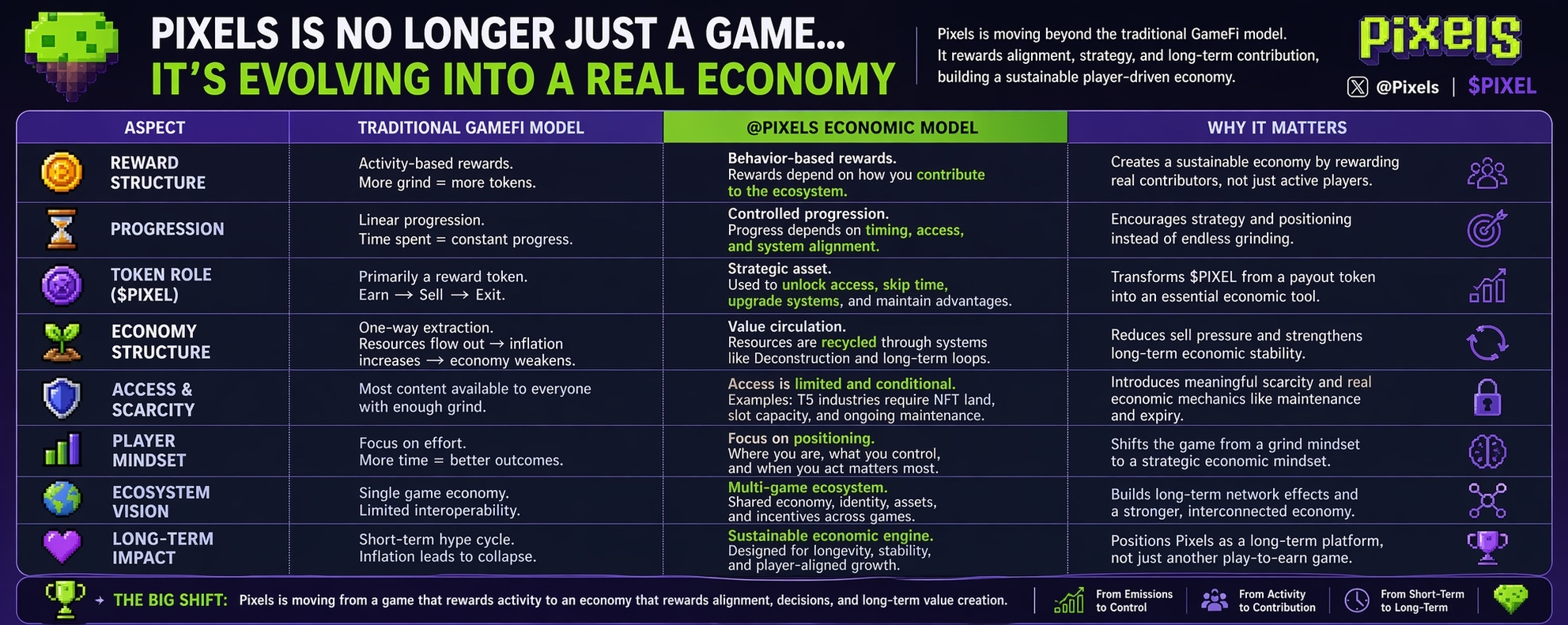
In most games, more activity means more rewards. Simple equation. That’s also why those systems collapse. Too many emissions, too little control, and eventually everyone just farms and exits.
Pixels doesn’t follow that pattern.
You can grind for hours and still feel like nothing meaningful happened. And honestly, that’s frustrating early on. But after a while, it starts to look less like a flaw and more like the point.
Progress here isn’t tied directly to activity.
It’s tied to when the system decides that activity matters.
A small example, but it explains a lot.
I had one session where everything was lined up properly. Crops ready, crafting queue planned, materials mostly there. Then everything stopped because I was missing a specific input. Not something rare, just badly timed.
I remember thinking I misplayed it.
Now I’m not so sure.
It felt like the system forcing a pause rather than me making a mistake.
That’s where Stacked comes in, and this is the part most people still underestimate.
Stacked isn’t just a reward system. It behaves more like a control layer sitting on top of the game.
Instead of rewarding every action, it filters behavior over time. It looks at how you’re interacting with the ecosystem, not just how active you are.
Two players can put in the same hours and end up in completely different positions.
That’s not random.
That’s selection.
Then you have the whole off-chain to on-chain dynamic, which changes how you think about value.
Most of what you do inside Pixels doesn’t instantly pay out. Farming, crafting, gathering it all feels productive, but it’s really just building up state.
The actual value only shows up when it connects with PIXEL.
And that connection doesn’t happen constantly.
It happens at specific points.
That delay is important.
Because it forces you to think ahead instead of just reacting.
The role of PIXEL itself has clearly shifted.
It doesn’t feel like a reward token anymore. It feels more like a tool you use to remove friction.
Skip time, unlock access, secure better positioning, enter higher-tier systems.
And if you look at Tier 5, that becomes obvious.
T5 industries aren’t something you just grind into. You need NFT land, slot capacity, and those slots expire. If you want to keep your position, you have to maintain it.
That’s not typical GameFi design.
That’s closer to how real economic systems behave.
Access exists, but it’s conditional.
Even systems like Deconstruction add to that.
Instead of constantly pushing new resources into the game, Pixels lets you break existing items down into rarer components. That changes how value moves.
It doesn’t just flow outward.
It cycles.
Which means the system holds itself together longer without needing constant external input.
What’s interesting is how all of this affects player behavior.
At the start, you think in terms of effort. More time, more output.
Later, that mindset stops working.
You start thinking in terms of positioning.
Where you are in the system. What you have access to. When you choose to act.
And that shift isn’t obvious unless you’ve actually felt the slowdown.
Right now, there are basically two types of players in Pixels.
The ones still optimizing their farming loops…
And the ones trying to understand where value is actually being created.
Same game, completely different outcomes.
From the outside, it might look like Pixels is slowing down.
Less obvious rewards, more friction, slower progression.
But internally, it’s doing the opposite.
It’s stabilizing.
Building layers instead of pushing emissions.
That’s why calling it “just a game” doesn’t really fit anymore.
It’s closer to a controlled economy that happens to use gameplay as its interface.
And if that model works, it changes how GameFi evolves from here.
@Pixels isn’t trying to reward everyone equally.
It’s trying to shape behavior.
And once you start seeing it that way, the whole system makes a lot more sense.
