
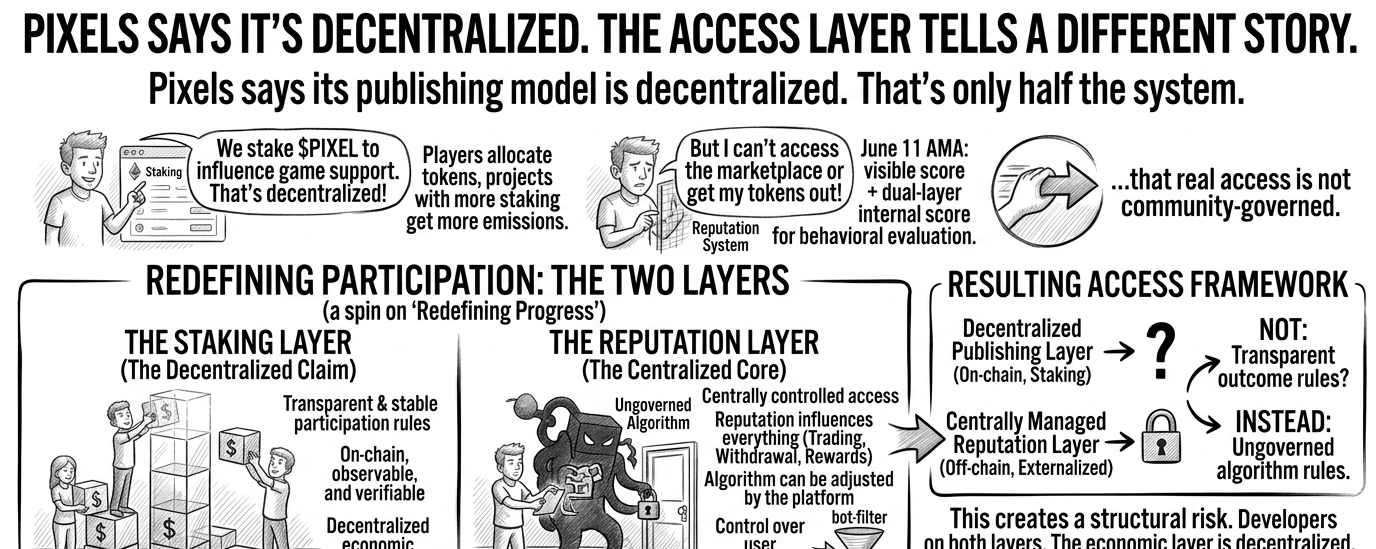
Pixels says its publishing model is decentralized. that’s only half the system.😂
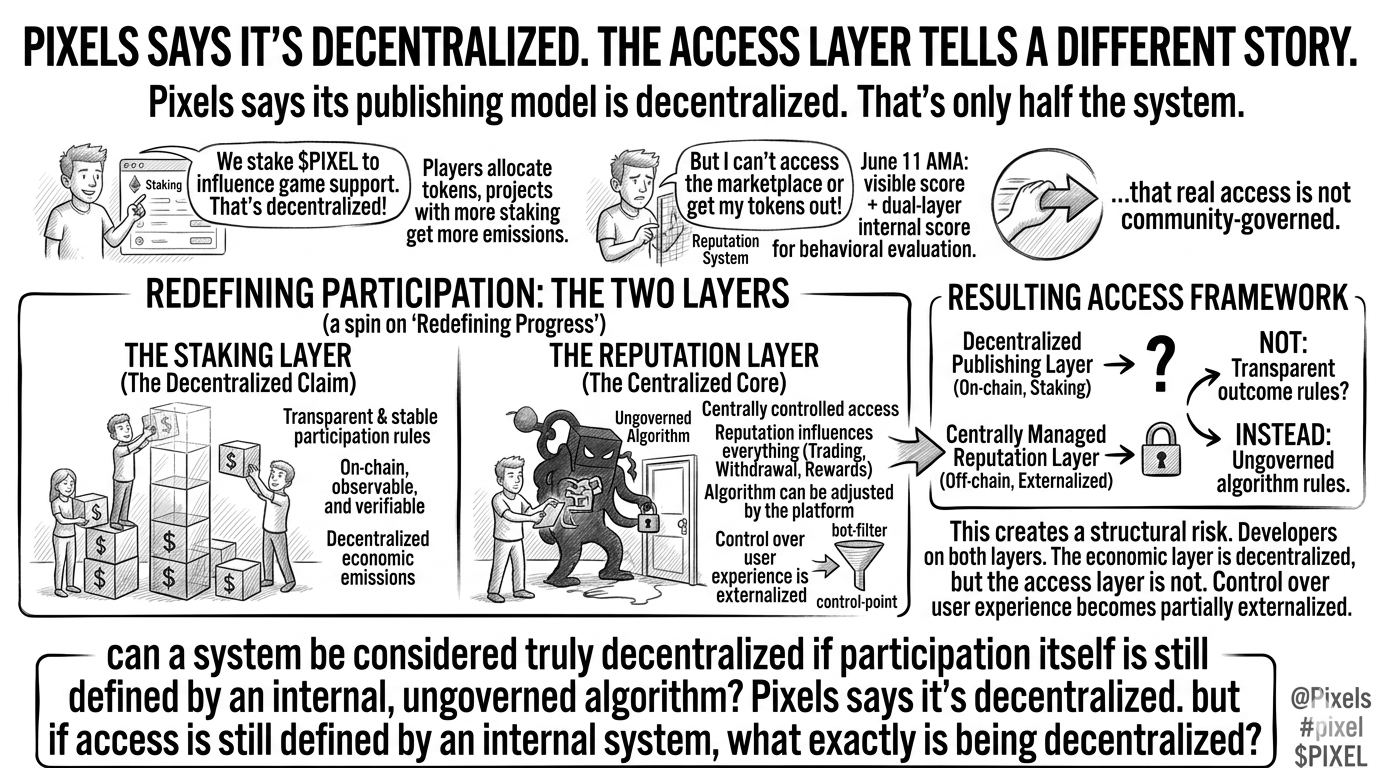
Pixels positions its publishing framework around a clear idea: staking $PIXEL gives the community influence over which games receive ecosystem support. During the April 30, 2025 AMA, this was explained directly. Players allocate their tokens, projects that attract more staking receive greater emissions, and those that don’t receive less. In theory, success inside the ecosystem is determined by collective behavior rather than a central authority. As a publishing concept, that structure is genuinely compelling. But there is another layer operating beneath it.
Access across the Pixels ecosystem is heavily influenced by a reputation system. Marketplace usage, withdrawal conditions, fee structures, and cross-game identity benefits are all tied to this score. Unlike staking, this system is not governed by the community. The June 11, 2025 AMA suggested a dual-layer approach: one visible score for players to track, and another internal score used for behavioral evaluation and access control. The public explanation focuses on quests and activity, but the underlying algorithm that determines real access is not disclosed.
This creates a tension at the core of the model.
A decentralized publishing environment implies transparent and stable participation rules. The staking layer aligns with that expectation. It is on-chain, observable, and verifiable. However, the reputation layer, which determines who can fully engage with the system, remains centrally controlled. The methodology can be adjusted by the platform, and while updates are communicated, they are not governed through community decision-making.
This introduces a structural risk.
Developers building within this ecosystem rely on both layers simultaneously. The economic layer is decentralized, but the access layer is not. Any partner integrating with Pixels effectively accepts that user classification, who gains access and under what conditions, is defined externally. The developer does not control that system. Pixels does.
Reputation originally served a practical purpose.
As an anti-bot mechanism, it protects the ecosystem from automated exploitation, which is a legitimate concern. However, its role has expanded significantly. It now influences trading ability, withdrawal efficiency, reward competitiveness, and participation across integrated experiences. What began as a filter has become a central control point.
Consider the implications for partner games.
If a developer integrates Pixels identity and uses reputation as a gating mechanism, their game experience becomes dependent on a score they cannot fully audit. If the algorithm changes, player access inside that game can shift without any direct action from the developer. Control over user experience becomes partially externalized.
This is where the decentralization narrative becomes complicated.
Transparency around outcomes is not the same as transparency around rules. Explaining how scores behave is helpful, but it does not replace governance over how those scores are calculated.
Pixels introduces an innovative publishing structure, but its consistency depends on alignment between its layers. As long as the reputation system remains centrally managed, the platform retains control over the most critical access mechanism in the ecosystem.
That isn’t unusual in platform design.
But it raises a final question:
can a system be considered truly decentralized if participation itself is still defined by an internal, ungoverned algorithm?
Pixels says it’s decentralized. but if access is still defined by an internal system, what exactly is being decentralized?
#MarketRebound #StrategyBTCPurchase #WhatNextForUSIranConflict #KelpDAOFacesAttack $CHIP