
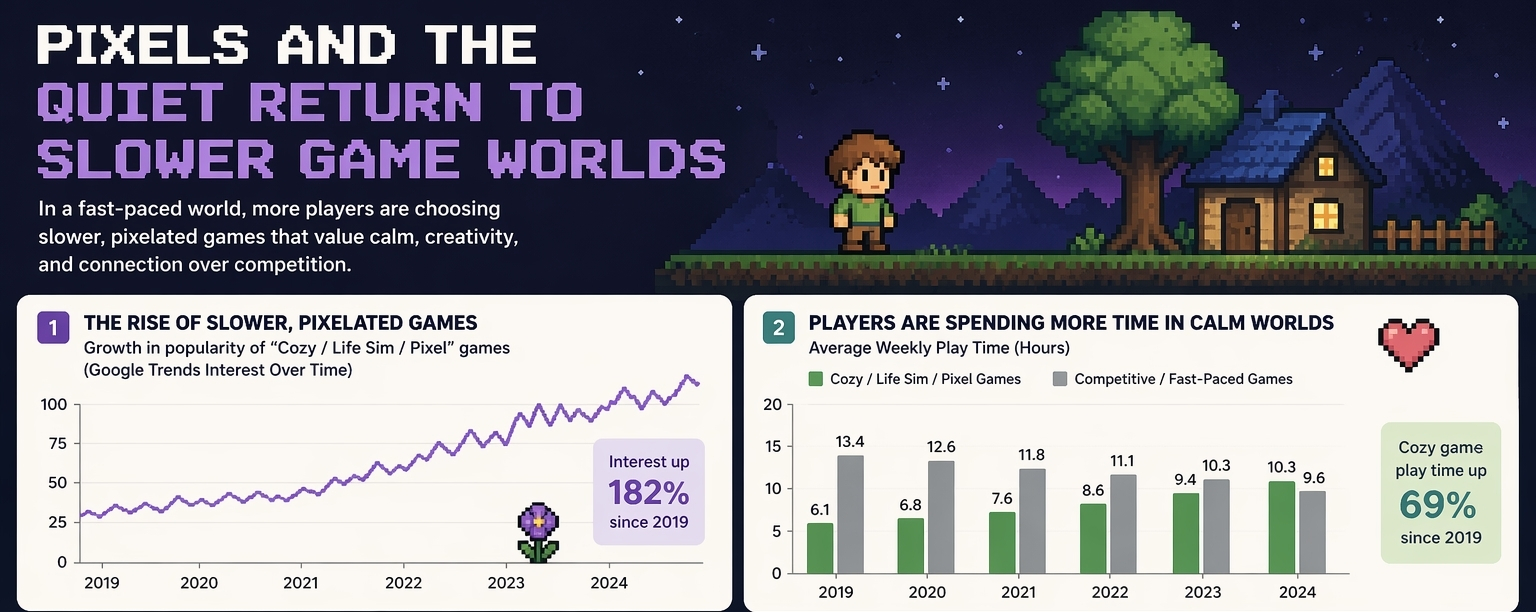
Pixels starts like a small thought rather than a big idea. A patch of land, a few simple actions, a world that doesn’t rush to explain itself. It doesn’t arrive with that familiar urgency you see everywhere else, where everything is framed as a breakthrough or a shift or something that demands attention right now. Instead, it feels like something built by people who got a little tired of all that noise and decided to make something slower, even if slower is harder to defend.
At first glance, it almost feels too simple for the space it lives in. Farming, exploring, crafting—none of these things are new, and that’s probably the point. There’s a kind of quiet resistance in choosing familiar mechanics in an ecosystem that usually tries to reinvent everything at once. But the moment you remember it sits on top of Web3 infrastructure, the simplicity starts to carry more weight than it should. Because in this space, nothing really stays simple once people begin interacting with it.
A field isn’t just a field anymore. It becomes time converted into something measurable. A routine becomes something that can be optimized. Even the calmest loop can turn tense once players begin asking what they’re getting back from it. That shift happens almost automatically. Nobody really announces it, but it shows up in behavior. People move differently when value is attached, even loosely.
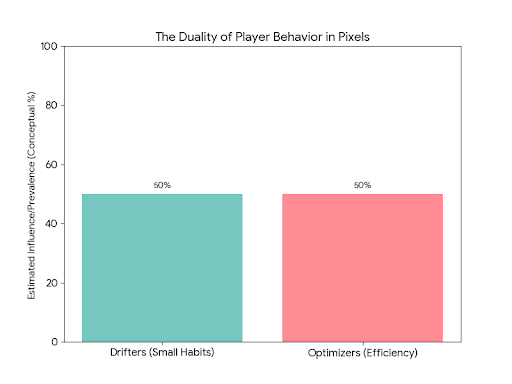
Pixels seems aware of that, but it doesn’t completely avoid it either. It sits in this middle space where it wants to feel like a place you can return to without pressure, while also existing in a system that quietly encourages pressure. That contradiction is hard to resolve. You can see it in how players approach it—some drift into it, take their time, build small habits. Others move through it like a checklist, efficient and detached. Both are valid, but they pull the experience in different directions.
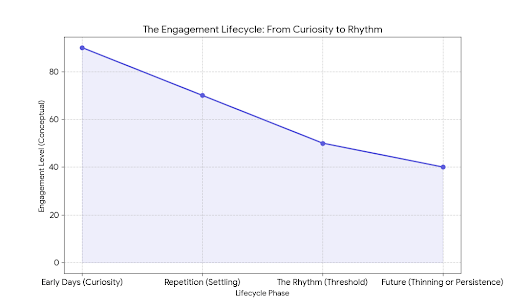
After watching enough of these projects, you start to notice how often they struggle with what happens after the first wave of curiosity. The early days are usually forgiving. Everything feels new, even repetition feels fresh because it hasn’t settled yet. But over time, the surface wears down. What’s left is just the rhythm of the system. And rhythm is unforgiving. If it doesn’t feel right, people don’t argue with it—they just stop showing up.
That’s where something like Pixels either becomes real or quietly fades into the background. Not through failure in the dramatic sense, but through a slow thinning of attention. A world doesn’t need to collapse to feel empty. It just needs fewer reasons to return.
There’s also something slightly uncomfortable about how much these kinds of games depend on people caring in ways that aren’t always visible. A social world isn’t really held together by mechanics alone. It’s held together by small, repeated acts—people choosing to stay, to interact, to make the space feel occupied. When that energy is there, even simple systems can feel alive. When it’s not, no amount of design can fully replace it.
Pixels seems to be trying to build around that idea of quiet persistence. Not forcing engagement, but hoping it happens naturally. It’s a subtle approach, and maybe a fragile one. Because the space it exists in doesn’t always reward patience. It rewards movement, growth, visible traction. Things that can be pointed to and measured quickly.
So there’s this underlying tension that never quite goes away. The project feels like it comes from a genuine frustration with how disposable digital worlds have become, but it still has to survive in an environment that encourages that same disposability. Players arrive with habits shaped by other systems. They test boundaries, look for efficiencies, sometimes leave as quickly as they came. The world has to absorb that without losing its shape.
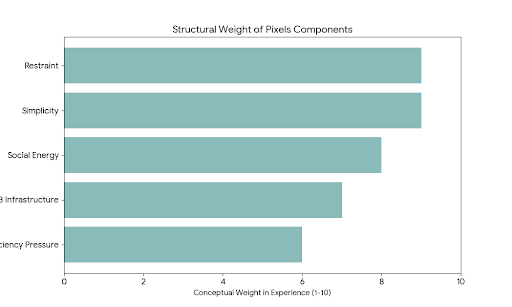
And maybe that’s the most honest way to look at it. Not as something trying to prove it’s different, but as something quietly testing whether a different pace can hold up under familiar pressures. There’s no clear answer yet. Just a system that feels like it’s been built with a bit more restraint than usual, and a question hanging over it about whether restraint is enough.
It’s not trying to impress in obvious ways, and maybe that’s why it stays in your mind a little longer than expected. Not because it stands out loudly, but because it doesn’t.