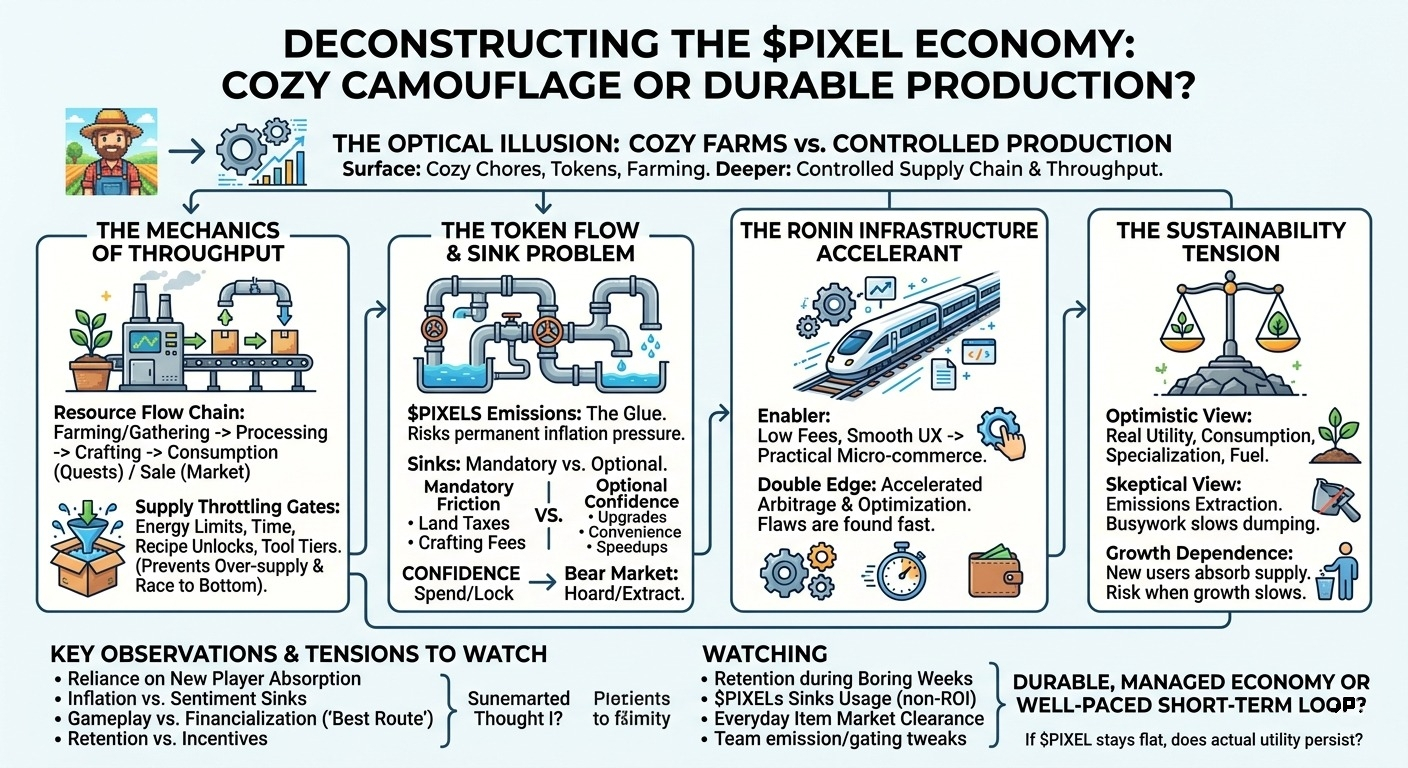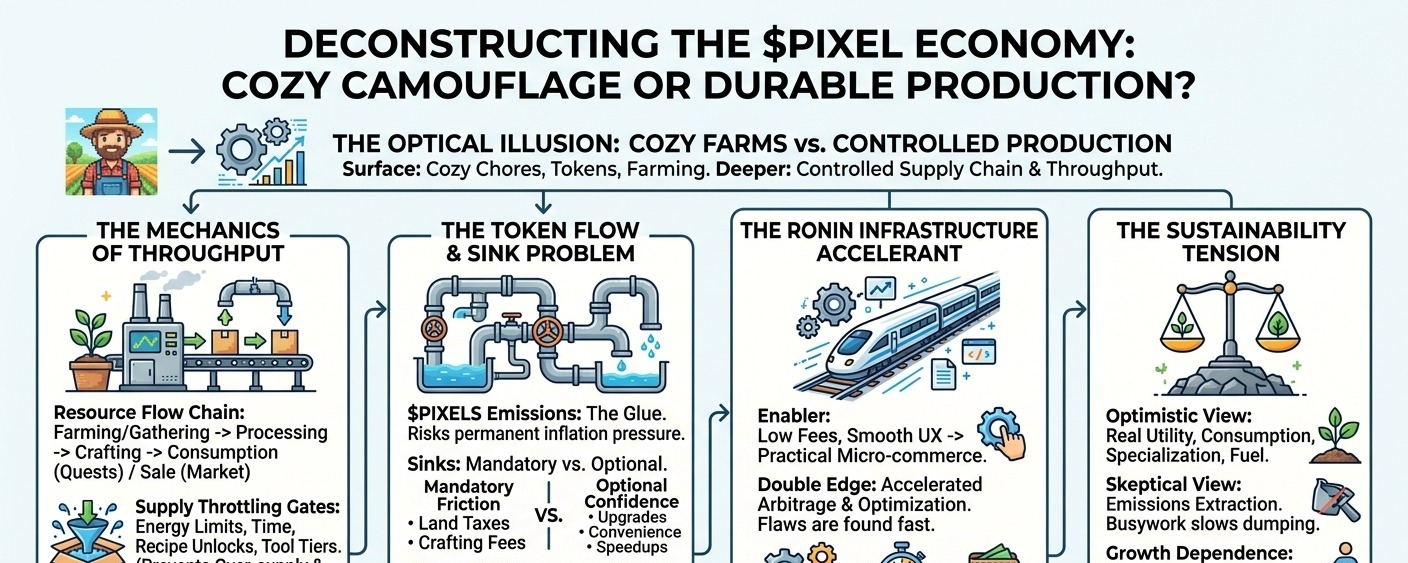
Most people describe pixels as “a farming game with a token on ronin,” and that’s basically the surface: you do chores, you get rewards, you trade stuff, maybe you buy an asset and optimize. but the deeper i go, the more it feels like pixels is really a controlled production economy that just happens to be rendered as crops and crafting benches.
resource generation is the first core piece, and it’s not really about farming skill, it’s about throughput. there’s a clear chain: farming/gathering → processing → crafting → consumption (quests/progression) or sale (player market). a loop i keep replaying: harvest a crop → process it into an ingredient → craft a consumable that’s required somewhere → list it on the market because other players don’t want to run the whole chain. what stands out is how many gates exist to stop that loop from becoming infinite supply: energy/time limits, recipe unlocks, tool tiers, and progression bottlenecks. it’s basically supply throttling, but dressed up as “progression.” and honestly, i get why—without those valves, you’d get instant commodity oversupply and the market becomes a race to the bottom.
then there’s token flow, where i’m still not fully convinced the loop closes. $pixels emissions seem to be the glue holding activity together. even if your crafted goods don’t sell well, token rewards can keep the daily loop feeling worthwhile. but emissions are also permanent inflation pressure unless sinks keep up. so i’m trying to map sinks in a boring way: what forces $pixels back out of circulation (or locks it) in a repeatable, non-optional way, versus what’s just “spend if you feel like it.”
and here’s the part i’m thinking about: optional sinks are confidence sinks. if spending $pixels is mostly upgrades, convenience, speedups, access boosts—stuff you do when you’re bullish—then sink demand disappears the moment players stop believing progression is worth it. in a traditional game, currency is trapped, so people spend by default. here, the currency is liquid, so “spend” competes with “hold” and “sell.” that changes everything. you can design the best upgrade tree in the world, but if players decide the optimal play is extraction, the sinks turn into a suggestion.
the infrastructure layer (ronin) is the quiet reason pixels can run this kind of high-frequency economy at all. low fees and decent wallet ux make it practical for players to list stacks of items, buy ingredients, and move assets around without every action feeling like friction. pixels needs that because its economy is basically micro-commerce, not occasional big nft flips. ronin also brings a market-native audience, which helps liquidity early. but it also increases the “this will get optimized” problem. any imbalance between crafting costs, reward rates, and market prices gets found fast. the better your rails are, the faster your economy gets stress-tested.
zooming out, i’m stuck between two interpretations of sustainability. the optimistic one is that players are generating value: items have real, repeatable utility, goods get consumed, specialization emerges (some people farm inputs, some craft, some trade), and $pixels acts mostly as settlement + progression fuel. the skeptical one is that players are mostly extracting emissions, and the item economy is an elaborate set of steps that slow down dumping and keep people busy.
what depends on continuous user growth is liquidity and absorption. new players buy starter goods, create fresh demand, and keep low-tier markets clearing. when growth slows, you find out if demand is intrinsic (steady consumption) or scheduled (quests/events temporarily spotlighting certain goods). scheduled demand can keep things looking healthy, but it’s also a bit like moving the goalposts to keep the market from settling.
tension points i can’t shake:
- reliance on new players to absorb supply
- token inflation vs sinks that don’t vanish when sentiment cools
- gameplay vs financialization (when “best route” becomes the whole game)
- retention vs incentives (do people stay when rewards normalize?)
watching:
- retention during boring weeks (no big event pressure, token flat)
- whether $pixels sinks remain used when roi isn’t obvious
- market clearance rates for everyday crafted items (not just rare assets)
- how often the team has to tweak emission/gating knobs to keep the loop coherent
no clean conclusion. pixels might be a durable, managed economy, or it might just be a really well-paced short-term loop. if $pixels stayed dull for months, would players still be buying each other’s outputs for actual utility, or does the whole thing slow to a crawl?