
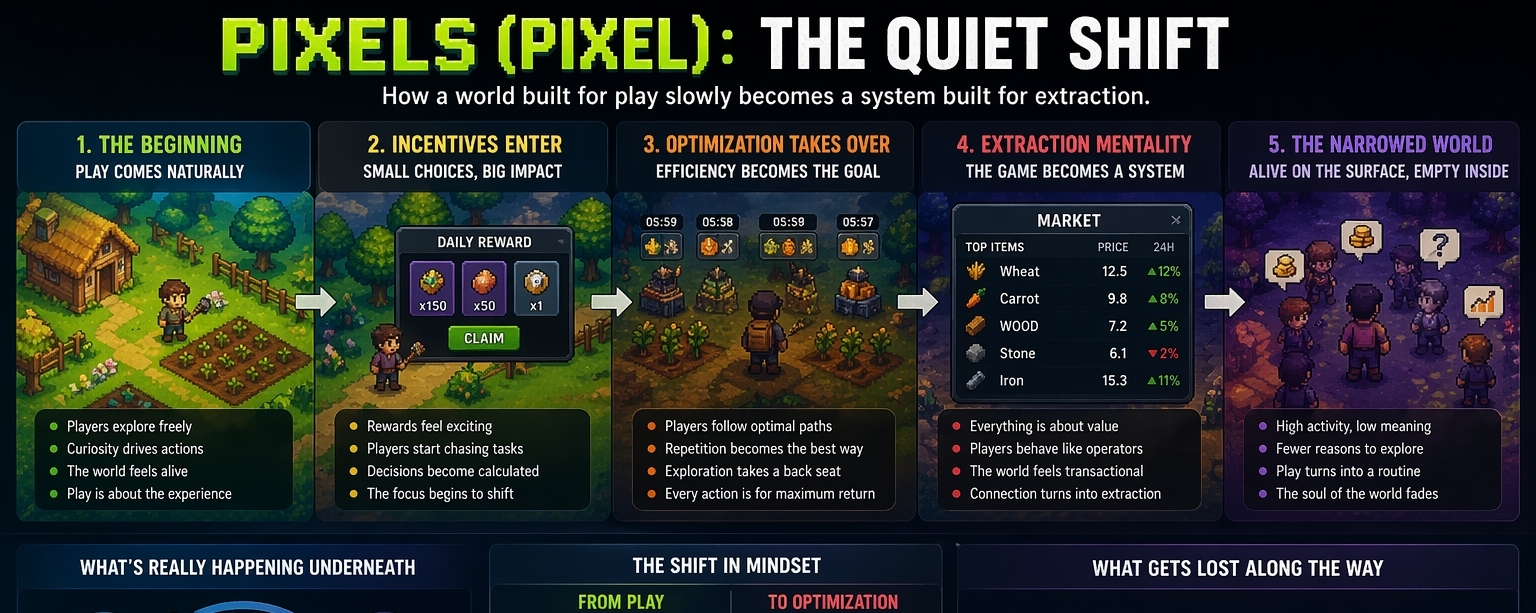
I've been thinking about this for a while now… how games like Pixels don’t really change overnight, but the way people interact with them slowly drifts without anyone fully noticing. In the beginning, it feels simple. You log in, move around, plant something, explore a bit… there’s no pressure behind it. It feels light, almost like you’re just passing time in a space that doesn’t ask much from you.
What stood out to me was how natural that early phase feels. People aren’t trying too hard. They’re not thinking in terms of efficiency or reward, they’re just there… doing things because it feels good to do them. And for a while, that’s enough. The world feels alive, not because of how much is happening, but because of how people are experiencing it.
But the shift was subtle. It didn’t come from one big change or update. It kind of crept in quietly. Over time, the idea of rewards started to sit in the background of everything. At first, it’s harmless… just something extra. But slowly, it begins to shape decisions. Players start thinking a bit more before doing something. Not in a heavy way, just small adjustments… choosing this over that because it gives slightly better results.
The more I watched, the more that small adjustment turned into a pattern. Movement became more intentional. Actions became more planned. It wasn’t about exploring anymore, not really. It started to feel like people were following invisible lines, moving through the game in ways that made the most sense mathematically, not emotionally.
What looked like growth from the outside carried a different feeling underneath. More players, more activity, more things happening… but the reason behind it all felt different. It started to feel less like a world people were enjoying, and more like a system people were trying to figure out. And once that mindset settles in, it changes everything, even if the game itself hasn’t changed much.
Underneath it all, the design begins to respond. Systems that reward consistency and repetition naturally push players toward doing the same things again and again. And players adapt quickly. Not because they’re told to, but because it becomes the obvious path. Efficiency slowly replaces curiosity.
It started to feel like the game was becoming smoother… but also thinner. Farming wasn’t really about the process anymore, it was about output. Exploration wasn’t about discovery, it was about coverage. Even creativity started to feel like it had a purpose beyond expression. Everything leaned slightly toward results.
And the strange part is, nothing looks broken. If anything, it looks like everything is working perfectly. The game is active, people are engaged, systems are being used exactly as intended. But underneath that surface, something quieter is happening. The connection players have with the game starts to change.
Over time, that change becomes easier to notice. Players stay, but not always for the same reasons. What once felt like a place to spend time becomes something closer to a system to move through. The focus shifts from “what can I do here?” to “what’s the best thing I should be doing right now?” And that small difference slowly reshapes the entire experience.
The pattern becomes clearer the longer you watch. Behavior influences design, and design reinforces behavior. It loops back on itself. And in that loop, some of the softer parts of the experience start to fade… the randomness, the small inefficiencies, the moments that didn’t really matter but somehow made everything feel more real.
It’s not something that collapses all at once. There’s no obvious breaking point. It just narrows. The range of how people play becomes smaller, more predictable. And while everything keeps moving, keeps functioning, it starts to feel a little less alive.
And somewhere along the way, without any clear moment to point to, it becomes harder to tell if people are still playing the game for what it is… or just moving through it for what it gives back.