I didn’t really notice it at first.
Pixels just felt… busy. Farms moving, trades happening, players grinding like they always do. At a glance, it looked like any other game economy doing its job — keeping people active long enough to matter.
But after a while, something started to feel off. Not broken. Just slightly uneven.
I couldn’t quite explain it at first.
Two players could follow the same loops, spend the same time, do almost everything the same — yet their outcomes didn’t really line up. Not immediately, but consistently enough to notice. Some players just seemed to show up at the right moments. Not faster, not more skilled. Just… there when it counted. Ko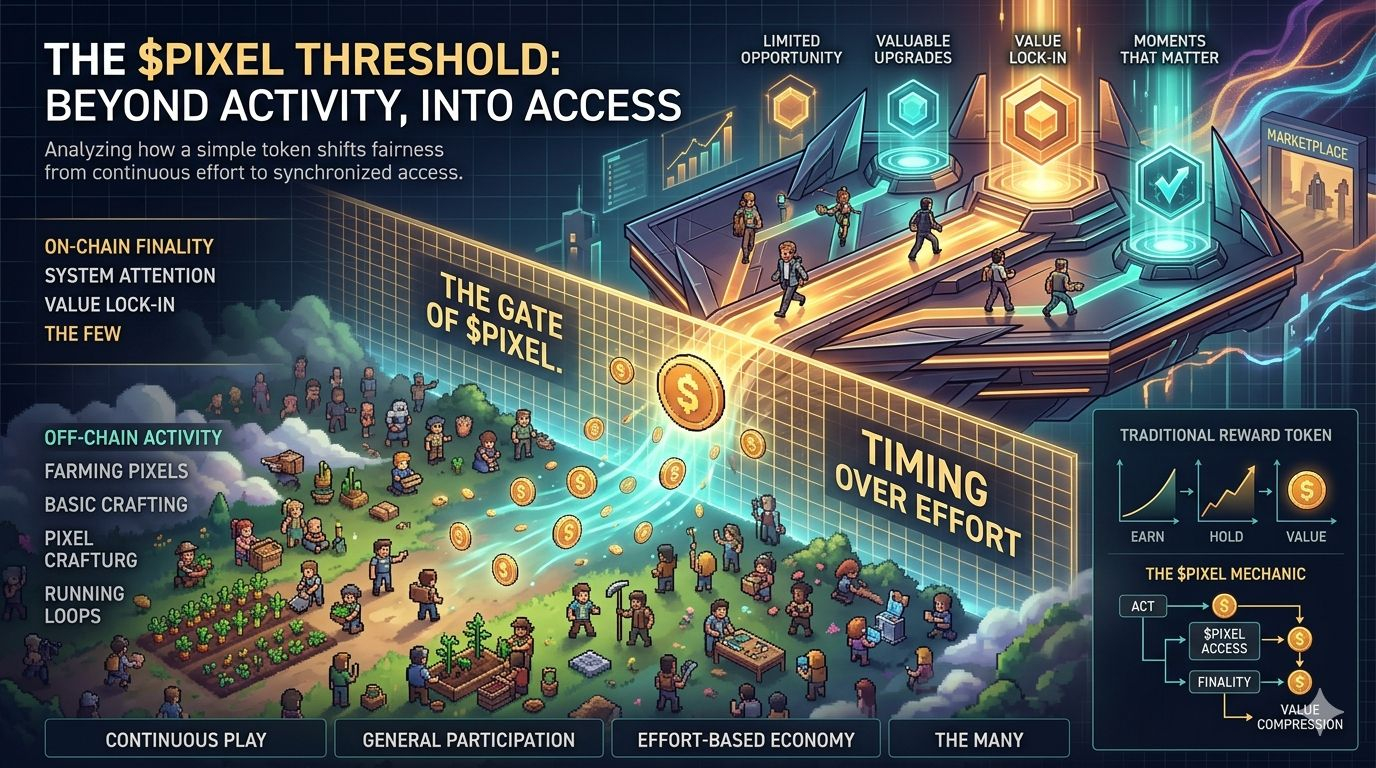
I kept thinking it was luck. Or maybe timing. But neither explanation fully held up.
That’s when I started looking at $PIXEL a bit differently.
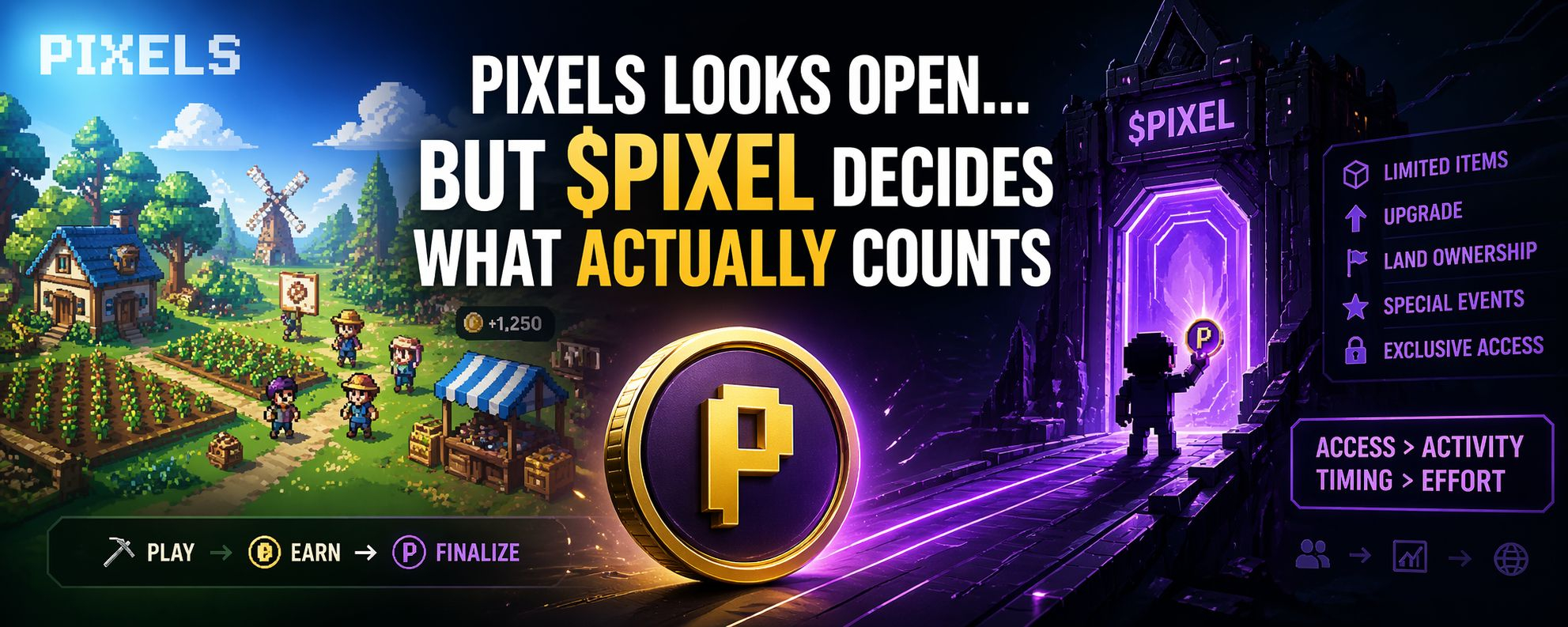
On paper, it’s simple. You play off-chain, build progress, and when something actually matters, you use $PIXEL to finalize it. Standard structure. A lot of systems separate cheap activity from more expensive final actions.
Still, the gap between those two layers felt wider than it should.
Most of the time, everything feels fluid. Farming, crafting, moving resources — it all happens in a kind of background flow. Nothing really forces a decision. But then something meaningful appears. A limited opportunity, a valuable upgrade, a moment that doesn’t really wait.
And suddenly, the system tightens.
It’s not about how much you’ve done anymore.
It’s about whether you can act right then.
That’s where #Pixel started to feel… different.
Not exactly like a reward. Something closer to access.
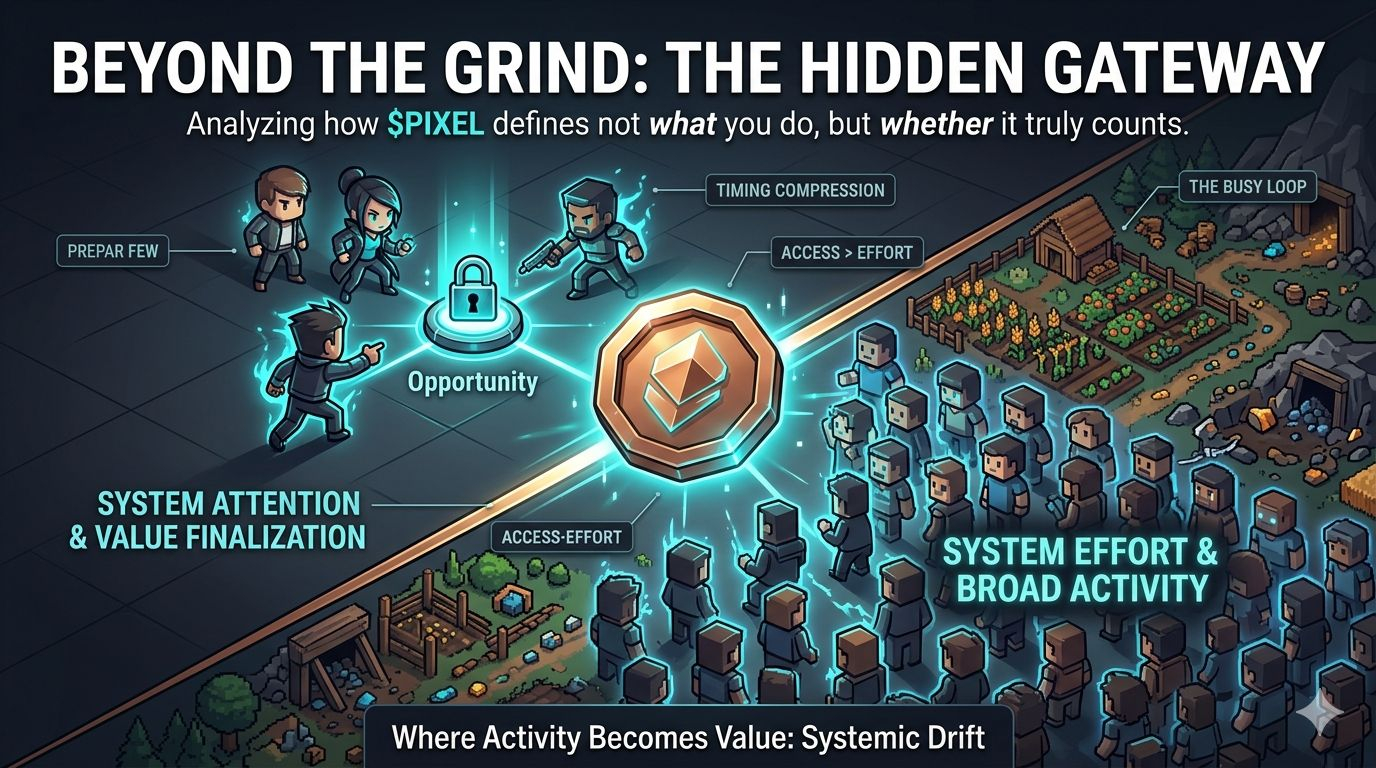
If it’s already there, you move. If it’s not, you pause — or miss the moment entirely. It’s subtle, but over time it adds up. The same players keep appearing at the exact points where value actually locks in. Not because they did more in that moment, but because they were already positioned before it.
I’ve seen this dynamic before — just not framed like this inside a game.
In markets, access usually matters more than effort. Traders with better liquidity don’t just trade more — they take the trades that matter. They’re present when timing compresses, when opportunities only exist for a short window. Everyone else is technically participating, but not really competing in the same way.
The more I watched Pixels, the more it started to feel similar.
On the surface, it still looks open. Anyone can play, anyone can earn, anyone can move through the system. And that’s true, at least in a general sense. But once you pay attention, not all actions carry the same weight. Some just circulate inside the system, while others pass through a narrower boundary and become something more permanent.
#Pixel seems to sit somewhere right at that boundary.
It doesn’t really decide what you do.
It just seems to decide whether what you did actually counts.
That distinction is a bit uncomfortable, because it shifts how you think about fairness in the system. If outcomes were purely tied to effort, things would probably flatten over time. Everyone optimizing the same loops, differences slowly compressing.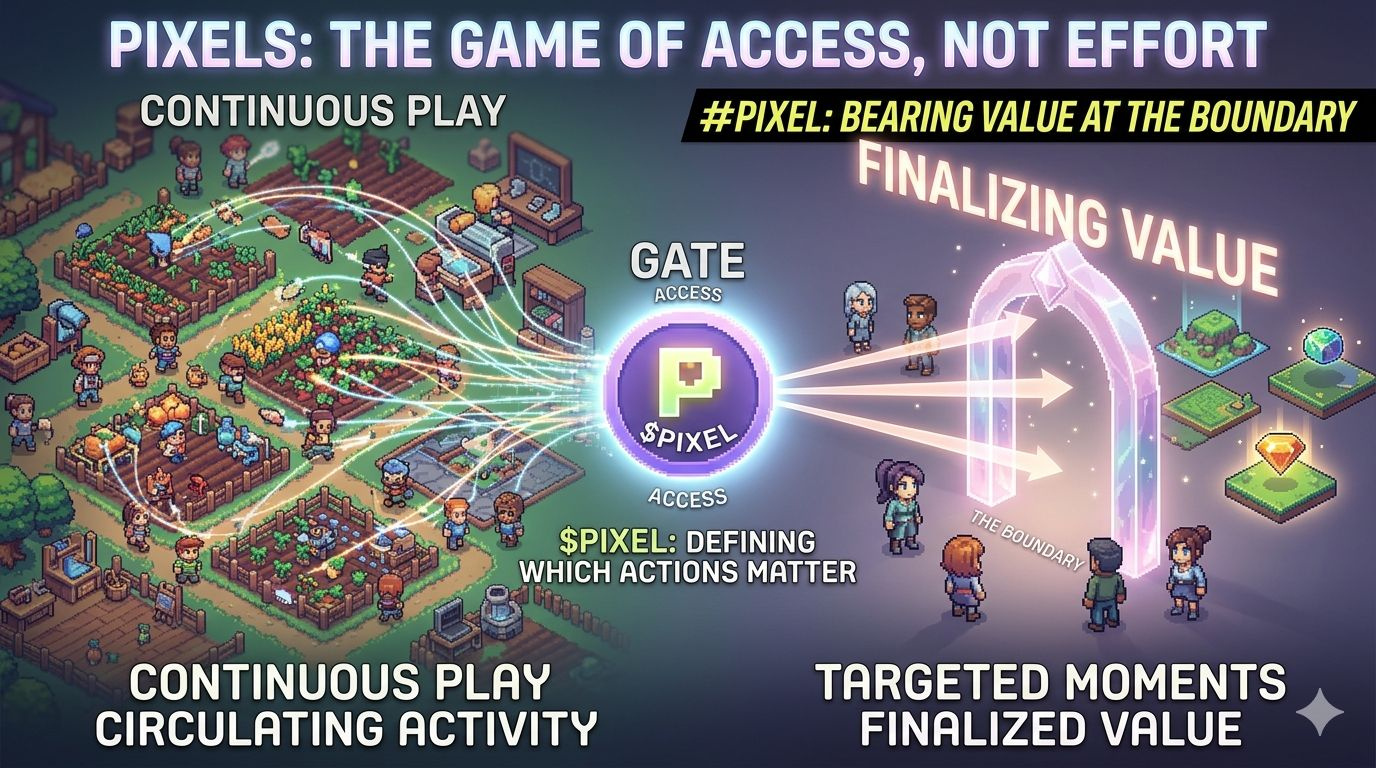
But that’s not quite what’s happening.
Something else is being filtered.
Not resources.
Attention.
Not the social kind — system attention. Which actions get recognized, processed, and actually turned into value.
I’m not even sure if this was fully intentional. It might just be what happens when you mix off-chain scale with on-chain constraints. Not everything can be finalized. Not everything can cross over. At some point, the system has to decide what moves forward.
So a gate forms.
And once there’s a gate, access to it doesn’t stay neutral for long.
That’s where Pixel starts behaving a bit differently from a typical reward token.
It’s less about how much you earn, and more about when you’re able to matter.
There’s a practical side to that. It keeps things from getting overloaded. It introduces pacing, a kind of structure that stops everything from collapsing into noise.
But it also creates a kind of drift.
Players start adjusting. Less wandering, more targeting. Less continuous play, more focus on specific moments — the points where value actually forms.
And when too many players converge on those moments, being prepared starts to matter more than just being active.
Those who already understand this don’t really dominate in obvious ways.
They just… keep showing up.
And over time, that compounds.
Meanwhile, everyone else keeps the system alive. Activity grows, the world feels busy, everything looks like it’s working.
But not all participation translates the same way.
Some players are in the system.
Others seem to be in the moments that define it.
And that gap is easy to miss if you’re mostly looking at surface metrics like activity or growth.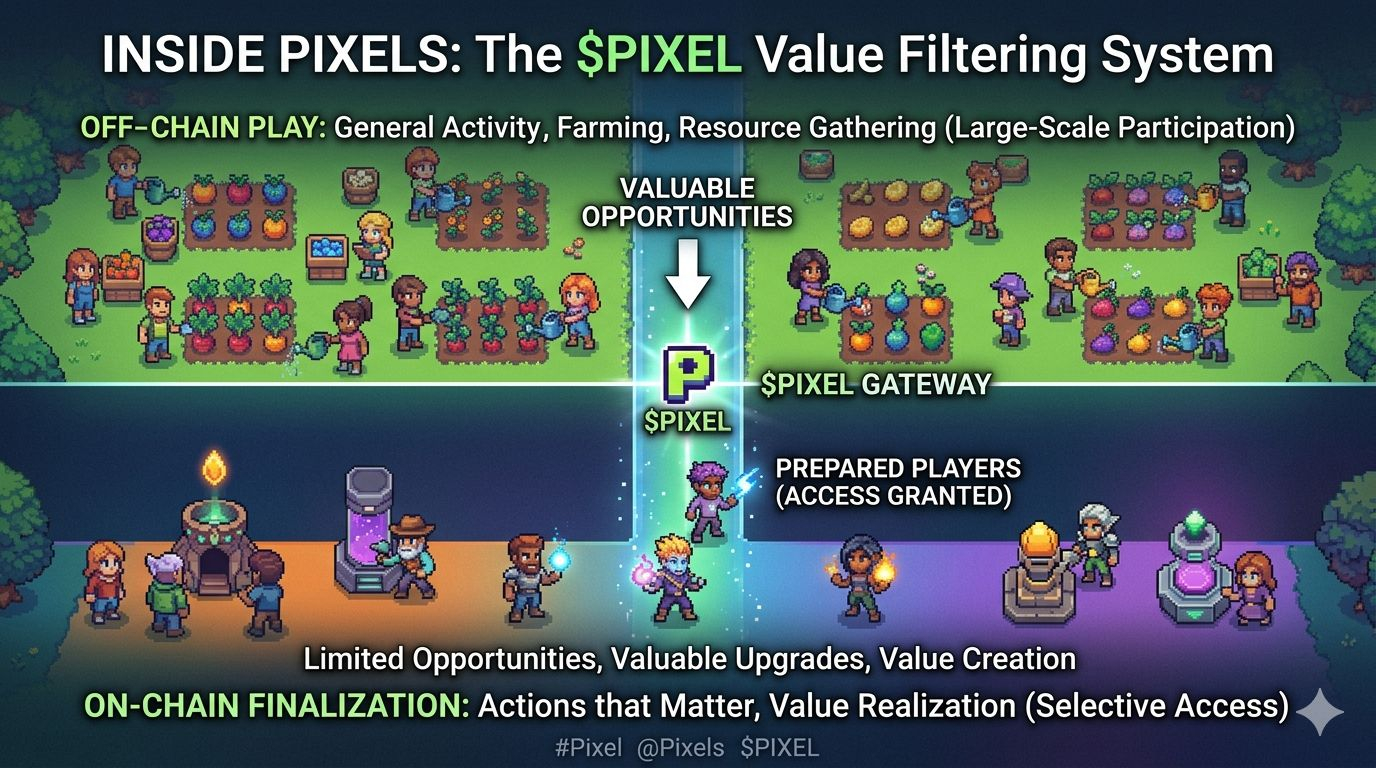
Because the real signal feels harder to measure.
It’s not just who’s playing.
It’s who consistently shows up at the exact moment when the system turns activity into value…
and who doesn’t.