most people talk about pixels like it’s a simple deal: cozy farming, some crafting, $pixels rewards, and ronin makes it cheap to trade. and yeah, that’s the headline. but what stands out when i try to follow the actual value path is that pixels is basically a set of conversion loops with carefully controlled throughput. the farm art just makes it feel less like you’re managing an economy.
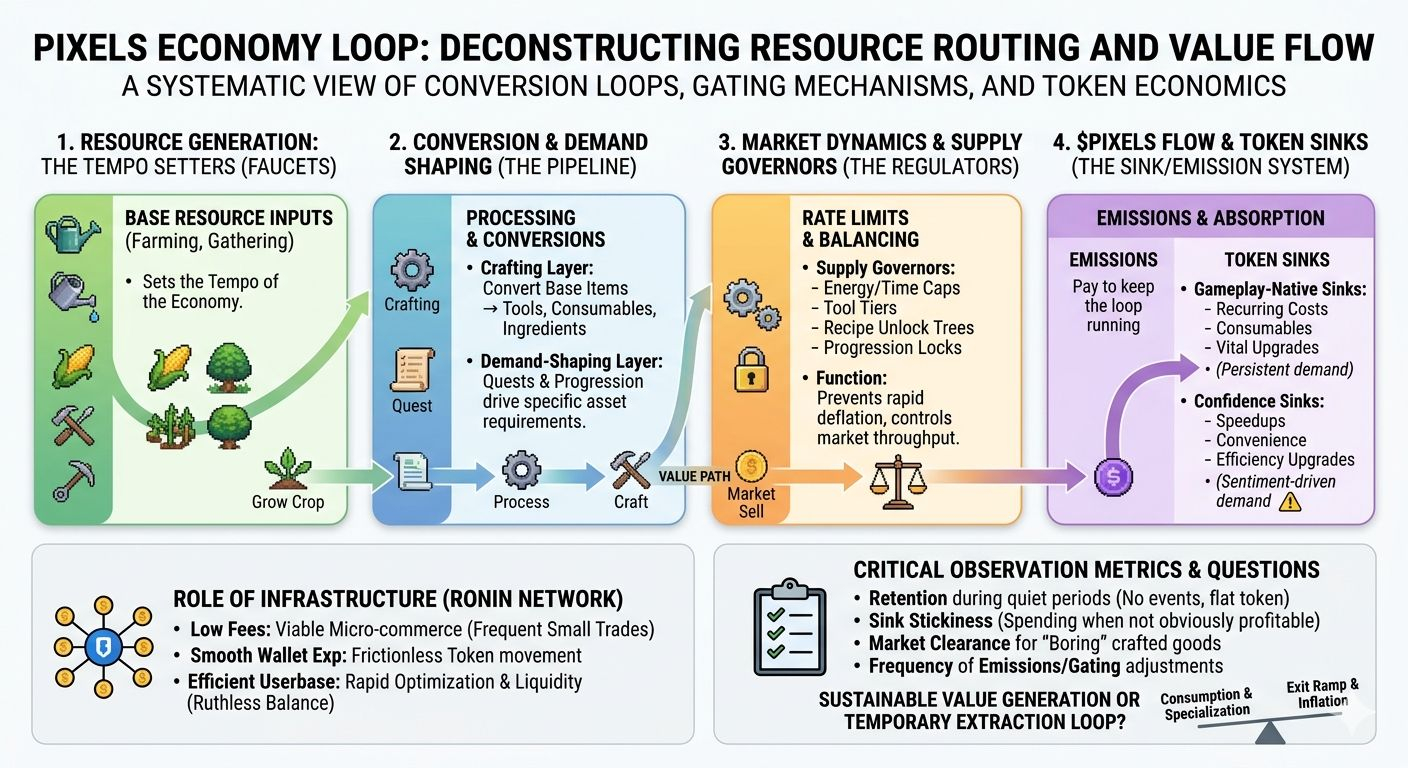
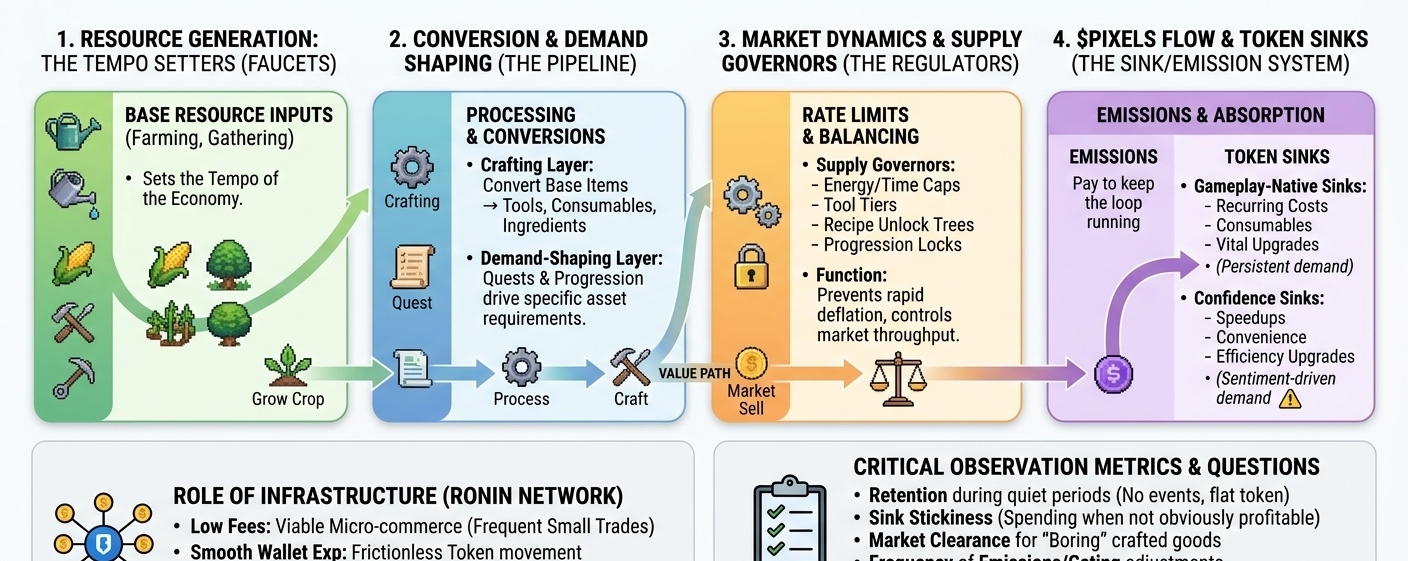
resource generation is where the system sets the tempo. farming and gathering are the base faucets, crafting is the conversion layer, and quests/progression are the demand-shaping layer. i keep replaying one basic example because it shows the whole machine: you grow a crop → process it into an ingredient → craft a consumable/tool → sell it to someone who needs it for a quest requirement or to unlock a recipe. that sounds like a normal player market, but the economics depend on the game maintaining “reasons to buy” that persist beyond a single event cycle.
and here’s the part i’m thinking about: pixels doesn’t really rely on hard scarcity as much as it relies on rate limits. energy/time caps, recipe unlock trees, tool tiers, and progression locks are basically supply governors. if those governors are too loose, the market becomes an undercut war in 48 hours. if they’re too tight, the game starts feeling like waiting rooms. the interesting question is whether players are actually specializing (input producers vs crafters vs traders), or if specialization is just a temporary byproduct of whatever bottleneck the system is currently emphasizing.
then there’s $pixels flow, and this is where i feel the most uncertainty. emissions are clearly the gravity: they pay you to keep the loop running. but emissions also create a permanent “where does it go?” problem. you can say “sinks exist” all day, but the real test is whether sinks scale with activity and remain attractive when the token is boring.
i keep splitting sinks into two types in my head:
1) gameplay-native sinks: stuff you spend on because it’s just part of playing (recurring crafting costs that feel fair, consumables that matter, ongoing progression requirements).
2) confidence sinks: stuff you spend on because you think it will pay back (speedups, convenience, upgrades that mainly increase earning efficiency).
honestly, confidence sinks are the ones that scare me. they look strong in good times, then vanish when sentiment flips. and because $pixels is liquid, sentiment flips faster than in a closed game economy. players can go from “reinvest everything” to “minimize spend, maximize withdrawal” without friction. if pixels ends up depending too heavily on confidence sinks, inflation pressure starts to leak out through sell behavior rather than being absorbed in-game.
the infrastructure layer is the quiet reason pixels can even attempt this. ronin’s low fees and relatively smooth wallet experience make frequent small transactions viable: buying ingredients, listing crafted goods, transferring assets, settling lots of tiny trades. that matters because pixels isn’t an economy of a few big items; it’s an economy of constant micro-commerce. if you put this on a high-fee chain, the market would either centralize offchain or just dry up for everything except high-ticket assets.
ronin also imports a particular kind of user. people there are used to nfts, used to markets, and pretty quick to optimize. that’s good for liquidity, but it’s also ruthless on balance. if there’s a craft chain that converts time → rewards more efficiently than the rest, it won’t stay a secret. the economy gets “solved” and then the team has to rotate demand (quests/events/new recipes) or adjust gates/emissions. which leads to the sustainability question: is the loop self-stabilizing, or is it stable because it’s actively piloted?
zooming out, i keep trying to answer: are players generating value, or mostly extracting it? a sustainable version of pixels looks like steady consumption (items leaving circulation because they’re used), specialization (players actually prefer roles), and a token that’s mostly spent back into play because it feels natural. a less sustainable version looks like items being intermediate steps on the way to claiming emissions, with the market acting as an exit ramp.
and yeah, continuous user growth matters. new players absorb inventory, create fresh demand for low/mid-tier goods, and keep markets clearing. if that inflow slows, the economy has to stand on real sinks and real retention, not just onboarding waves and event spikes.
watching:
- retention during quiet weeks (no major event pressure, token flat)
- sink stickiness: do people still spend $pixels when it’s not obviously profitable?
- marketplace clearance for “boring” crafted goods (not just rare assets)
- frequency of emissions/gating changes (routine tuning vs constant leak-plugging)
i don’t have a clean conclusion yet. pixels feels well-constructed, but i’m still trying to see whether it can survive a long flat period without turning into a pure extraction loop. if $pixels stayed dull for six months, what’s the thing that keeps players buying each other’s output?