
Nothing in Pixels really stops. You log in and everything is already moving crops ready, tasks refreshed, energy back, coins circulating. Doesn't feel like starting over. Feels like stepping into something that kept going without you. Honestly, that's impressive. Most games make you feel the gap. Pixels doesn't.
For a while that feels like good design. No friction, no reset, no dead air. You just pick up where you left off and keep moving.
Then something starts feeling slightly off.
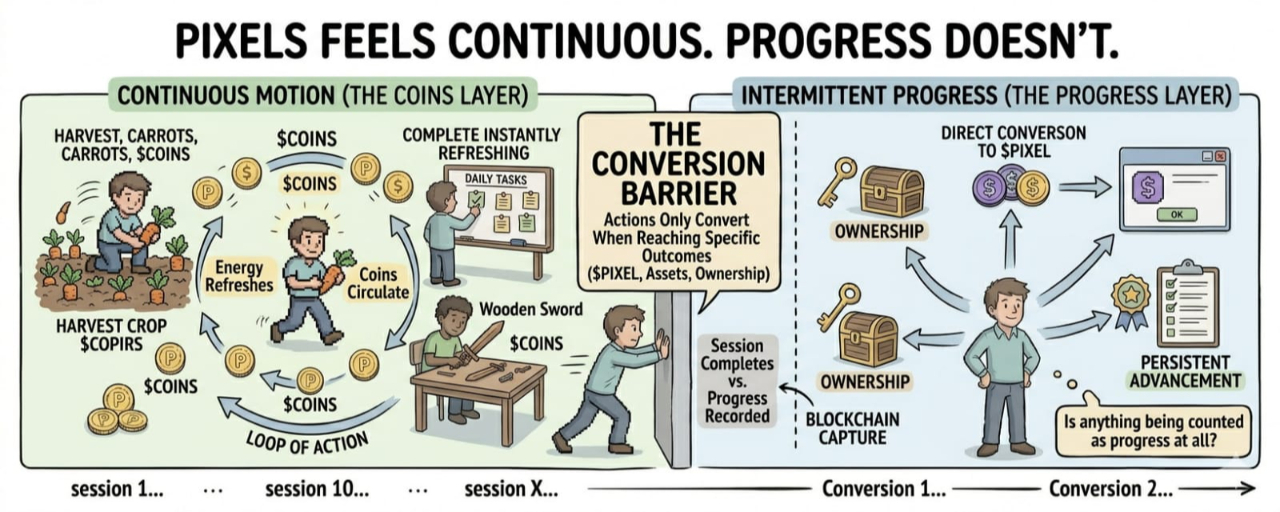
The activity is continuous. The progress isn't.
You can run full sessions complete tasks, rotate energy, move through farming and crafting loops for hours and still struggle to point at a single moment where anything actually shifted. Not failure. Not frustration exactly. Just... no clear step forward. The loop kept running. You kept showing up. But nothing moved in a way that stuck.
The easy explanation is pacing. Rewards spread out to keep things stable, players retained, economy balanced. Makes sense on paper. Except nothing actually feels delayed. Tasks refresh on time. Actions resolve instantly. Coins move. There's no visible wall slowing you down. So if the system isn't slowing you, why does progress feel like it's happening somewhere slightly out of reach?
The answer is in how Pixels separates its layers. Most of what you do lives inside the Coins layer. Farming, crafting, repeating tasks all of it feeds back into that same loop. Coins absorb the activity and return it to you as more activity. You're always doing something. It always feels productive. That part is real. But Coins don't carry progress. They carry motion. And those two things feel identical until you notice they aren't.
The shift only happens when something crosses out of that layer when activity connects to PIXEL, to assets, to something that holds weight outside the immediate loop. And that doesn't happen continuously. It happens selectively, quietly, in patterns that take time to recognize.
The more you play the more this becomes something you feel before you can explain it. Some sessions feel full you stayed active, completed everything available, never stopped moving but nothing converted. Other sessions feel lighter, almost accidental, and yet something actually moved toward ownership or token or progression that persists beyond the next login. It's not about how much you do. It's about whether what you do reaches the conversion point. And most of it doesn't.
The architecture makes this inevitable rather than accidental. Most gameplay happens off-chain fast, repeatable, frictionless. That's why everything feels smooth. The blockchain only captures certain outcomes. Tokens. Assets. Ownership. Not every action. Not even most actions. So most of what you do stays inside the system, circulating, feeding the loop, keeping the activity metrics healthy. Only a portion actually crosses out into something that holds.
That's why Pixels feels continuous. The Coins layer never stops. Tasks keep refreshing. Energy keeps resetting. The system is always on. But the layer that defines real progress what actually leaves that loop isn't continuous at all. It's intermittent. Selective. And the gap between those two rhythms is where the tension lives without ever being named out loud.
Once that becomes clear the experience changes a little. You stop thinking in sessions. You start thinking in conversions. Which actions actually move beyond Coins. Which tasks push toward PIXEL. Which patterns lead somewhere that persists past the next login. Most of what you do doesn't reach that point. It surrounds it. Keeps the system warm. Keeps you feeling productive without necessarily being productive in the way that compounds.
That's probably how Pixels maintains its balance. The system stays active because most activity never leaves it. Energy keeps cycling. Coins keep moving. Players keep showing up. But the deeper question the one that doesn't have a clean answer yet isn't whether you're progressing. It's whether what you're doing is even being counted as progress in the layer that actually matters. Most sessions, if you're honest about it, the answer is probably no. And the system is designed well enough that you don't notice until you've already been playing for weeks.
