
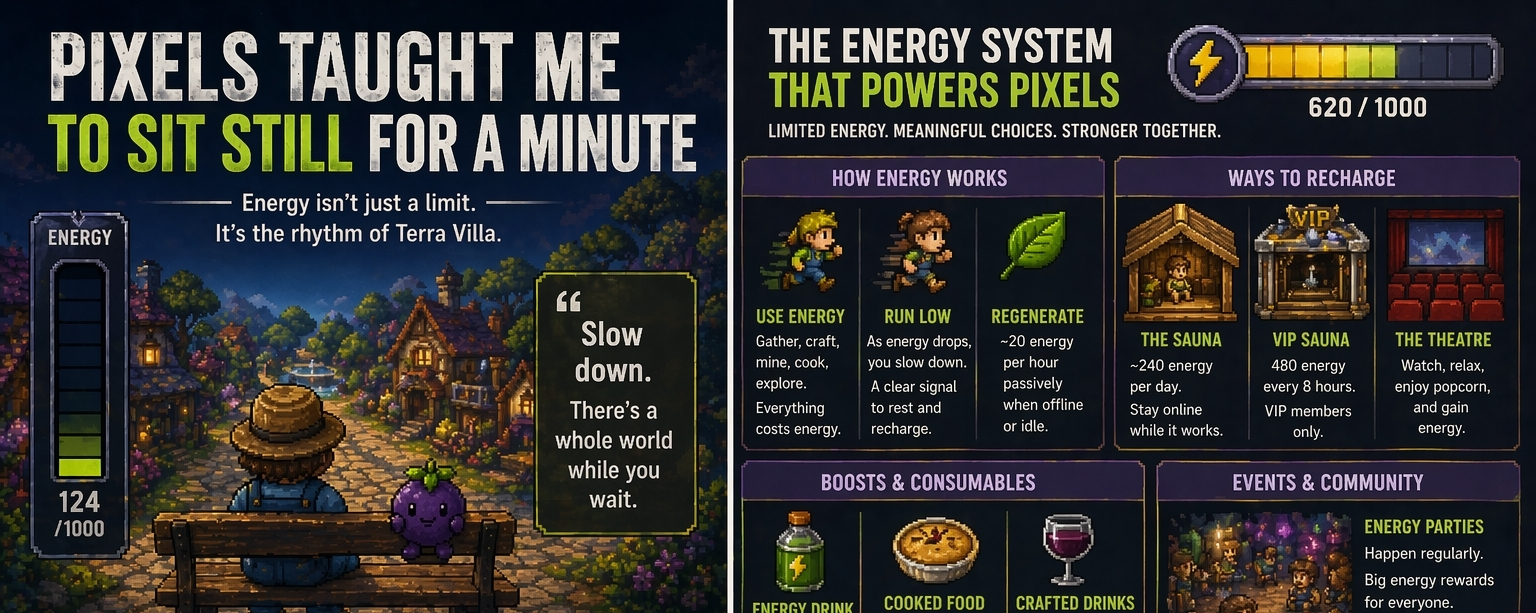
I burned through my energy in about forty minutes the first time.
Did not plan it. Just kept clicking. Planted things, watered them, ran to the mine, ran back, started a crafting cycle, wandered into a neighboring land to use their press. The energy bar in the corner was ticking down the whole time and I was only half watching it. Then it hit somewhere near empty and my little character started moving like they had just climbed a mountain. Slow, heavy, barely responsive.
The game was not broken. It was telling me something.
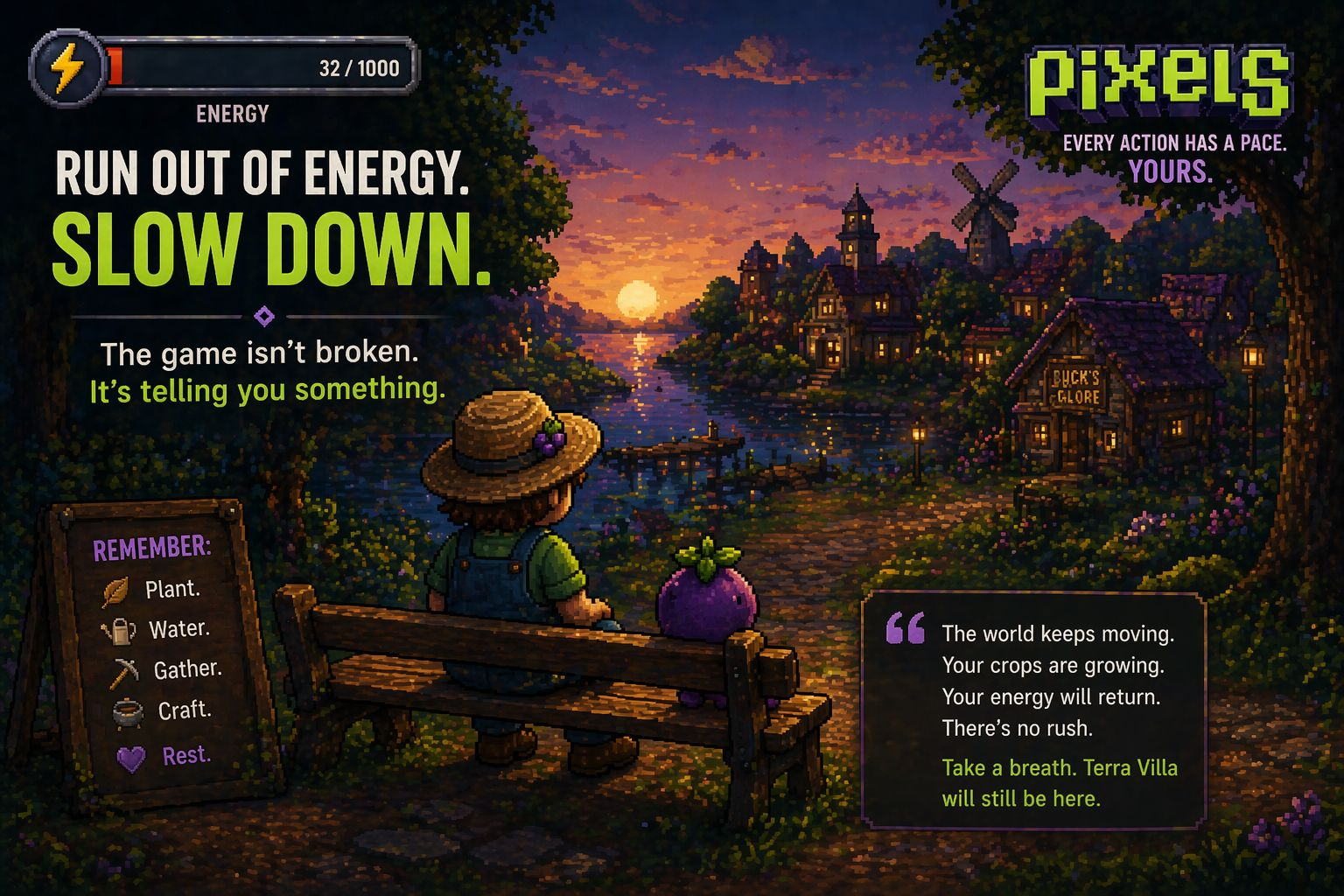
Every player in Pixels carries a maximum energy capacity of 1000. As that bar approaches zero, your character visibly slows down, moving at a reduced pace as a signal that reserves are running low. Most players experience this as an obstacle. I have come to think of it as the most honest mechanic in the game.
Energy in Pixels regenerates passively at around 20 points per hour when you are offline or idle. Active regeneration is faster but requires presence. The Sauna in Terra Villa gives roughly 240 energy per day, but you need to remain online while it works. VIP players get a better deal, 480 energy every eight hours from the VIP Sauna room, still requiring them to be present and click the coals to start the cycle.
What that means in practice is that the game has multiple speeds. The fast speed where you are actively burning through your bar, clicking, crafting, harvesting, running between lands. And the slow speed where you have used what you had and now you wait. Most games try to eliminate the slow speed entirely. Pixels leans into it.
I think that is genuinely interesting and almost nobody talks about it this way.
There is a building in Terra Villa called the Theatre. Players can go there, wait for the popcorn to pop, and sit through content while passively gaining energy from the experience. A game that builds a theatre so players have somewhere to be while they wait is a game that understands downtime is not the enemy of engagement. It is part of the rhythm.
The sauna works similarly. You walk in, you sit, your energy refills, you talk to whoever else is in there. Some of the more unexpected conversations I have read about from long-term Pixels players happened in the sauna queue. Not because the game designed a conversation mechanic. Just because it gave people a reason to be in the same place with nothing urgent to do.
That is harder to engineer than it sounds.
Energy drinks bought from other players or from Buck's Galore restore 50 energy each, and cooked foods can provide varying amounts depending on the recipe. Popberry pie gives a meaningful energy boost. Crafted wines and more complex recipes can extend sessions further for players who have invested in cooking skills.
So the energy system creates a secondary economy almost by accident. Players who have leveled cooking can produce consumables that other players need to stay active. The person who figured out the most efficient energy restoration recipe and started selling it at the marketplace is participating in an economic loop that the energy cap created entirely. Remove the cap and that loop vanishes. The cook loses a customer. The buyer loses a reason to interact with another player.
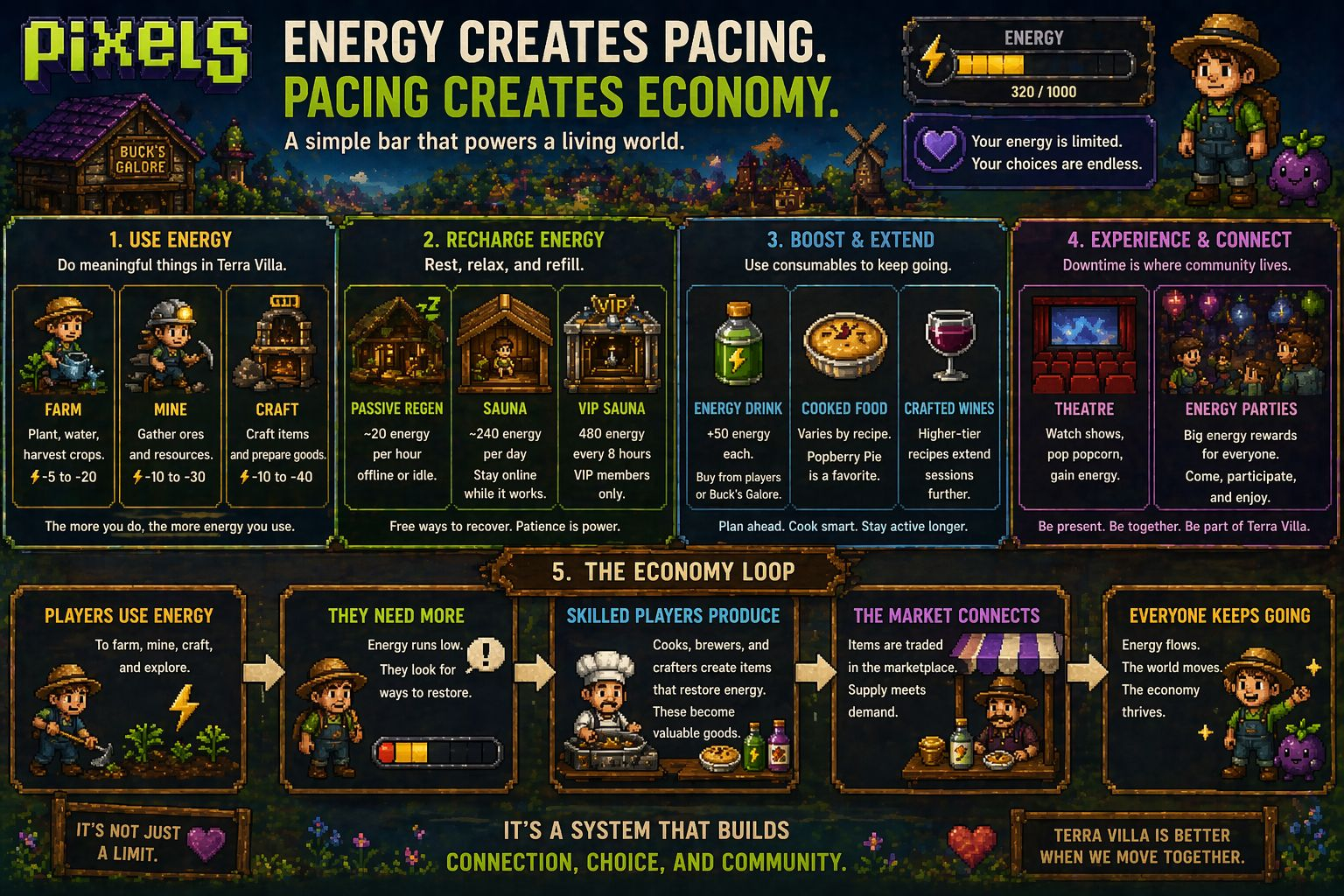
Scarcity generates interdependence. That is true of real economies and it turns out to be true of virtual ones.
What gets me about all of this is that most game designers treat energy limits as a monetization lever. Run out of energy? Buy more. The mobile gaming industry built entire revenue models on that psychology. Pixels uses the same constraint but routes it differently. You can buy your way to more energy if you want, through VIP membership or consumables. But the game also gives you free paths back to full capacity if you are willing to be patient and present.
The sauna is free. Passive regeneration is free. Energy parties happen regularly and give large amounts to anyone who shows up at the right time. Before an energy party starts, experienced players recommend burning through most of your current bar first so you can absorb the maximum available from the event. That small piece of player knowledge, passed from veteran to newcomer in the sauna or the town square chat, is the kind of thing that builds community culture without any developer involvement.
Games that never ask you to stop tend to produce a certain kind of player. One who optimizes every session, chases every efficiency, and quietly burns out after a few weeks because there was never any texture to the experience. Just continuous output.
Pixels asks you to stop. Not rudely. Not with a paywall. Just with a bar that empties and a character that slows down and a world that keeps moving around you while you wait for it to refill. Other players walk past. Someone sits down in the sauna. The crops you planted earlier are nearly ready. In twenty minutes you will have enough energy to harvest them.
That twenty minutes is not dead time. It is the space where the game becomes something other than a production loop.
I did not expect to appreciate that when I first hit the wall. I do now.