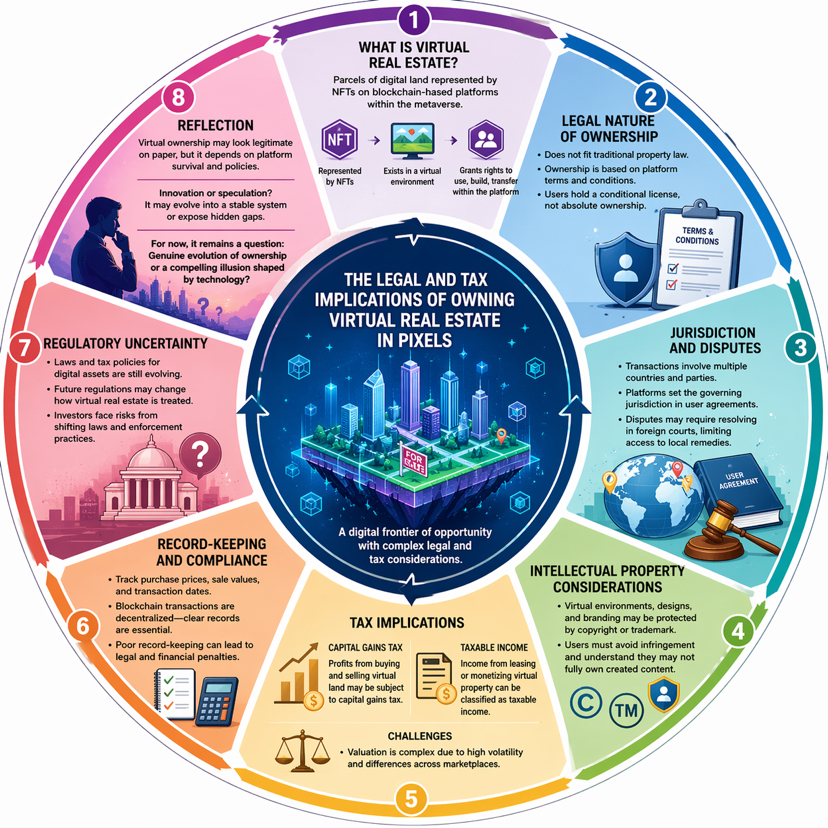
The concept of owning virtual real estate has gained significant traction in recent years, driven by the rise of blockchain technology and immersive digital platforms often referred to as the metaverse. At its core, virtual real estate consists of parcels of digital land represented by non-fungible tokens (NFTs), which grant users certain rights within a specific virtual environment. While the idea may appear innovative, it raises complex legal and tax considerations that are still being defined by regulators worldwide.
From a legal perspective, virtual real estate does not fit neatly into traditional categories of property ownership. Unlike physical land, which is governed by well-established property laws and protected through land registries, digital land exists within privately owned platforms. Ownership rights are typically determined by the terms and conditions set by these platforms rather than by national legal systems. As a result, users do not possess absolute ownership but rather a conditional license to use and transfer digital assets within the platform’s ecosystem.
Another critical legal issue is jurisdiction. Virtual real estate transactions often involve participants, servers, and companies located in different countries. This creates ambiguity regarding which legal framework applies in case of disputes. Most platforms address this by specifying a governing jurisdiction in their user agreements, which may require users to resolve disputes in foreign courts. This arrangement can limit access to legal remedies and complicate enforcement of rights, particularly for international users.
Intellectual property rights also play a role in virtual real estate ownership. The digital environment, including buildings, designs, and branding within virtual land, may be subject to copyright or trademark protections. Users must ensure that their activities do not infringe on existing rights, while also understanding that they may not fully own the content they create within these platforms.
Taxation presents another layer of complexity. In many jurisdictions, virtual real estate transactions are treated similarly to cryptocurrency transactions. Profits generated from buying and selling virtual land may be subject to capital gains tax. Additionally, income earned from leasing or monetizing virtual property can be classified as taxable income. The challenge lies in determining accurate valuations, as digital asset prices can be highly volatile and vary across marketplaces.
Proper record-keeping is essential for tax compliance. Individuals engaging in virtual real estate transactions must track purchase prices, sale values, and transaction dates. Given the decentralized nature of blockchain transactions, maintaining clear and accurate records can be difficult but is necessary to avoid potential legal and financial penalties.
Despite these structured frameworks, regulatory clarity remains limited. Governments and tax authorities are still developing policies to address digital assets, and future regulations may significantly alter how virtual real estate is treated. This evolving landscape creates uncertainty for investors and participants, who must navigate risks associated with changing laws and enforcement practices.
I find myself pausing when I think about what “ownership” really means in this context. On paper, it looks legitimate there are transactions, records, even marketplaces but the foundation feels unusually fragile. If everything depends on a platform’s continued existence and policies, then the sense of control seems more temporary than traditional property ownership.
The more I consider it, the harder it becomes to separate innovation from speculation. I can see why people are drawn to the idea, but I can’t shake the feeling that it rests on assumptions that may not hold over time. Perhaps it will mature into a stable system, or perhaps it will expose gaps that were easy to overlook in the excitement. For now, it leaves me questioning whether virtual real estate is a genuine evolution of ownership or simply a compelling illusion shaped by technology.