
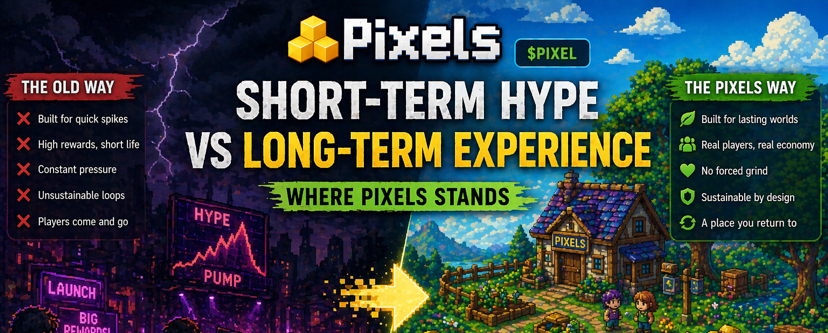
If you zoom out and look at Web3 gaming as a whole, one thing becomes clear.
A lot of projects are designed for impact, not longevity.
They launch with strong momentum. Incentives are high, activity spikes, and everything feels like it’s moving fast. But that speed comes with a cost.
Sustainability.
When a system is built to grow quickly, it often struggles to maintain that growth. Rewards need to stay high, engagement needs to be constantly pushed, and the entire structure becomes dependent on continuous stimulation.
Once that slows down, users start to leave.
Not because they hate the game,
but because there’s nothing grounding them.
Pixels approaches this differently.
Instead of optimizing for early spikes, it focuses on creating something stable. The gameplay loop is simple, consistent, and easy to return to. It doesn’t rely on constant pressure or aggressive incentives to keep players engaged.
It relies on familiarity.
You log in, and you already know what to expect. The world feels steady, not chaotic. That consistency builds a different kind of trust between the player and the game.
You’re not chasing moments.
You’re building a habit.
Another important aspect is how the world itself evolves.
Pixels doesn’t feel like a temporary environment designed for a campaign or a cycle. It feels like a space that continues over time. Players interact within it, shape it, and move through it at their own pace.
That creates a sense of persistence.
And persistence is what turns a game into something people return to.
From a technical perspective, running on Ronin supports this approach. Lower friction and smoother interactions make it easier for players to stay connected without interruptions. The experience remains stable, which reinforces the long-term design.
But the most important difference is philosophical.
Pixels is not trying to capture attention.
It’s trying to keep it.
And those are two very different goals
Capturing attention is easy with enough incentives.
Keeping it requires a better experience.
From a broader perspective, this reflects a shift that Web3 gaming needs.
Less focus on hype cycles.
More focus on building environments that last.
Because in the end, users don’t stay where they are excited for a moment.
They stay where they feel comfortable returning.
And that’s exactly where Pixels positions itself.
