
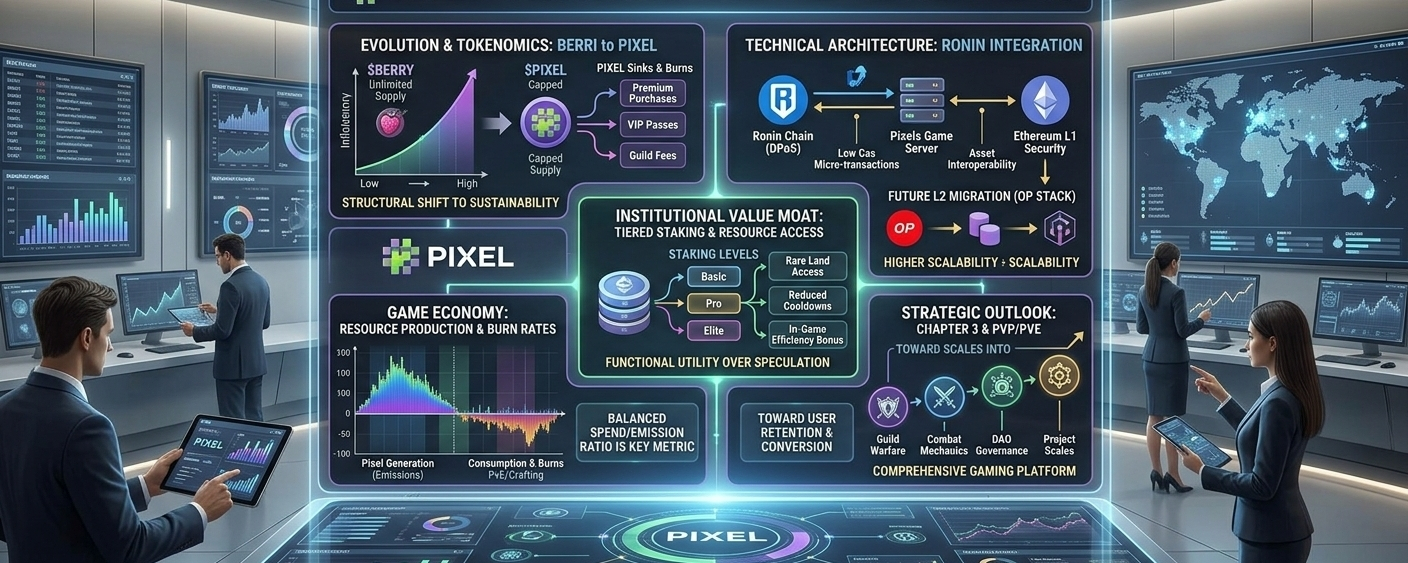
The evolution of Web3 gaming has often been characterized by boom-and-bust "play-to-earn" cycles. Pixels (PIXEL), the cornerstone of the Ronin-based gaming ecosystem, represents a pivotal shift away from inflationary models toward a sustainable, multi-utility economic structure. This analysis dissects the protocol’s architecture, its strategic pivot, and its institutional-grade value proposition for the Binance Square community.
## 1. Structural Evolution: From Inflation to Sustainability
The most significant development in the Pixels protocol was the transition from the inflationary $BERRY token to a structured, multi-utility economic model centered around the PIXEL token.
This was not merely a cosmetic change; it was a fundamental re-engineering of the game’s "monetary policy." By phasing out $BERRY—which suffered from unlimited supply and lack of long-term sinks—and consolidating value into $PIXEL, the protocol created an environment where:
*Token Utility:** PIXEL is now the primary medium for in-game purchases, quality-of-life upgrades, VIP battle passes, and guild participation.
*Scarcity Mechanisms:** By tying in-game progression and premium features directly to the token, the protocol creates a continuous burn/spend cycle. When in-game utility demands consistently exceed emission rates, the token shifts from being an "earning" asset to a "strategic" resource.
## 2. Technical Architecture & Network Synergy
Built on the Ronin Network—a sidechain specifically optimized for gaming—Pixels benefits from a unique technical moat.
*Low-Latency Transactionality:** Gaming requires high-frequency micro-transactions. By leveraging Ronin, Pixels minimizes gas friction, allowing players to trade, craft, and interact with digital assets without the prohibitive cost barriers of the Ethereum mainnet.
*Interoperability:** As Pixels expands into a multi-game platform, its infrastructure is designed to carry a player’s reputation and achievement data across different game instances. This "Single Account" system creates a persistent digital identity that is becoming increasingly valuable in the Web3 social-fi space.
*Layer-2 Integration:** With the scheduled migration of Ronin to an Ethereum Layer-2 network (utilizing the OP Stack), Pixels is positioned to inherit superior security guarantees from Ethereum while maintaining the performance thresholds required for a Massively Multiplayer Online (MMO) environment.
## 3. The Institutional-Grade Value Moat: Staking & Governance
Institutional interest in GameFi is moving away from speculative "yield farming" toward projects that offer "value capture." Pixels has successfully implemented a tiered staking ecosystem that functions as a security and loyalty moat.
### The Staking Flywheel
Staking in the Pixels ecosystem is not passive; it is functional. It binds token holding to resource access:
1. Resource Gatekeeping: Staking requirements unlock rare land resources and crafting recipes.
2. Operational Efficiency: Staked tokens provide tangible benefits like reduced production cooldowns, effectively rewarding efficient gameplay.
3. Ecosystem Security: By incentivizing long-term locking of circulating supply, the protocol stabilizes price action and reduces structural sell pressure, providing the "price discipline" often observed in its recent chart structures.
## 4. Analytical Outlook: The Path to Chapter 3
As the project moves into Chapter 3, the introduction of PvE (Player vs. Environment) and PvP (Player vs. Player) combat modes marks the transition from a "farming simulator" to a "comprehensive gaming platform."
### Strategic Indicators to Watch
*User Retention & Conversion:** Pixels has maintained superior retention rates compared to industry benchmarks (68% 30-day retention). Continued monitoring of these metrics will signal the health of the incoming player base during the Chapter 3 rollout.
*Governance Transition:** As the project moves toward a DAO-like structure for the community treasury, the role of PIXEL as a governance asset will become a key value driver, allowing holders to direct the development of new game modes and ecosystem initiatives.
*Economic Data:** Keep a close eye on the ratio of "In-game Spend vs. Token Emission." A sustainable project is defined by its ability to maintain a neutral-to-positive balance here; this is the fundamental "north star" for investors and participants alike.
## Conclusion: The "Rational Privacy" and Sovereignty Narrative
The Pixels protocol is fundamentally about digital sovereignty. It provides players with true ownership of their assets and a verifiable, transparent ledger of their progress. For the creator community on Binance Square, the narrative here is clear: Pixels is building a foundation that treats gaming as a legitimate, institutional-grade economic engine rather than a speculative bubble.
As the market continues to consolidate around high-quality projects with real utility, Pixels' focus on sustainable ecosystem growth, coupled with the upcoming Ronin network upgrades, positions it as a resilient benchmark in the future of decentralized digital
