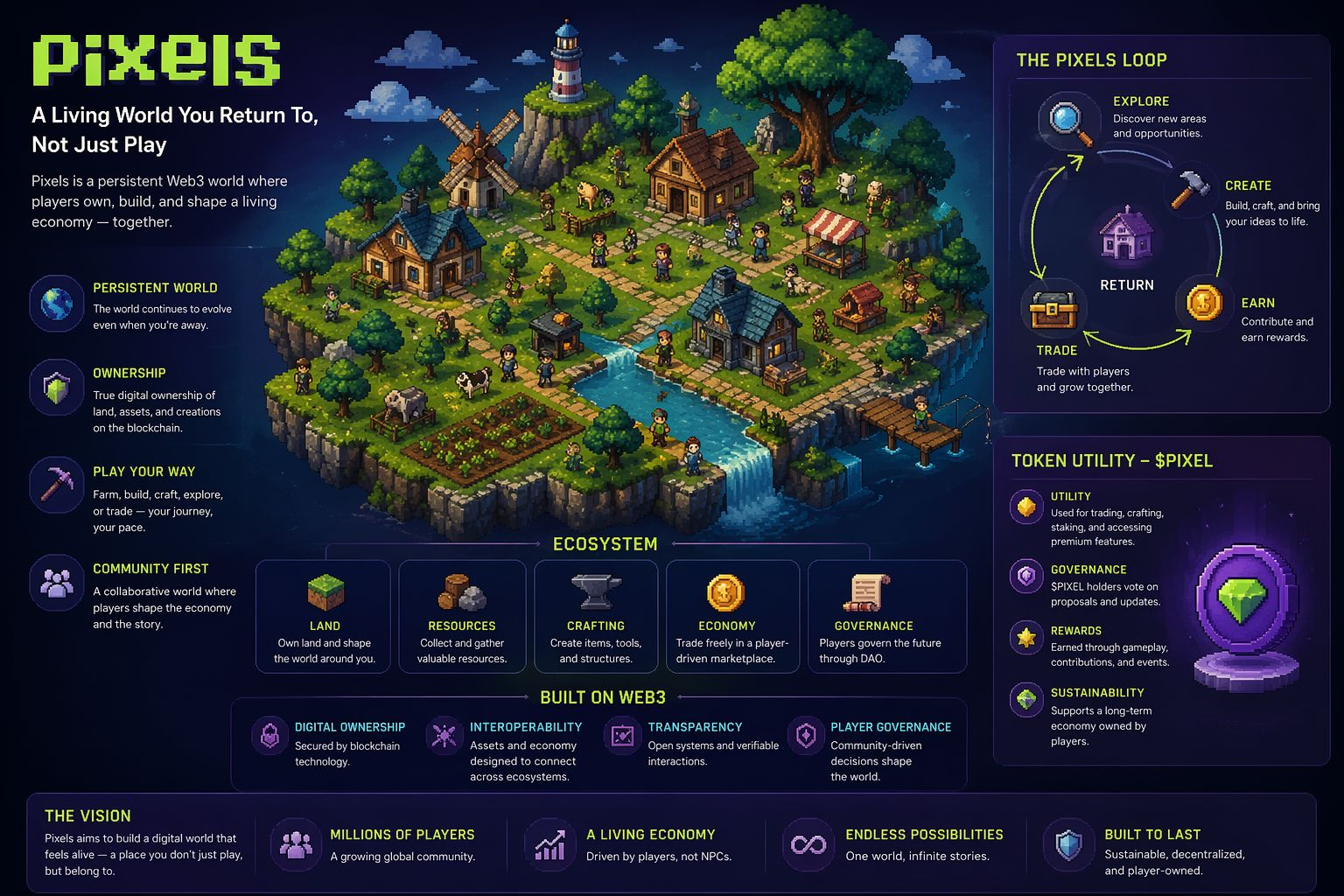
This paper examines how Pixels reflects an emerging shift in Web3 gaming: from episodic play systems to persistent digital environments. Instead of treating games as bounded experiences with start and end states, Pixels demonstrates the architecture of an always-on economic and social space where user engagement is continuous but non-compulsory.
1. 🔬 From Game Loops to Persistent Systems
Traditional Web3 games operate on reward loops: play → earn → exit.
Pixels instead introduces a persistent world model, where:
Assets remain active in absence of the player
Environmental state evolves continuously
Time becomes an economic variable, not just a gameplay mechanic
👉 This shifts the system from event-driven interaction to state-driven continuity.
2. 🧠 Behavioral Shift: From “Playing” to “Returning”
The core transformation is psychological:
Users are no longer incentivized only to “play”
They are structurally encouraged to return to a living system
This creates what can be described as:
Recurrence-based engagement loops
instead of
transactional engagement loops
The result is a softer, but more durable form of participation.
3. 🌐 Social Topology: From Competition to Co-presence
Rather than high-frequency competitive pressure, Pixels fosters:
Low-friction co-existence
Repeated non-strategic encounters
Emergent social memory (recognition through repetition)
This produces a spatial social graph, where users are defined less by performance and more by presence.
4. ⚙️ Economic Layer: Invisible but Active Infrastructure
A key design feature is the separation between:
User experience layer (simple, game-like)
Economic infrastructure layer (complex, automated)
Tokenized systems (including $PIXEL mechanics) operate as:
Background incentive engines
Resource redistribution systems
Long-horizon value stabilization mechanisms
This reduces cognitive load while preserving economic depth.
5. ⏳ Time as a Design Variable
Pixels redefines time in three dimensions:
Real-time continuity: the world does not pause
Asynchronous participation: users are not required to synchronize
Cumulative value formation: progress is stored, not reset
This positions time itself as a core economic primitive.
6. 🧭 Conceptual Outcome: Game → Place
The most important transition is definitional:
A game ends when objectives are completed
A place persists regardless of participation
Pixels moves toward the latter:
Not a system to be completed, but a system to be revisited.
🧾 Conclusion
Pixels illustrates an early-stage prototype of what may be called persistent digital economies—systems where gameplay, economy, and social structure are not separate layers, but continuously interacting states.
The implication is significant:
Web3 gaming may not be evolving toward “better games,”
but toward enduring digital environments that behave more like places than products.

Článok
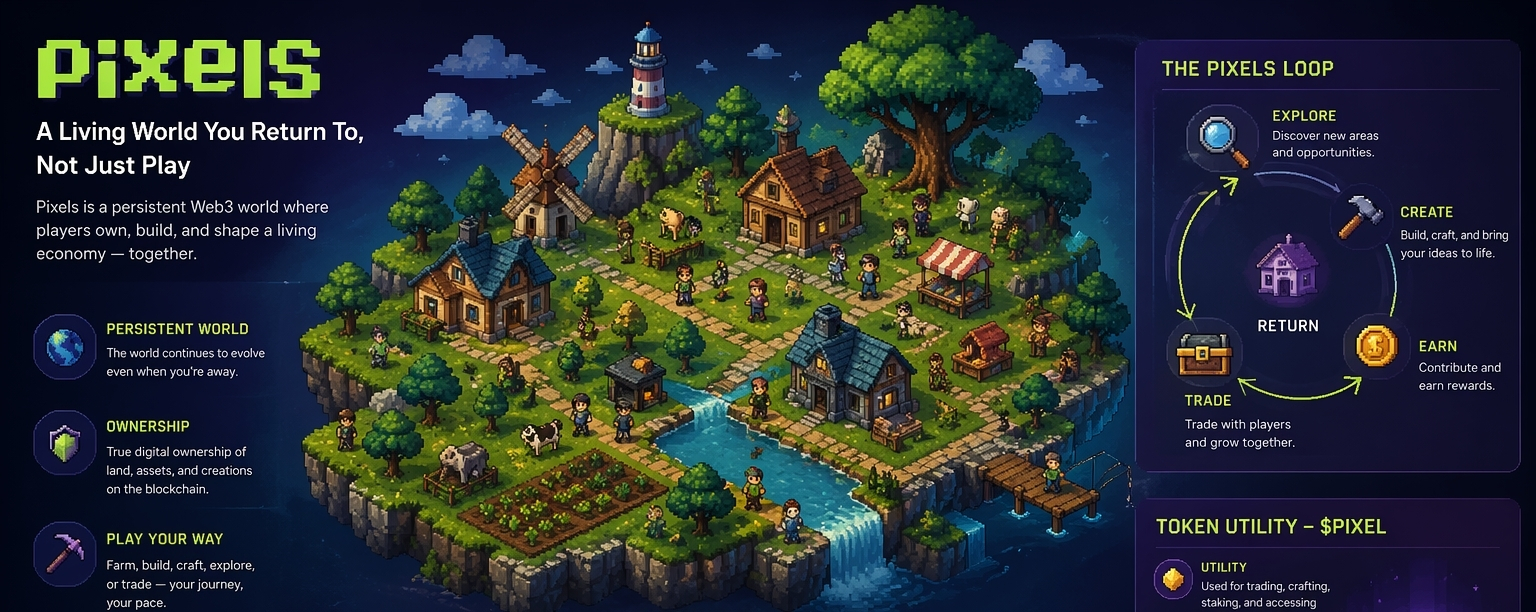
Toward Persistent Digital Economies: Pixels as a Case Study in Web3 “Place-Based” Game Design
--
Zrieknutie sa zodpovednosti: Obsahuje názory tretích strán. Toto nepovažujte za finančné poradenstvo. Môže zahŕňať sponzorovaný obsah. Pozrite si zmluvné podmienky.