
I used to think most game tokens fail for the same simple reason. Too many rewards, not enough reason to stay. People show up, collect what they can, then quietly leave when the numbers stop making sense. It’s a pattern you don’t even question anymore. You just expect it.
But something about Pixel doesn’t sit exactly in that pattern. I didn’t notice it at first. It still looks like a farming game on the surface, still has the usual loops. Yet the way rewards show up feels… uneven. Not broken, just selective. Almost like the system is paying attention in a way older GameFi setups never really did.
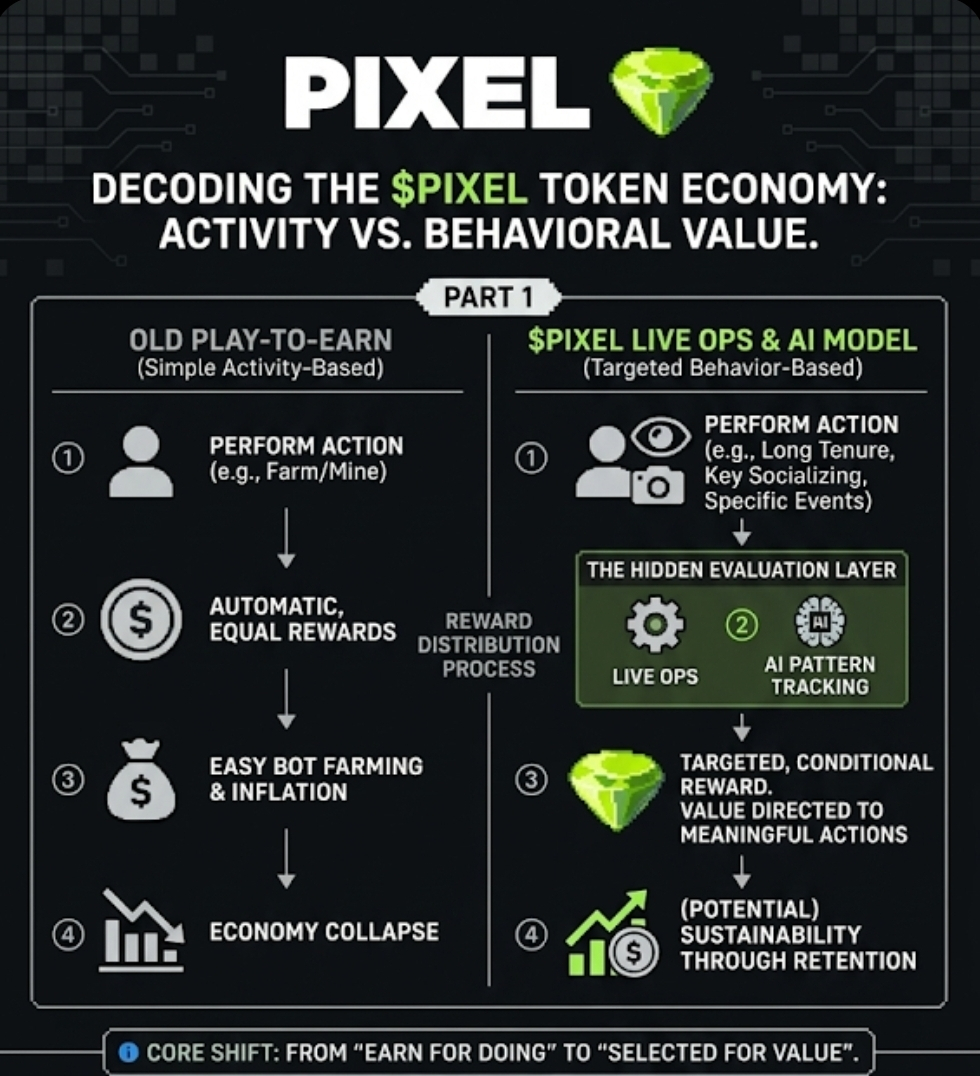
That’s where it starts to feel different. Not because the token changed, but because the logic around it is changing. Pixels talks a lot about targeting rewards, which sounds like a small design choice, but it isn’t. It means the system is no longer just handing out value for activity. It’s trying to decide which activity matters.
And once that decision layer exists, the token stops being neutral.
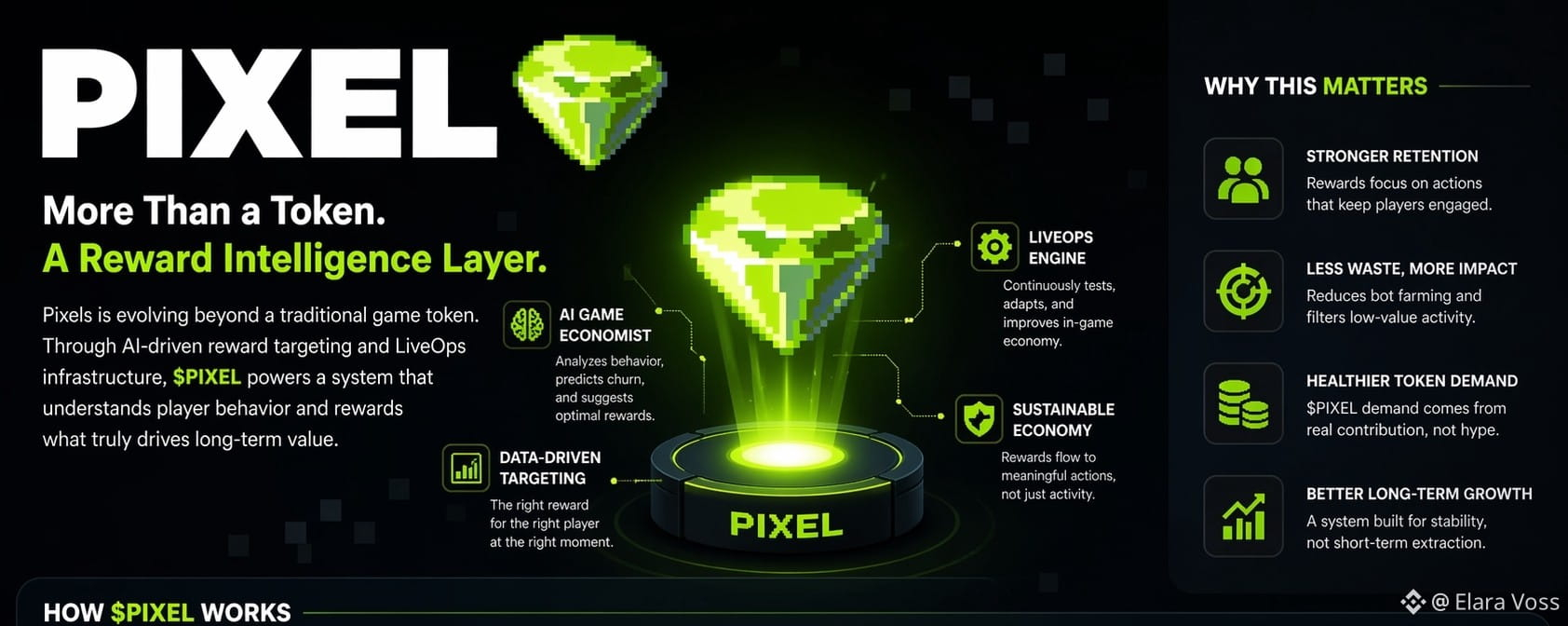
I keep coming back to this idea that Pixel might not be the main product anymore. It’s more like the output of something happening underneath. There’s this LiveOps layer, basically a system that keeps adjusting the game while people are playing. On top of that, there’s an AI model trying to understand player behavior. Not in a futuristic way, just pattern tracking. Who stays, who leaves, what they do before they leave. Simple questions, but at scale.
Now imagine rewards flowing through that.
It doesn’t mean every player is treated the same. Actually, the opposite. Some actions start to matter more than others, even if they look similar on the surface. Two players could spend the same time in the game, but the system might value one differently based on patterns it sees. That’s where things get a bit uncomfortable, at least for me.
Because at that point, you’re not just playing. You’re being evaluated.
I’ve seen something similar on Binance Square, just in a different form. Not every post gets the same reach. You can write two posts with the same information, but one gets pushed, the other disappears. Over time, you start adjusting. Not consciously at first, but slowly. You learn what kind of tone works, what kind of structure gets picked up. The system doesn’t tell you directly, but it nudges you.
Pixels might be doing something like that with players.
The token, in that sense, becomes less about earning and more about being selected. That’s a strange shift. It moves Pixel away from simple supply and demand into something closer to behavioral filtering. The demand isn’t just “I need the token to play.” It’s also “I need to behave in a way that keeps me inside the reward flow.”
There’s a strength in this, no doubt. Older play-to-earn models collapsed because they rewarded everything equally. Bots farmed it, real players got diluted, and the economy couldn’t hold. If Pixels can actually direct rewards toward meaningful behavior, it might avoid that trap. It might even make the token more stable over time, because it’s tied to retention, not just activity spikes.
Still, it comes with trade-offs.
When a system decides what behavior is valuable, it quietly starts shaping that behavior. Players may begin optimizing for what the system wants, not what feels natural. You don’t notice it immediately. It creeps in. Suddenly you’re not asking “what do I want to do in the game,” but “what is the system likely to reward right now.” That’s a different mindset.
And there’s another layer I’m not fully comfortable with. Most of this evaluation happens in the background. Players don’t really see why they’re being rewarded or ignored. It’s not transparent in a clear way. That can work while things feel fair, but if outcomes start to feel inconsistent, people will try to reverse-engineer it. They always do.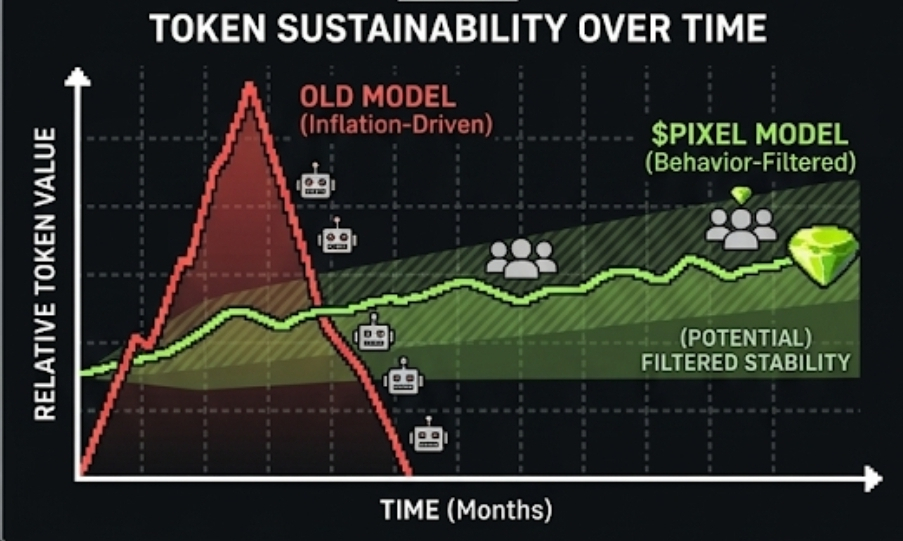
At that point, the system becomes a moving target.
What makes this interesting to me is that $PIXEL ends up sitting right in the middle of all this. It’s still a token, still tradable, still part of the economy. But it’s also carrying the result of these hidden decisions. It reflects what the system values, even if players don’t fully understand that logic.
I’m not sure we’ve fully seen what that does over time. Maybe it makes the ecosystem stronger. Maybe it just makes it harder to read.
For now, it just feels like Pixel is drifting away from being a simple reward. It’s becoming something more conditional, more dependent on how the system interprets you. And once that shift happens, the game doesn’t just run on players anymore. It runs on the system deciding which players matter.