
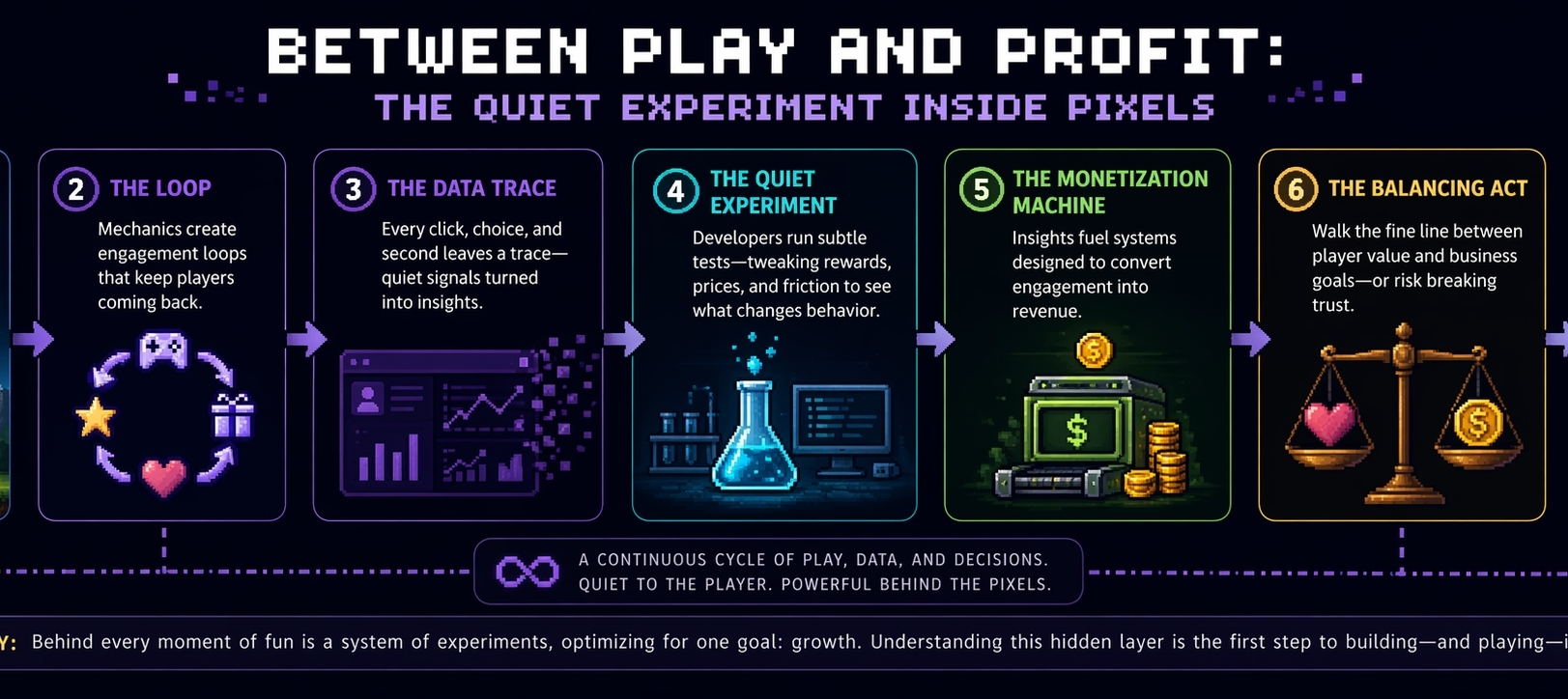
I’ve been spending time around Pixels in a way that feels almost accidental. I don’t log in with a plan or a goal—I just drift into it when I want something quiet. At first, it presents itself as exactly that: a soft, easygoing world built on farming, collecting, and slow exploration. Nothing about it demands urgency. It’s the kind of space you can sit in without feeling pulled or pressured.
But the longer I linger, the harder it becomes to ignore what’s sitting beneath that calm surface.
Because Pixels isn’t just a game—it’s structured like something much deeper. Under the familiar loops of planting, gathering, and crafting, there’s an entire layer built on ownership, tokens, and digital economies. And what keeps pulling my attention isn’t just that those systems exist—it’s how quietly they’re integrated. Unlike a lot of Web3 projects that put the “earn” front and center, Pixels almost hides it. You’re not greeted by mechanics—you’re eased in through experience.
That design choice changes everything.
Most people don’t enter virtual worlds because they care about infrastructure. They come for feeling—curiosity, comfort, maybe even escape. Pixels seems to understand that. It doesn’t ask you to think about wallets or assets right away. It lets you play first. And only later, almost gradually, you begin to notice that your time inside this world might carry weight beyond the screen.
That’s where the tension begins to build for me.
Because once value enters a space that was originally designed to feel playful, the entire meaning of interaction starts to shift. Farming, in a traditional sense, feels calming because it’s repetitive and low-stakes. You’re not trying to optimize—you’re just moving with the rhythm. But when that same loop connects to rewards that can be measured, traded, or valued, it becomes something else entirely.
Not worse. Just… different.
The act itself doesn’t change—but your relationship to it might.
I keep thinking about how subtle that transition can be. You start by playing casually, planting crops because it feels relaxing. Then, at some point, you realize there’s a more efficient way to do it. A better route. A smarter strategy. And slowly, without any clear moment of decision, enjoyment begins to overlap with optimization.
You’re still playing—but you’re also calculating.
And that overlap is where Pixels starts to feel less like a simple game and more like an experiment in behavior.
Because incentives don’t just sit quietly in the background. They shape how people move, think, and interact. Some players will always be there for the atmosphere—for the gentle pace and sense of community. But others will see patterns, opportunities, and systems to maximize. They’ll approach the same world with a completely different mindset.
Neither approach is wrong—but when they exist together, the environment begins to evolve in unpredictable ways.
That’s what fascinates me most. Pixels isn’t just testing mechanics—it’s testing how different kinds of intentions coexist inside the same space. What happens when one player is chasing calm, and another is chasing efficiency? What kind of culture forms when both are valid ways to engage?
The idea of ownership adds another layer to this.
On paper, digital ownership feels like progress. It gives players a sense that their time matters—that what they earn or build isn’t locked away inside a closed system. That’s powerful. It shifts the balance, even if only slightly, away from platforms and toward players.
But ownership also brings structure. It introduces scarcity, positioning, and advantage. The moment something holds value, it can be accumulated. And once it can be accumulated, it can be controlled. Over time, that creates differences—between early players and late ones, between those who hold assets and those who don’t.
It doesn’t break the system, but it changes its shape.
And I think that’s where the idea of fairness becomes more complicated than it first appears. Transparency can show you how the system works, but it doesn’t guarantee that the outcomes will feel equal. It just makes them visible.
Then there’s trust—the part that doesn’t disappear, even in decentralized systems.
Even if transactions are verifiable and ownership is clear, players are still relying on the people designing the world. The balance of rewards, the pacing of progression, the structure of scarcity—those are all human decisions. So while blockchain changes how trust works, it doesn’t remove the need for it.
In Pixels, that trust is quiet but constant. It lives in the assumption that the world won’t tilt too far in one direction—that it will stay engaging without becoming extractive, rewarding without becoming purely transactional.
And that’s not a technical challenge. It’s a human one.
Because eventually, every system—no matter how well designed—meets real behavior. People bring their own motivations into the space. Some collaborate. Some compete. Some speculate. Some just exist. And from that mix, something organic forms—a culture that no code can fully predict.
The more I sit with Pixels, the more it feels like that’s the real story here.
It’s not just about whether the game works, or whether the economy holds. It’s about what emerges when those two things are blended together. When play carries value. When time becomes measurable. When ownership reshapes participation.
At that point, you’re not just growing crops anymore.
You’re growing patterns.
Habits.
Expectations.
And maybe even new ways of thinking about digital space itself.
That’s why Pixels stays on my mind. Not because it has everything figured out, but because it doesn’t. It feels like something in motion—something still unfolding. A world where the boundaries between game and system, between fun and function, haven’t fully settled yet.
And maybe they never will.
Because once a space starts blending play with value, it stops being just a game. It becomes something more fluid—part environment, part economy, part social experiment.
And that leaves me with a question I can’t quite shake:
When we spend time in worlds like this, what are we actually building over time?
Not just assets or progress—but instincts. Priorities. Ways of engaging with systems.
Pixels might look like a quiet farming game on the surface, but underneath, it’s cultivating something far less predictable. A space where relaxation and ambition can quietly merge. Where enjoyment and efficiency can blur together.
And if that continues to evolve, the real outcome won’t just be a successful game.
It’ll be a shift in how we understand what it means to play in a world where everything can carry value.
