
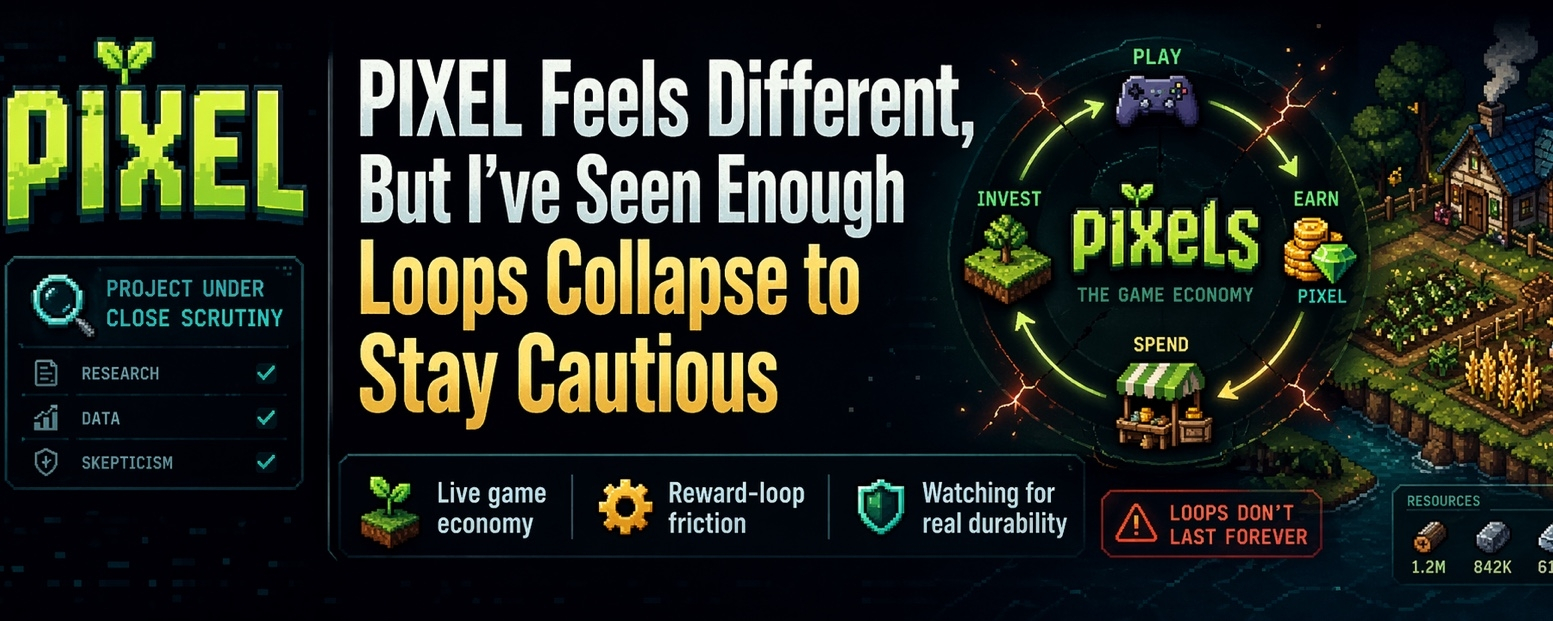
PIXEL is the kind of project I don’t want to judge too fast, mostly because I’ve judged too many too fast before. Some deserved it. Most did. Crypto gaming has a habit of recycling the same pitch with different artwork, different reward names, and the same slow bleed underneath. Pixels, though, still makes me pause. Not because I’m convinced. I’m not. But because there is enough movement inside the project that dismissing it as another empty loop feels a little lazy.
I came in doubtful. That is the honest starting point.
I’ve seen this pattern too many times: a game launches, players rush in, rewards look attractive, activity spikes, everyone calls it “community,” and then the grind starts showing its teeth. The people who came for fun get tired. The people who came for yield get sharper. The economy turns into a machine. At that point, you are not really watching a game anymore. You are watching extraction with a user interface.
That was my fear with PIXEL.
But here’s the thing. Pixels does not feel completely hollow. There is an actual project structure underneath the token: land, farming, resources, player progress, in-game activity, and a world that people are still interacting with. That matters. I don’t say that with excitement. I say it with caution, because even a real game can still have a weak economy. A project can be alive and still be fragile.
The part that interests me most is where PIXEL makes its decisions. Not on the screen. Not when a player collects something. Not when someone sees a reward appear. The real decisions happen earlier, buried inside the design. How rewards are paced. How resources get used. How land becomes useful or useless. How much friction the team adds before the system becomes too easy to drain.
That hidden layer is everything.
If Pixels gives too much away, farmers eat the system. If it gives too little, normal players drift off. If it becomes too deep, casuals get lost. If it stays too simple, serious users leave because there is no edge. This is the ugly middle ground every crypto game eventually reaches, and most of them do not survive it. They either inflate themselves to death or tighten so hard that the game starts feeling like work.
I’m looking for the moment this actually breaks. That is how I read PIXEL now.
Not because I want it to fail, but because pressure reveals what the project really is. When attention drops, does the world still feel active? When rewards are not generous, do players still return? When the market gets bored, does the game still have a pulse? These are the questions that matter more than whatever people are saying during a green week.
Pixels has one thing going for it: it has not disappeared into the usual fog. A lot of gaming projects fade once the first wave of noise dries up. They keep the token alive, maybe post updates, maybe promise a new season, but the world itself starts feeling abandoned. PIXEL does not quite feel like that. It feels pressured, uneven, unfinished, but not dead.
That is a small compliment. Maybe the only one I’m comfortable giving.
The token side still bothers me. It should. PIXEL has already been through real market punishment, and I don’t trust easy recovery stories. A lower price does not automatically mean hidden value. Sometimes it just means the market lost interest and moved on. Sometimes the project is quietly rebuilding while nobody cares. The hard part is that both can look exactly the same for a long time.
This is where the grind comes in. Pixels has to keep people inside the world without turning every player into an accountant. It has to make land matter without making land feel like a gate. It has to make rewards useful without letting rewards become the only reason anyone shows up. That is not clean design. That is constant maintenance. Tuning. Cutting. Adding friction. Annoying some users to protect the system from others.
And I think that is what makes PIXEL more interesting than I expected. Not safer. Not obvious. Just more interesting.
The project is trying to hold together two things that naturally fight each other: a game that wants patience and a token that wants attention. Players want progress. Traders want movement. Farmers want yield. The team has to manage all of that while pretending, at least publicly, that the system is smoother than it probably is behind the curtain.
I don’t know if PIXEL gets through that cleanly. Maybe it becomes one of the few crypto gaming projects that learns how to slow the extraction loop before it eats the actual game. Maybe it just becomes another long chart with a few good updates buried under market exhaustion.