In March 2025 during an AMA about bots Luke Barwikowski said something that mostly went unnoticed.
We want to predict what users will do with their tokens before we even give it to them.
At the time most people were focused on other parts of the conversation.
I only caught it later while rereading the transcript. That line made me stop. I scrolled up for context then back down again. He was talking about anti fraud but the sentence didn’t really sound like anti fraud. It sounded more like a description of how Stacked actually works.
Stacked is the AI platform Pixels opened to external studios in early 2026 built on four years of internal use. Officially it’s described as a system that delivers personalized rewards based on individual player behavior instead of distributing rewards evenly.
That framing makes sense.you play the system observes the system rewards.
But in one of Stacked’s demo campaigns the target group was lapsed spenders players who hadn’t spent in over 30 days. The system doesn’t wait for them to act. It detects that they’re approaching an exit point and deploys an offer before they decide to leave.
So it’s not rewarding past behavior. It’s intervening in behavior that hasn’t happened yet.
From the player’s perspective it looks the same you receive an offer. But underneath the direction of causality is completely reversed.
To make this work Stacked operates on two layers. The first is tracking. every micro action becomes a signal recorded in real time through an SDK once a studio integrates the platform. The second is prediction. models trained on four years of Pixels data including periods where 2% of users captured 50% of rewards when $BERRY was heavily botted and when the task board was criticized as just gambling. The system has seen the full spectrum including patterns later labeled as extractive users.
What it produces is probability.which player is about to churn which one is likely to convert.
Rewards are deployed at those moments not to acknowledge behavior but to validate the prediction.
This creates what you could call a prediction economy.
The system doesn’t simply react to what you do. It reads your behavior anticipates what you’re about to do and places rewards in ways that nudge you in that direction. Each cycle improves the model, making future predictions more accurate.
And because rewards are only given to behaviors the model wants to sustain everything else gradually fades. Nothing needs to be banned lack of reinforcement is enough.
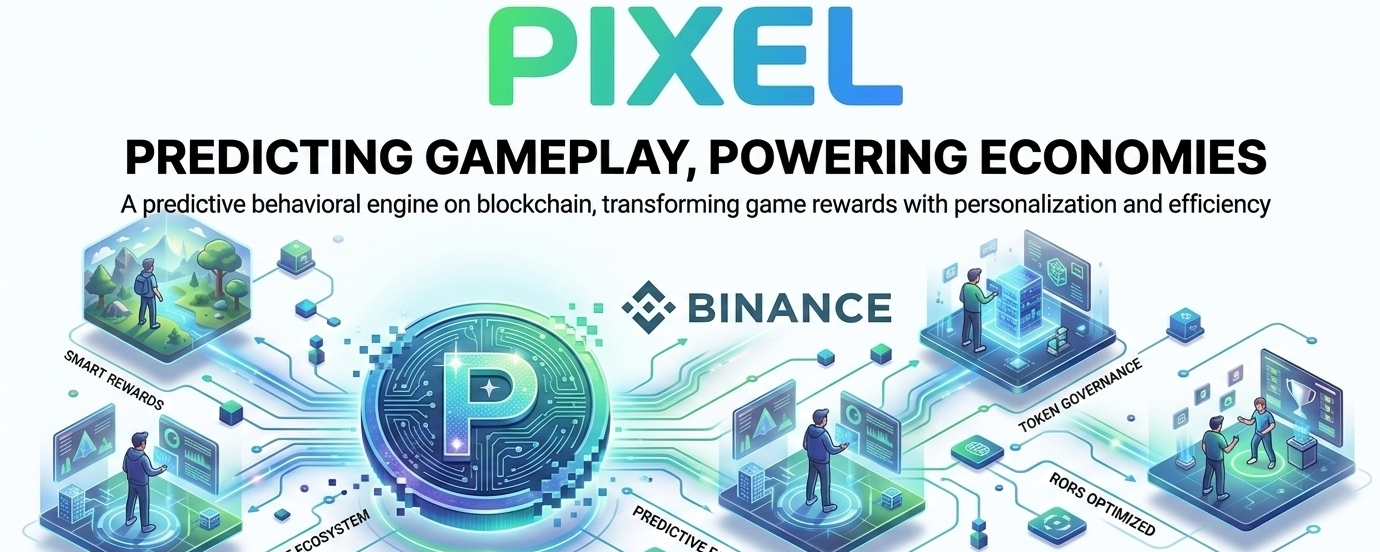
The key metric here is RORS (Return on Reward Spend). how much revenue each $PIXEL generates. It doesn’t measure whether players are enjoying the experience. It measures whether the prediction was correct. The system isn’t optimized for better gameplay it’s optimized for keeping you playing in ways it can already anticipate.
At that point Goodhart's Law applies quite cleanly. A strong RORS doesn’t necessarily mean a healthy economy it just means the system is efficiently reinforcing the patterns it has chosen.
There’s another implication that isn’t discussed as much. If players start to understand how Stacked predicts behavior they could begin to perform against it intentionally appearing inactive hitting thresholds that trigger retention offers and repeating the cycle. Not bots but real players optimizing in reverse.
At that point, the data stops reflecting genuine behavior. Pixels has already seen a simpler version of this with its task systems. The difference now is that real player optimization is much harder to detect because it looks identical to normal play.
And since Stacked deploys different offers based on churn risk two players with identical behavior might receive different rewards. In an ecosystem where $PIXEL functions as both a governance and staking token that difference isn’t just personal it has broader implications.
None of this suggests that Pixels is doing anything inherently wrong. Stacked is solving a real issue. uniform rewards tend to feed bots rather than valuable players. But when RORS becomes the primary objective a more important question emerges what kind of behavior is the system shaping and is that behavior actually desirable?
From a player’s perspective the takeaway is simpler. the offer you receive isn’t a reward for what you’ve already done. It’s the result of a prediction about what you’re about to do designed to make that prediction come true.
And that idea was quietly named almost by accident in a single line about bots spoken in an AMA where most people were paying attent7ion to something else.