
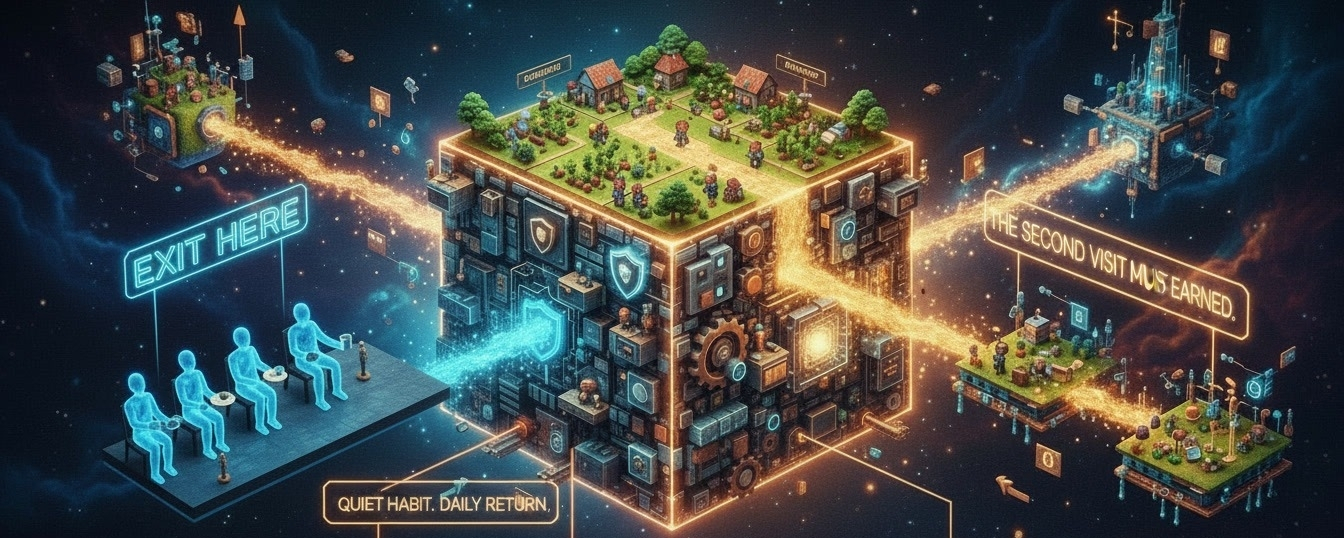

I keep thinking a lot of studios still believe their main job is to get people in the door. Better trailers, louder launches, bigger partnerships, more reach, more hype. Maybe that worked for a while. But attention has become crowded, expensive, and thin. People arrive fast now and disappear even faster.
That feels like the real problem most still ignore.
It’s like opening a restaurant and obsessing over the sign outside while the kitchen can’t make anyone return. You can buy a first visit. The second one has to be earned.
When I look at Pixels, I don’t mainly see a farming game. I see a project spending serious energy on the second visit. The daily return. The quiet habit. The reason to check in again when nobody is forcing you.
That distinction matters more than it sounds.
On the surface, Pixels looks simple enough. Plant crops, gather materials, craft items, trade goods, improve land, come back later. The loops are readable. Progress is visible. In my own experience, simple systems often get dismissed too quickly because they do not look impressive from the outside.
But simple is sometimes what survives contact with real users.
Many studios build experiences that are exciting to announce and tiring to maintain. Pixels seems to be moving in the opposite direction. The first hour may not look revolutionary, but the tenth day can matter more than the first ten minutes.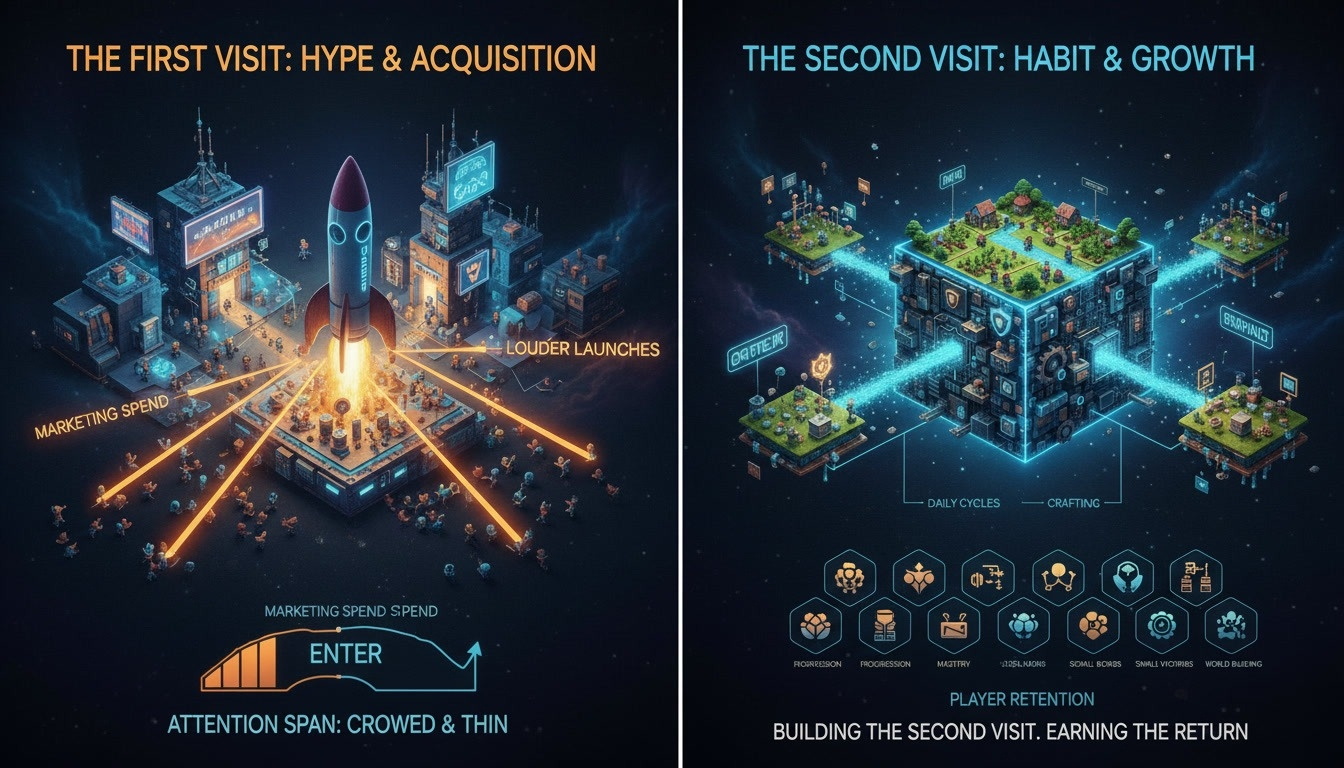
That is where I think they may be solving something others still avoid.
Underneath the farming loops is a structure built around repeat behavior. Timers bring people back. Land improvements create unfinished goals. Resource needs create reasons to plan ahead. Trading adds motion to ordinary tasks. Small upgrades turn routine actions into future advantages.
None of this is glamorous.
That may be the point.
A lot of game design chases spectacle because spectacle is easy to market. Retention is harder to screenshot. Habit loops look boring until you realize they are carrying the business.
Pixels appears to understand that quiet truth.
When a user returns daily, many useful things begin to happen. They learn systems more deeply. They care more about progress. They notice pricing differences. They start optimizing routes. They recognize familiar names. They feel friction if they miss a day. Time inside the world begins to accumulate meaning.
That is valuable.
Not just emotionally. Economically.
In normal money terms, repeat users are often cheaper than constantly replacing lost users. They spend more steadily, give better data, create more stable markets, and respond faster to new features. A studio that depends only on new arrivals can look busy while quietly leaking strength.
I have seen this in crypto especially. Huge spikes of users, loud metrics, then hollow retention a month later. It is the digital version of pouring water into a bucket with holes.
Pixels seems more interested in patching the bucket.
That changes behavior too. In weaker systems, users think about quick extraction. What can I earn now, flip now, leave with now. In steadier systems, users begin asking different questions. Should I upgrade tools? Expand land? Hold resources until pricing improves? Build a better route for tomorrow?
Those questions are signals.
They mean the user is thinking in future tense.
That is harder to create than hype.
There is risk here, of course. Routine can become chore. Timers can become obligation. Efficient users can dominate slower ones. Economies built on daily return can punish people who step away. It is still unclear where the healthy line sits for any live system.
No design escapes trade-offs.
But I think Pixels may have chosen the right problem to work on. Many studios still focus on attracting people who have no reason to stay. Pixels seems more focused on giving ordinary reasons to come back. That sounds less dramatic, but often matters more.
Because durable businesses are rarely built on first impressions alone.
They are built on repeated behavior that feels natural enough to continue.
The broader pattern goes beyond games. A lot of modern products learned that acquisition can be rented through ads, influencers, incentives, or novelty. Retention usually cannot. Retention has to be built into the experience itself.
Studios keep relearning this the expensive way.
If this holds, Pixels is changing how value is created in game economies. Not through one giant moment, but through thousands of small returns that slowly become habit.
And most markets overpay for attention while underinvesting in reasons to return.
