
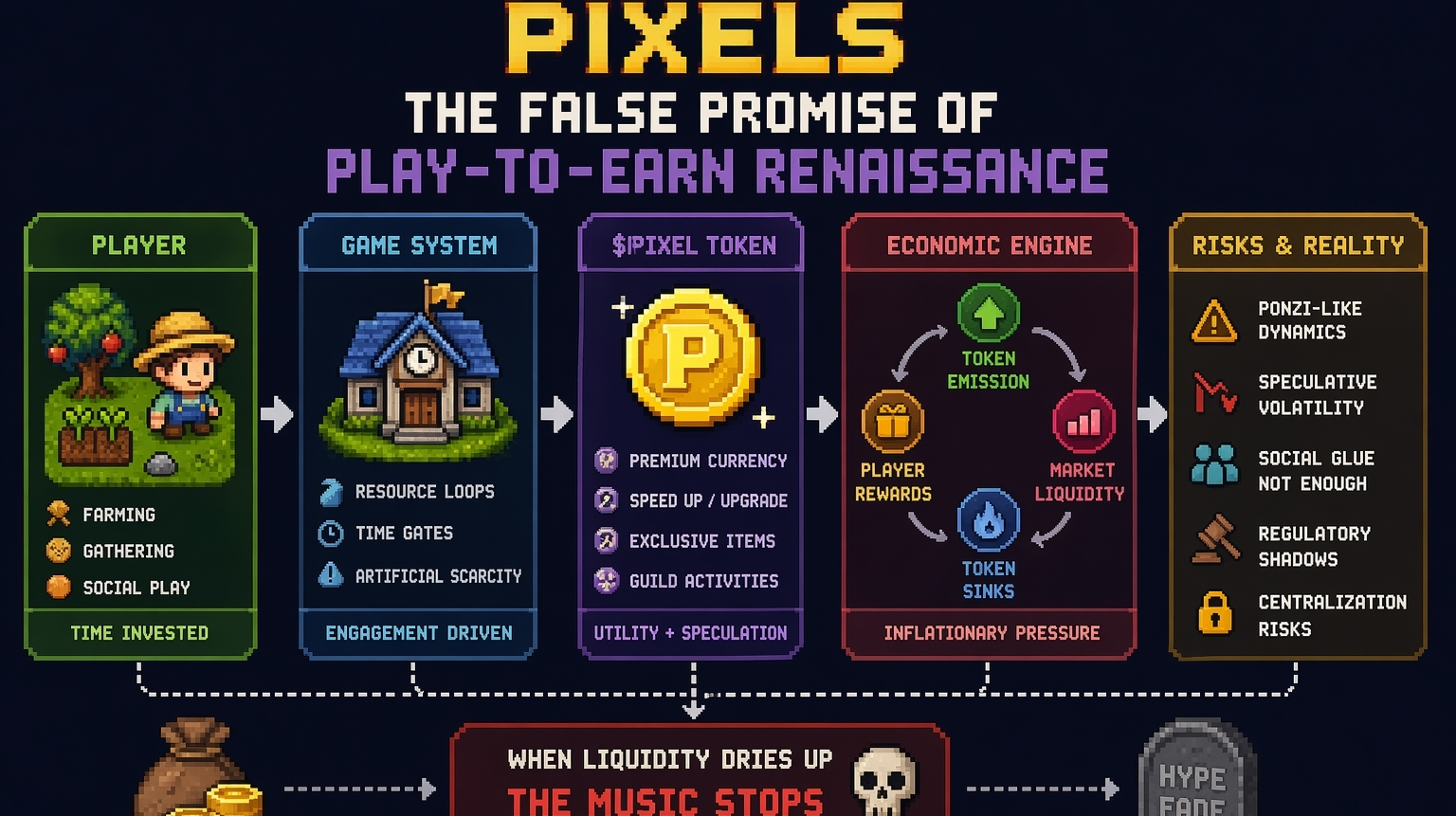
I have been watching the cryptocurrency sector stumble through various narratives for the better part of a decade, and the gaming vertical has always been the most frustrating theatre of operations. We have seen the rise of Axie Infinity, the subsequent collapse of its economy, and the endless parade of low-effort projects attempting to replicate that fleeting success under the guise of innovation. Pixels, a farming simulation game built initially on the Ronin Network, has recently captured the imagination of the market following its migration and token generation event for $PIXEL. To the casual observer, it appears to be a charming, social farming game reminiscent of early Facebook era favourites like FarmVille. Look closer. What we are witnessing is not the dawn of a new entertainment paradigm but rather a sophisticated rebranding of digital labour, dressed up in pixelated nostalgia to mask a brittle economic engine.
The premise is seductively simple. Players engage in farming, resource gathering, and social interaction. Unlike traditional games where your progress is locked in a walled garden, here your efforts translate into tangible assets. The industry loves to throw around terms like "ownership" and "sovereignty," but let’s be honest about what is actually happening. The game is essentially a user interface for a complex set of smart contracts designed to extract value from player attention. The core problem Pixels claims to solve is the inequity of the traditional free-to-play model, where developers hoard the revenue generated by player engagement. By introducing a token, $PIXEL, the developers argue that value is being returned to the community. This is a compelling pitch. It is also a dangerous simplification that ignores the fundamental mechanics of how these economies function under stress.
Most discussion around Pixels focuses on its aesthetics or its impressive retention metrics. What is missed in this superficial analysis is the structural reality that the game relies on a constant influx of new capital to sustain the rewards for existing players. This is the classic Ponzi mechanic repackaged for a Web3 audience. When you "monetise time," you are essentially creating a liability. Every hour a player spends grinding resources represents a cost to the system that must be paid out later. In a traditional game, that cost is recouped through cosmetic sales or battle passes. In a play-to-earn environment, the "earn" component creates an inflationary pressure on the token that requires either aggressive burning mechanisms or perpetual user growth to balance. I have seen this movie before, and it rarely ends with a happy ending for the late arrivals.
Let us examine the system architecture and how the token actually functions. The $PIXEL token serves as the premium currency within this ecosystem. It is used for exclusive items, guild activities, and accelerating gameplay loops that would otherwise require significant time investment. This is where the "pay-to-play" and "play-to-earn" models collide in an uncomfortable mess. The game creates artificial friction—time gates, resource scarcity—that can be bypassed by spending $PIXEL. This is standard monetisation in mobile gaming. However, by tokenising this premium currency, the developers have introduced speculative volatility into a system that requires stability to function as a game. If the token price crashes, the incentive to grind vanishes. If the token price skyrockets, the game becomes prohibitively expensive for new users. It is a tightrope walk that no project has successfully managed for a prolonged period.
The economic layer is where the skepticism should harden into scrutiny. The token acts as fuel, yes, but it also acts as a speculative asset detached from the actual utility of the game. The "monetization of time" narrative suggests that your hours spent clicking are valuable. But value is relative to liquidity. When thousands of players try to exit their positions simultaneously, who is the buyer? The game’s mechanics rely on a continuous loop of resource generation and token emission. Without a robust "sink"—a way to permanently remove tokens from circulation—the system is inherently inflationary. The developers have implemented various sinks, such as pet mints and land maintenance, but these are merely friction, not solutions. The grim reality is that the system only works as long as the hype cycle persists.
Where this model attempts to differentiate itself is in its reliance on social coordination rather than pure financial extraction. Pixels leans heavily on guilds and social structures to bind users to the platform. The theory is that social capital will act as a retaining wall against economic downturns. If your friends are there, you will stay even if the token price dips. It sounds tidy. On paper, at least. But when you peel back the marketing, the glue starts to melt. Social bonds in online games are strong, but they are not immune to economic reality. When the cost of participation exceeds the potential reward, even the tightest-knit guilds disintegrate. The social layer is a sticking plaster over a structural wound.
The hard problem facing Pixels is one that the entire industry has failed to crack: the separation of player and investor. In a functional economy, these are distinct actors. In Pixels, they are the same person. This confluence creates a perverse set of incentives where players are motivated to extract value rather than contribute to the game’s ecosystem. A game cannot thrive if its primary purpose is financial extraction. It ceases to be a game and becomes a job, and a poorly paid one at that. The developers must somehow decouple the gameplay enjoyment from the financial speculation, a feat that borders on the impossible given the current design.
We must also consider the regulatory shadows gathering over this sector. The "monetization of time" argument walks a fine line with labour laws and securities regulation. If a game’s primary value proposition is the ability to earn, it risks being classified as an investment contract by regulators like the SEC in the United States or the FCA here in the UK. The marketing materials might avoid explicit promises of profit, but the community and the secondary market sentiment certainly do not. I have sat in enough boardrooms to know that legal ambiguity is often a feature, not a bug, in early-stage crypto projects. It allows for explosive growth during the bull run and plausible deniability during the crackdown.
The migration to the Ronin Network was a strategic move to lower transaction fees and target a specific demographic of crypto-natives familiar with Axie Infinity. While this solves the immediate technical hurdle of expensive gas fees, it places the project in an echo chamber. It isolates the game from the broader Ethereum ecosystem while tethering its success to a blockchain whose reputation is still scarred by one of the largest exploits in crypto history. Centralisation risks are also rampant. While the rhetoric is decentralised, the reality is that a small team controls the smart contracts, the treasury, and the development roadmap. If the core team decides to pivot or if the treasury is mismanaged, the token holders have little recourse. Governance tokens are often little more than theatre, providing the illusion of control without the substance of power.
The quiet monetization of time is not a revolution; it is a reversion to the piecework model of the industrial revolution, albeit digitised and gamified. The project’s success will depend on whether it can transition from a speculative vehicle into a genuinely entertaining game that people play for fun, not for yield. That is a hurdle that requires a level of game design prowess and capital discipline that we have rarely seen in the crypto space. As it stands, Pixels is a fascinating experiment in behavioural economics, a case study in how far people will go when promised a slice of the pie. But let’s not mistake it for the future of entertainment. When the music stops, and the liquidity dries up, we will see who is left holding the bag.