I did not take the share-to-earn mechanic seriously the first time I read about it.
It sounded like every other post about us and win promotion that crypto projects run when they need organic reach and do not want to pay for it. Cheap marketing dressed up as a feature. I filed it away and moved on.
Then I looked at how Pixels actually structured it and the framing shifted.
This is not a posting contest. It is a yield mechanism with attribution logic built underneath it.
Here is what I mean.
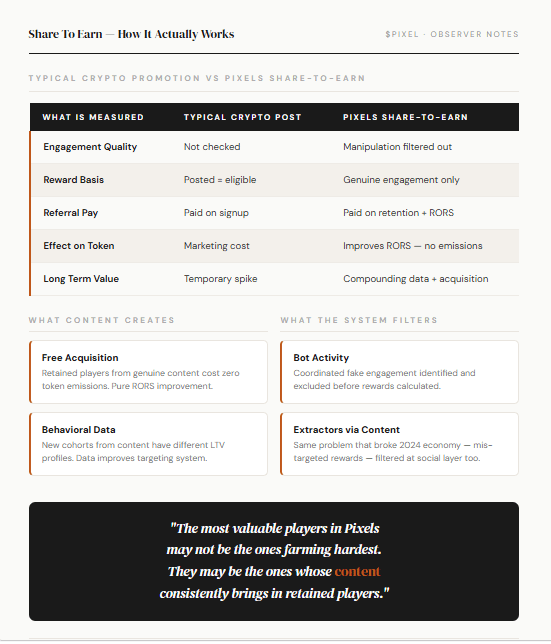
Traditional content rewards in crypto are simple. Post something, use the hashtag, maybe win a prize. There is no connection between the quality of what you posted, whether anyone engaged with it, and what you receive. The reward is random or subjective. The relationship between effort and outcome is loose.
$PIXEL built something different. The Social Monitoring Tool tracks engagement around ecosystem games but it uses detection methods specifically designed to filter out manipulation. Fake engagement, bot activity, coordinated artificial inflation the system is built to identify and exclude these. Only genuine community growth gets rewarded.
That distinction matters more than it sounds.
If rewards go to fake engagement, you are subsidizing actors who extract value without contributing any. The same problem that broke the token economy in 2024 mis targeted rewards flowing to extractors shows up again, just in a different channel. Pixels designed the social layer specifically to avoid repeating that mistake.
But the deeper insight is what share-to-earn actually does to the RORS calculation.
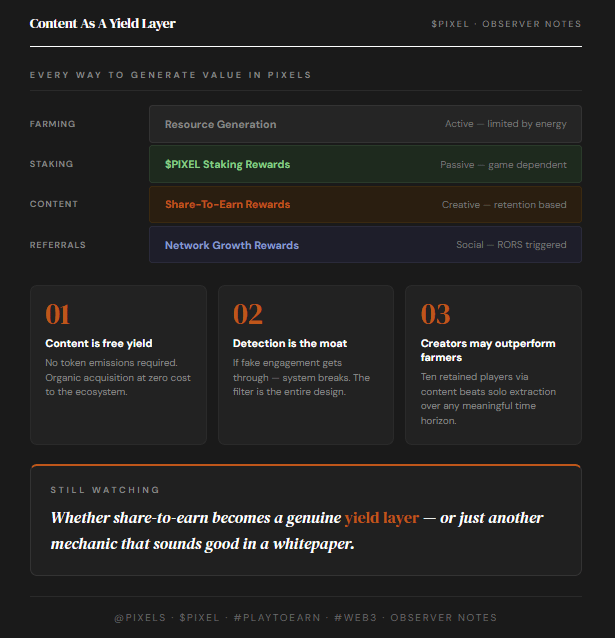
Every piece of genuine user-generated content that brings in a new retained player is acquisition that the ecosystem did not pay for through token emissions. It is organic reach with measurable downstream effects. If that new player spends inside the game, the revenue flows back. The content creator gets rewarded. The ecosystem RORS improves without additional token spend.
Content becomes yield. Not metaphorically structurally.
The referral layer makes this more interesting. Referral rewards only trigger if the referred player maintains positive RORS. You do not get paid for bringing someone in. You get paid for bringing someone in who actually stays and contributes. The incentive is aligned with ecosystem health rather than raw growth numbers.
That is a meaningful design choice. Raw growth was exactly what inflated the 2024 metrics without building a sustainable economy underneath them.
Here is what I keep coming back to.
If this system works as designed, the most valuable players in Pixels are not necessarily the ones farming the hardest. They are the ones whose content and referrals consistently bring in retained, high LTV players. A creator who brings in ten players who each spend and stay is generating more ecosystem value than a solo farmer maximizing their own extraction.
That reframes who the ecosystem is actually built to reward and it is not who most people assume.
Whether the detection system is sophisticated enough to prevent gaming or whether motivated actors find ways to simulate genuine engagement at scale is the question I cannot answer yet.
I am still watching whether share to earn becomes a genuine yield layer or just another mechanic that sounds good in a whitepaper.
Do you create content about $PIXEL and have you ever thought about it as part of your yield strategy?