
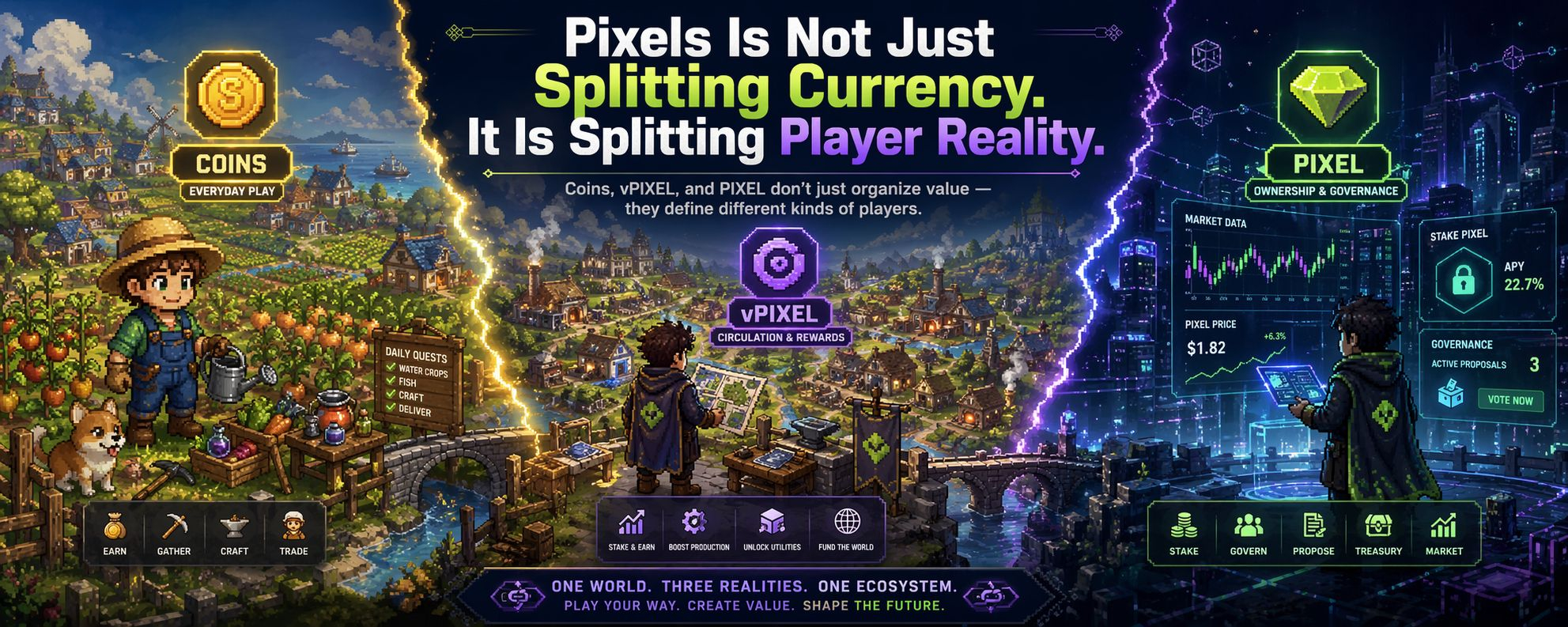
The most interesting thing about Pixels’ economy is not that it has three currencies.
That part is easy to notice. Anyone can point at Coins, vPIXEL, and PIXEL and say the system is layered. The more useful question is quieter: what kind of player is each currency really speaking to?
Because that is where the design starts to look less like a technical choice and more like a social one.
A game like Pixels is not dealing with one audience. It is dealing with several different groups pretending to live inside the same world. There are players who log in to farm, craft, decorate, trade, and slowly build a routine. There are landowners thinking about output, labor, rent, and long-term positioning. There are token holders looking at yield, governance, unlocks, and market movement. Some people are playing a game. Some are managing an asset. Some are doing both and constantly switching between those identities.
A single currency would make that look simpler. It would also make it less honest.
Coins seem to exist for the part of Pixels that still wants to feel like a game before it feels like a financial dashboard. That matters more than Web3 people sometimes admit. Small actions need to stay small. A player should not have to mentally price every crop, tool, recipe, or casual trade against market volatility. If the basic loop feels too exposed to token economics, the game stops feeling approachable. It becomes a spreadsheet with pixel art on top.
That is where Coins do useful work. They give daily activity its own breathing room. Not everything needs to touch the chain. Not every player needs to enter through the same economic door. The ordinary layer of the game has to be allowed to function without being constantly dragged into the premium layer.
PIXEL carries a very different kind of weight. It is not just another in-game balance. It is the part of the economy that touches ownership, influence, staking, scarce access, and public market value. That makes it powerful, but also dangerous if used carelessly. A token like that cannot be treated as the answer to every gameplay need. When a game forces its main token into too many places, the token becomes overworked. It has to reward players, attract investors, support governance, price assets, absorb speculation, and still somehow remain fun to use.
That usually ends badly.
Pixels appears to understand that premium value needs distance from ordinary activity. That distance is not just convenience. It is protection. It protects casual players from unnecessary complexity, and it protects the main token from being consumed by low-level transactional noise.
Then vPIXEL enters as the awkward but important middle child.
It is easy to underestimate because it does not have the obvious prestige of PIXEL or the everyday clarity of Coins. But vPIXEL says something revealing about the system’s priorities. It is a way to keep some earned value circulating inside the game rather than immediately sending everything toward withdrawal and sale. That is not a moral statement. Players will always make rational choices based on incentives. If selling is the best option, many will sell. The design question is whether the game gives them a reason to do anything else.
vPIXEL is an attempt to shape that moment.
Not by preaching loyalty. Not by pretending players are not economically motivated. But by creating a route where rewards can stay useful without instantly becoming market pressure. That is a practical concern, and it is one of the harder problems in Web3 gaming. Reward systems are easy to launch. They are much harder to keep from turning into extraction machines.
The land mechanic adds another layer of tension. Landowners in Pixels are not just cosmetic collectors sitting on rare plots. They can occupy a stronger economic position through production, commissions, and staking advantages. That makes land meaningful, which is good. Empty ownership is one of the most boring habits in blockchain games.
But meaningful ownership also creates hierarchy.
That is not automatically bad. Games can have hierarchy. Economies can have advanced roles. The concern is whether the structure still leaves enough room for players who are not early, wealthy, or deeply invested. If land, staking, and production benefits become too tightly stacked, the top layer can start pulling away from the rest of the game.
This is why the Coins layer may be more important than it looks.
It is not just the beginner economy. It is the public floor of Pixels. It is where most people will experience whether the world feels alive, fair, understandable, and worth returning to. A million-user game cannot be built only for the people optimizing staking positions. The broad player base needs a version of the economy that does not make them feel like tourists inside someone else’s investment vehicle.
That is the difficult balance Pixels is trying to hold.
It wants the premium token to matter without making the whole game depend on premium participation. It wants land to be valuable without making non-landowners feel irrelevant. It wants rewards to motivate players without turning every motivated player into a seller. It wants an economy with depth, but depth always risks becoming opacity.
And that is where my caution sits.
The design is thoughtful, yes. But thoughtful systems can still become confusing systems. A player may understand how to earn Coins but not understand why PIXEL matters. A staker may understand yield but not care about the health of the game loop beneath it. A landowner may see the system clearly because the incentives point directly at them, while a casual farmer only sees another set of rules they were never fully taught.
Economic architecture is not only about separating functions. It is also about making those separations feel natural to the people using them.
Pixels has made a strong choice by refusing to flatten everything into one token. That deserves attention because it shows a more mature understanding of how different kinds of value behave. Daily play, premium access, market exposure, and reward circulation are not the same thing. Forcing them into one currency may look elegant, but it often creates hidden damage.
Still, the real test will not be in the diagram.
It will be in the habits of players.
Do they spend Coins because the game feels rewarding, or because they are trapped below the real economy? Do they hold PIXEL because they believe in the world, or only because the staking math makes sense for now? Do they use vPIXEL because it adds meaningful in-game choice, or because it quietly limits what rewards can become?
Those questions matter because currencies are never just currencies in a game like this. They are instructions. They tell players what kind of participant they are allowed to be.
Pixels’ three-currency model is interesting because it does not treat all participation as equal. It separates the casual player, the committed builder, and the market-facing holder into different economic lanes. That may be exactly what gives the game room to grow.
But it also means the system has to keep proving that those lanes connect to one world, not three separate games sharing the same name.