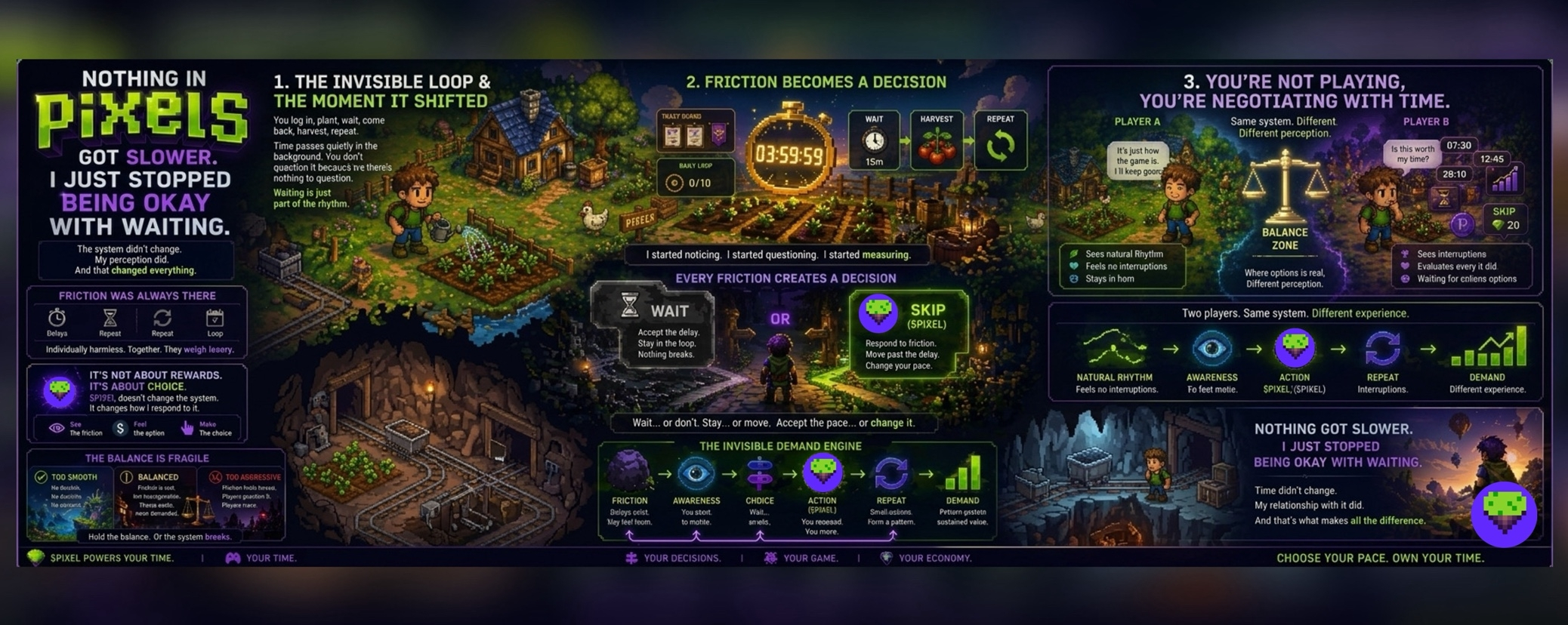


At first, Pixels felt exactly like I expected.
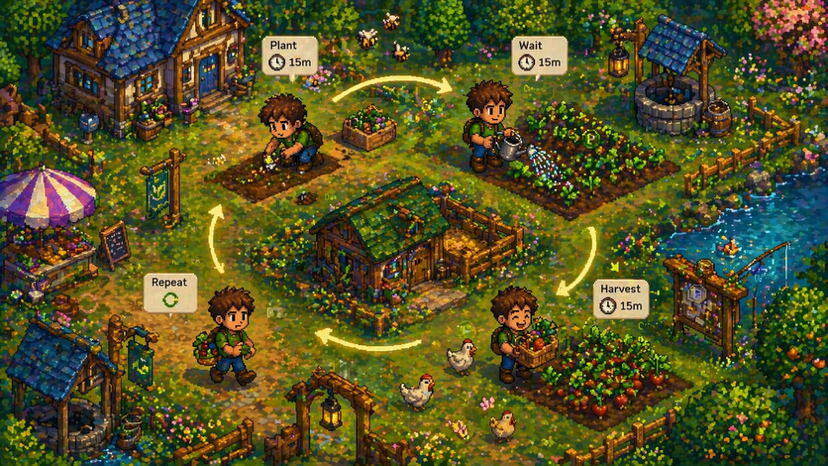
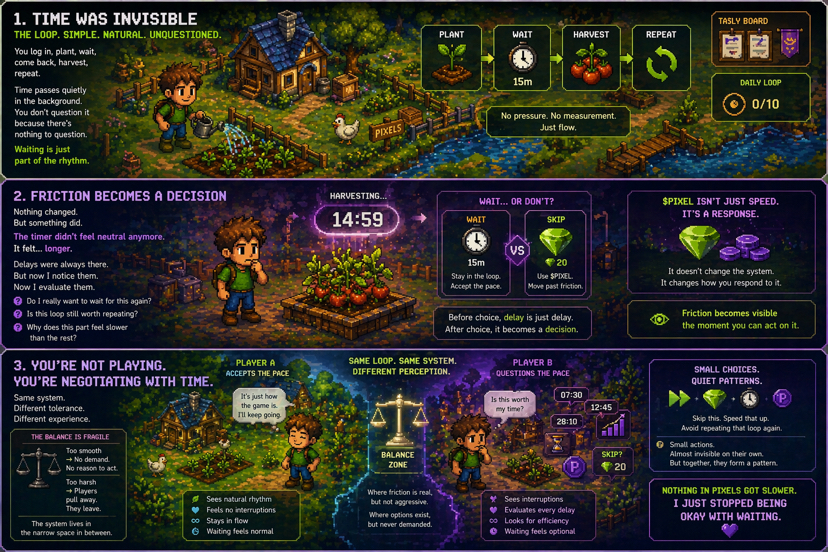
A simple loop. Familiar. Predictable in the way most farming games are. You log in, plant something, wait, come back, harvest, repeat. Time passes quietly in the background, almost invisible. You don’t question it because there’s nothing to question. Waiting is just part of the rhythm.
And for a while, I moved through it without thinking.
Days blurred together into the same pattern. I wasn’t measuring anything. I wasn’t evaluating anything. I was just… inside it.
Then something shifted.
Not all at once. Not dramatically. Just a small moment that didn’t feel important at the time. I opened the game, saw a timer I had seen a hundred times before, and for the first time, it didn’t feel neutral. It felt like it was asking something from me.
It felt… longer.
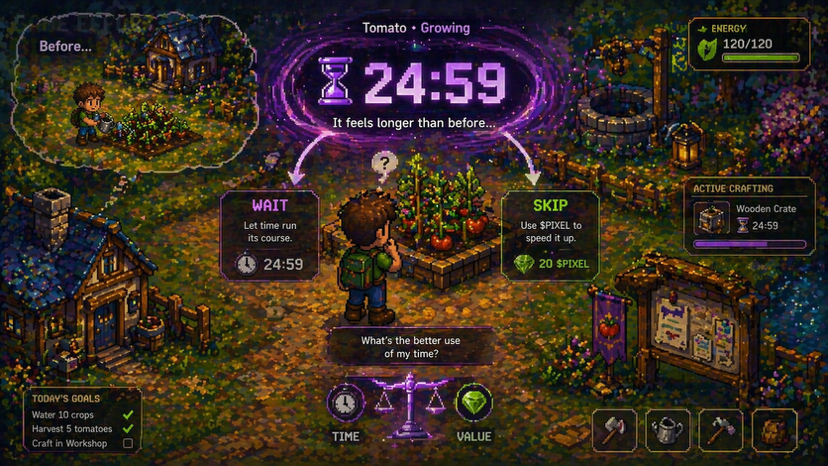 Nothing had changed. Same duration. Same loop. Same everything.
But I reacted differently.
That’s when I started noticing it.
The delays were always there. The pauses between actions. The small gaps in progression. The moments where the system asks you to wait, just a little longer, just one more cycle, just one more loop. Individually, they’re harmless. Almost invisible. But together, they form something else. Something heavier than they look.
Before, I didn’t feel that weight.
Now I did.
And the strange part is, the system didn’t become slower.
I just stopped being okay with it.
At some point, without realizing it, I started evaluating time. Not consciously at first. Just small questions that began to surface on their own.
Do I really want to wait for this again?
Is this loop still worth repeating?
Why does this part feel slower than the rest?
Those questions weren’t there before.
And once they appear, they don’t really go away.
That’s where $PIXEL enters, but not in the way I expected.
At first, it looks like a shortcut. A way to speed things up. A convenience layer. Something optional. But the more I paid attention, the less it felt like it was changing the system itself.
It was changing me.
It gave me a way to respond to friction.
And that alone was enough to make friction visible.
Because before you have a choice, delay is just delay. It doesn’t carry meaning. It doesn’t ask anything from you. But the moment you can act on it, it becomes something else. It becomes a decision.
Wait… or don’t.
Stay… or move.
Accept the pace… or change it.
And that’s where everything shifts.
Not because the game forces you to spend. It doesn’t. You can ignore it completely. You can stay in the loop, accept every delay, and nothing breaks.
But once you’ve seen the alternative, once you’ve felt what it’s like to move past that friction, even just once, the baseline changes.
Waiting doesn’t feel the same anymore.
It feels optional.
And when something feels optional, it also starts to feel… negotiable.
That’s the part I didn’t expect.
Because now the system isn’t just something I move through. It’s something I’m constantly responding to. Not in a heavy way, not in a way that breaks immersion, but just enough that it changes how I experience each moment inside it.
Two players can go through the same exact loop and come out with completely different experiences.
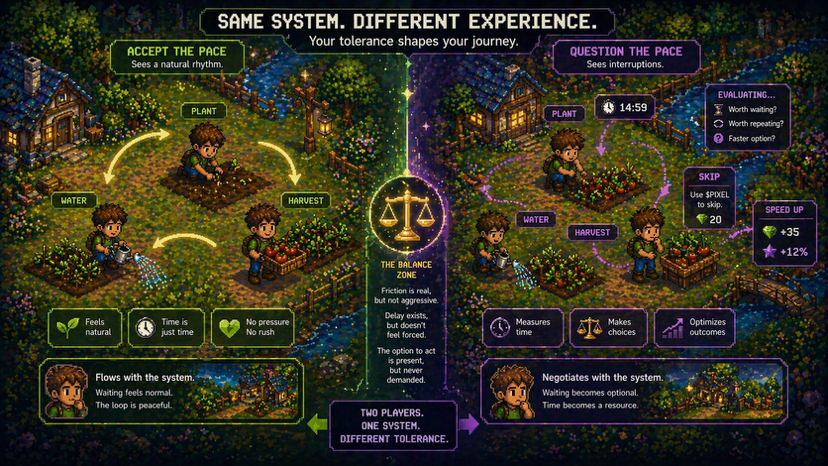
One sees a natural rhythm.
The other sees interruptions.
One accepts the pace.
The other questions it.
Same system.
Different tolerance.
And that difference is where everything starts to matter.
Because demand doesn’t come from the system being fast or slow.
It comes from how players feel about the time inside it.
If waiting feels fine, nothing happens. No pressure. No reason to act.
If waiting starts to feel just slightly uncomfortable, not enough to frustrate, but enough to notice, then something changes. The decision appears. And once that decision appears, it can repeat.
Not loudly. Not dramatically.
Just quietly.
Skip this. Speed that up. Avoid repeating that loop again.
Small actions. Almost invisible on their own.
But together, they form a pattern.
And patterns are where systems either hold… or break.
Because if players stop noticing the friction, if everything becomes smooth, then the decision disappears. There’s nothing left to act on. No reason to spend. The token becomes optional in the worst way.
But if the friction becomes too obvious, too intentional, too visible, then something else happens. Players don’t lean in.
They pull away.
They question it.
They leave.
So the system sits in this narrow space in between.
Where friction is real, but not aggressive.
Where delay exists, but doesn’t feel forced.
Where the option to act is present, but never demanded.
That balance is fragile.
Much more fragile than it looks from the outside.
And that’s why I don’t think this is really about rewards.
Or even about progression.
It’s about something quieter.
Something harder to see.
The moment where you stop accepting the system as it is… and start negotiating with it.
Because once that happens, you’re not just playing anymore.
You’re measuring.
You’re choosing.
You’re deciding what your time feels like.
And that’s not something most games can hold for very long.
Which is why I keep coming back to the same thought.
Nothing in Pixels actually got slower.
I just stopped being okay with waiting.