
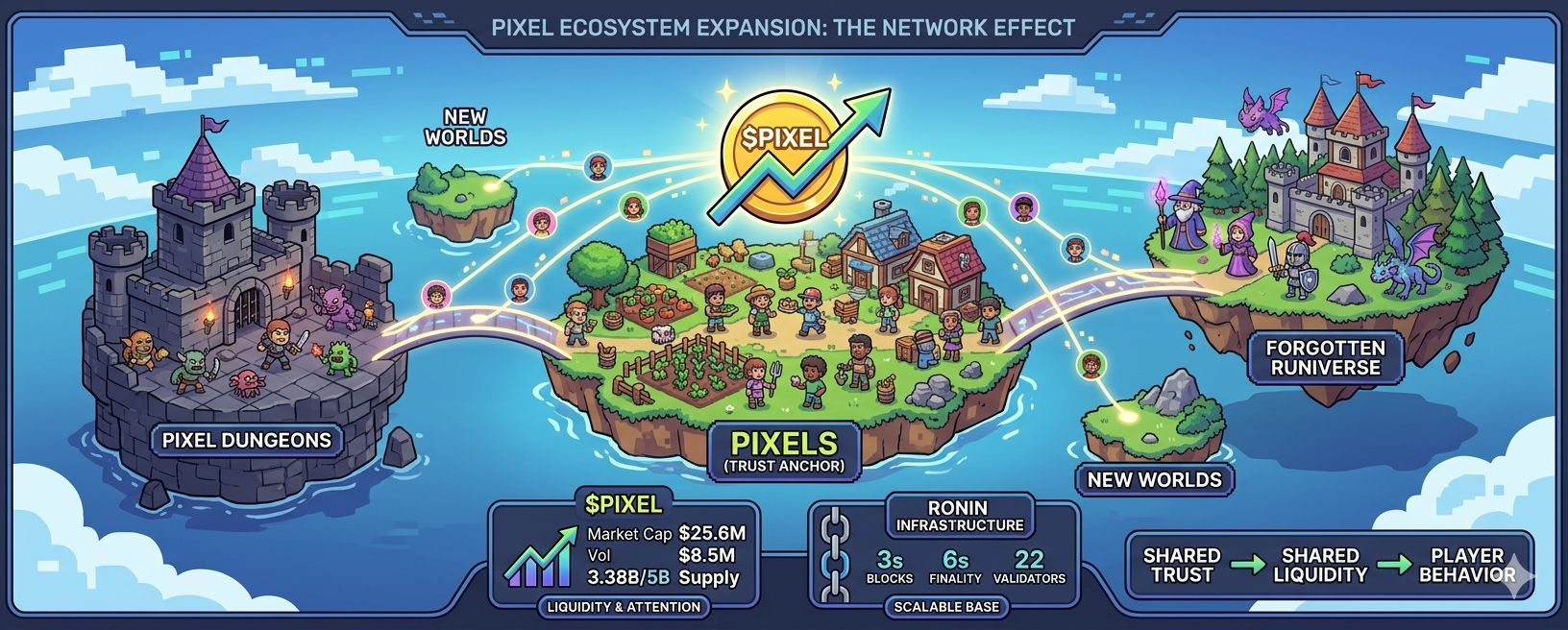

I used to think PIXEL’s future had to be judged mainly inside Pixels itself. That felt logical. One token, one flagship game, one farming loop and one community. But the more I look at the way Pixels is positioning itself now the harder that frame becomes to keep. The common mistake is treating ecosystem expansion as a branding move as if adding more games simply gives the token more places to appear. I think the sharper thesis is quieter $PIXEL only becomes more interesting if the success of one game turns into shared trust, shared liquidity and shared player behavior across several worlds.
Pixels already has the first ingredient which is not technology but attention. Its own site claims over 10 million players and that matters because network effects do not begin with tokens. They begin with enough people caring about the same system for habits to form. On the surface that number says “large player base.” Underneath, it means new games entering the Pixels orbit are not starting from zero. They may be borrowing a little trust from a world players already know. That is useful but also dangerous. Borrowed trust can decay quickly if the connected games feel thin. 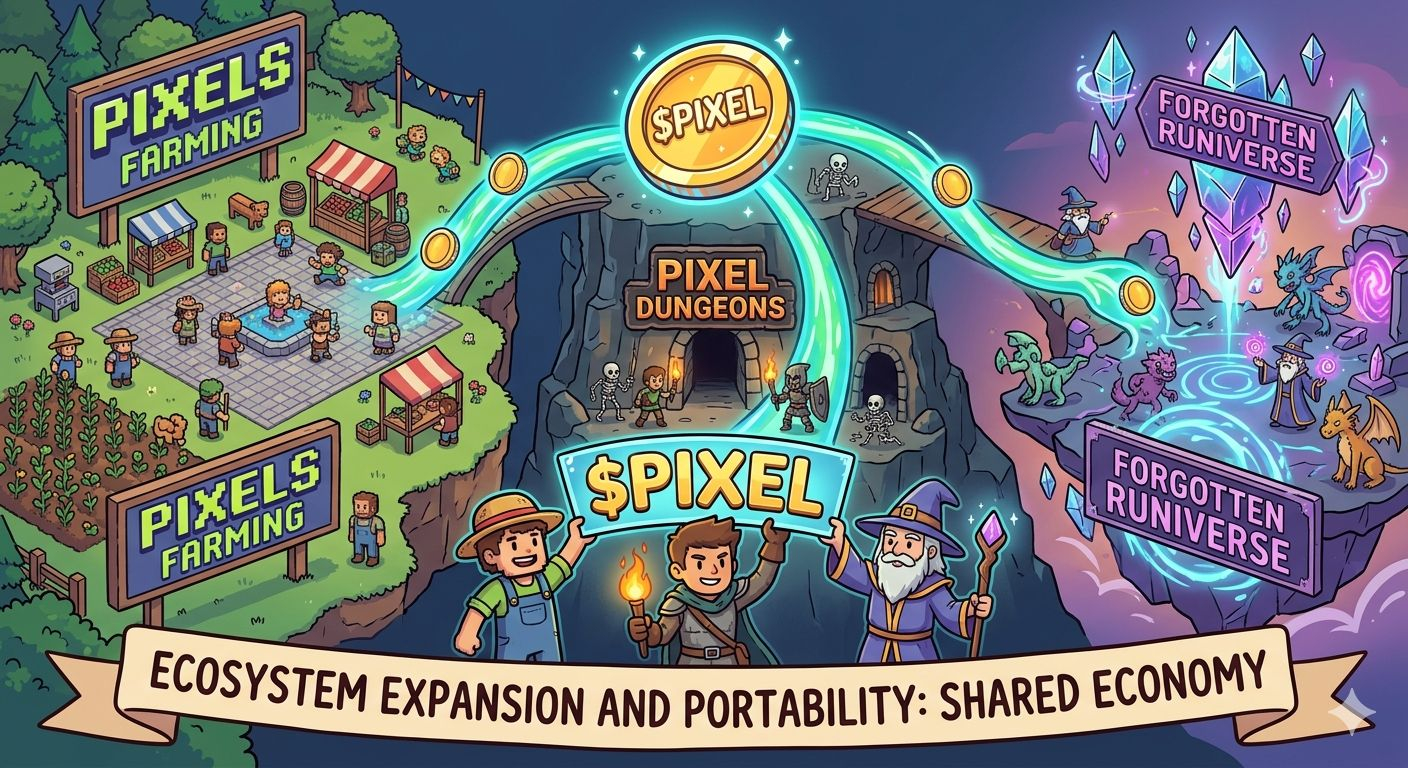
This is why ecosystem staking is more important than it first sounds. Staking simply means players lock PIXEL toward a game or pool usually to earn some reward or express support. On the surface it looks like yield. Underneath, it becomes attention routing. Pixels’ staking system initially linked Pixels, Pixel Dungeons and Forgotten Runiverse, which means #pixel is no longer only sitting inside one gameplay economy; it is being used to point capital and belief toward multiple experiences. That creates an early network effect but not a free one. If rewards lead the behavior more than the games do the system becomes a farming contest wearing a community mask.
The Forgotten Runiverse event shows the same tension in a more practical way. Ronin described an event where players could earn and spend PIXEL in Runiverse use it for boosts and Mana and claim PIXEL through Quanta. On the surface this is a crossover. Underneath, it tests whether value can move between games without making either game feel like a side quest for extraction. What it enables is portability time spent in one world can become economically meaningful in another. The risk is that portability becomes shallow if players only arrive for rewards and leave before culture forms. 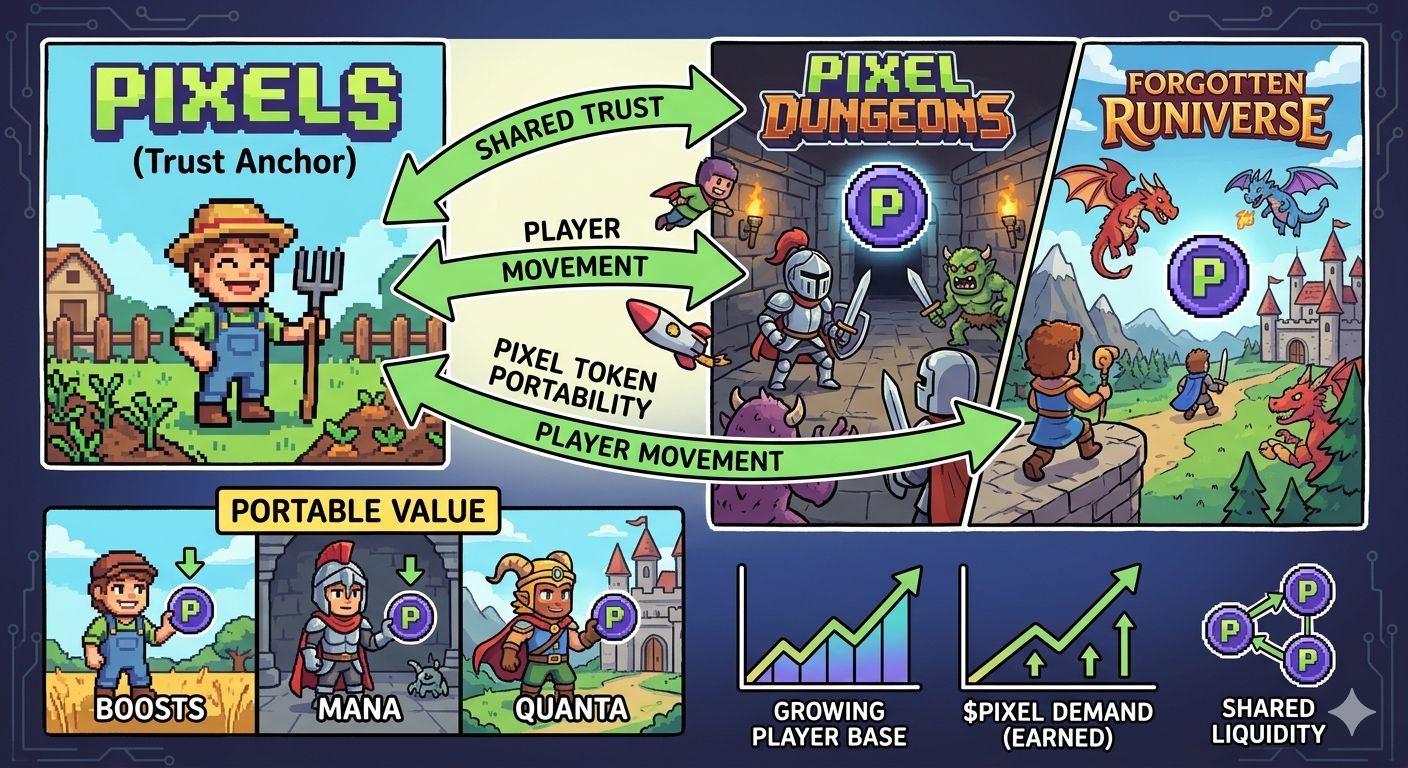
The market backdrop makes that distinction more important. @Pixels is still small around $0.0075, roughly $25.6 million in market cap, about $8.5 million in 24-hour volume and 3.38 billion tokens circulating out of a 5 billion max supply. Those numbers say two things at once. There is enough liquidity for attention to move the token but not enough depth for the market to ignore weak fundamentals. A token at this size can react quickly to announcements but lasting repricing needs repeated demand not a single loud event.
Ronin’s infrastructure helps explain why this bet is even plausible. Its mainnet uses roughly 3-second blocks about 6-second finality, and a 22-validator set. Plainly, block time is how quickly new transaction batches are produced finality is how soon players can treat those actions as settled. For games this matters because slow or expensive settlement breaks the feeling of play. Underneath, Ronin is trying to make ownership and rewards feel quiet enough that players do not constantly notice the chain. The tradeoff is that a gaming focused chain still has to prove reliability, fairness and decentralization under stress, not just speed in normal conditions. 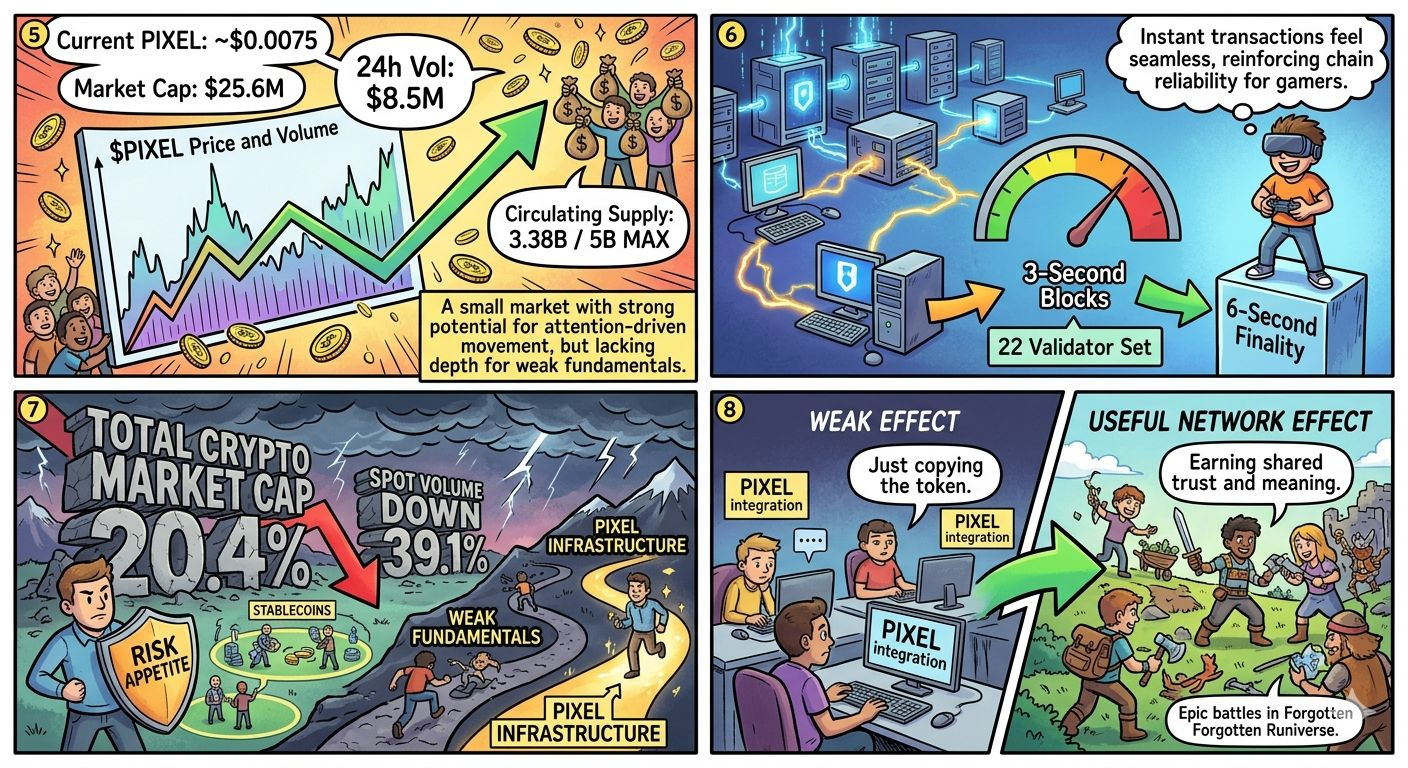
Zooming out, the wider market is not forgiving speculative stories the way it did in looser cycles. CoinGecko reported that total crypto market cap fell 20.4% in Q1 2026 to $2.4 trillion, while stablecoins ended the quarter near $309.9 billion and centralized exchange spot volume fell 39.1% to $2.7 trillion. That mix tells me liquidity is still present but risk appetite is more selective. People can trade, but they are less willing to underwrite vague narratives. In that environment PIXEL’s ecosystem expansion has to behave less like marketing and more like infrastructure for actual player movement.
This is where I think the contrarian part sits. More games using PIXEL is not automatically bullish. It can even weaken the token if each integration adds supply side noise without demand side texture. A useful network effect is earned when each connected game gives players a reason to return, spend, stake, craft, compete or identify with something. A weak network effect just copies the token into another interface and hopes the chart notices.
The better version is slower. Pixels remains the trust anchor. Pixel Dungeons adds a different retention rhythm. Forgotten Runiverse brings a different fantasy, economy and community. PIXEL then becomes the bridge between behaviors not the replacement for them. That is a much harder design problem than announcing partnerships because every new loop must answer the same question does this make the player’s next action feel more meaningful or just more monetized?
I also think this connects to where digital systems are heading. As AI native tools make it easier to generate worlds, characters, quests and content scarcity will move away from raw production and toward coordination. Anyone may be able to make more game but not everyone can make a durable economy where people trust the rules, return voluntarily, and carry value without feeling trapped. That is the real strategic bet behind PIXEL’s expansion.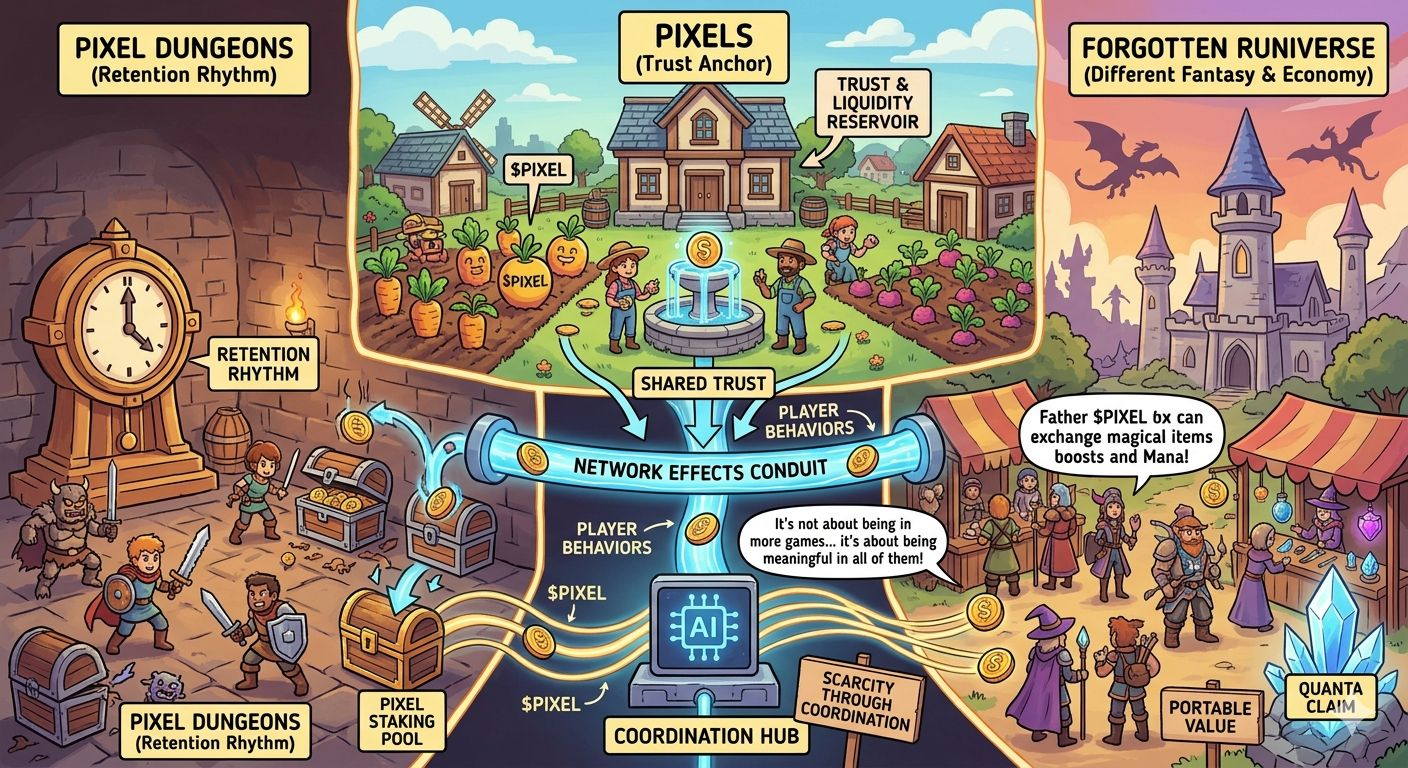
So the success of one game can become a network effect for PIXEL but only if the token stays disciplined. It has to carry trust without overwhelming play connect worlds without flattening them and reward participation without bribing empty traffic. The memorable part is simple PIXEL does not become stronger because more games borrow its name it becomes stronger only when more games give that name something earned to coordinate.
