
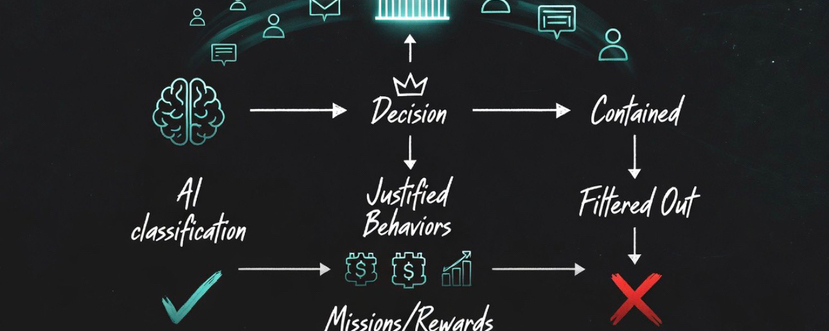

Ownership was supposed to fix everything.
Give players assets, give them tokens, let them participate in the economy… and the system should take care of itself. That was the assumption.
But most of those systems didn’t fail because ownership was missing.
They failed because ownership had nothing to anchor to.
Players owned things, but the loops around those things didn’t hold. The moment liquidity appeared, the system started draining. Not because players were wrong—but because the system gave them no reason to stay once value became real.
That’s the part I kept thinking about while reading Stacked.
This isn’t really about rewards.
It’s about what sits underneath ownership and decides whether it actually means anything.
The easiest way to misunderstand Pixels is to focus on the surface.
Farming loops, missions, tokens, assets. It looks like another player-owned economy trying to balance incentives.
But the structure underneath is different.
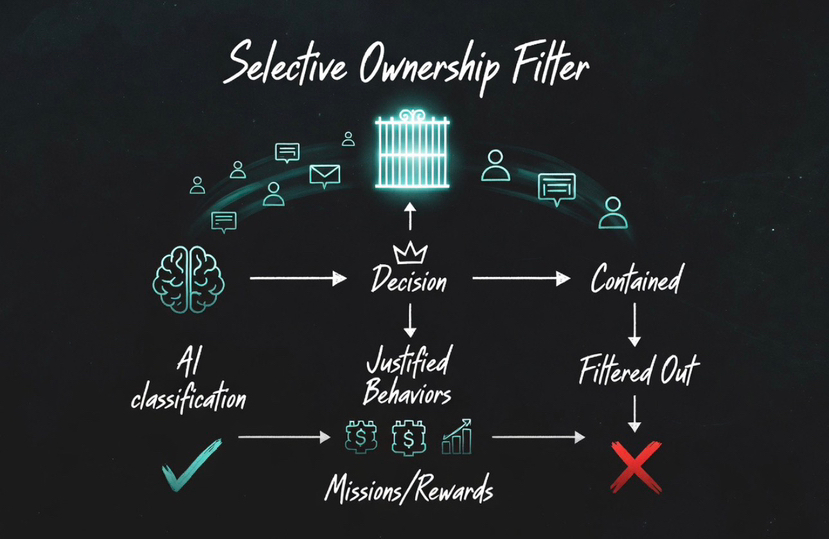
Stacked isn’t just distributing rewards. It’s deciding which behavior deserves to be connected to ownership in the first place.
That’s a harder problem.
Because once ownership is real, every reward has a cost. Every payout has to be justified. And not all player activity can survive that pressure.
Inside Pixels, every action becomes an event.
That part sounds simple, but what happens next is where the system starts separating itself.
Those events don’t automatically turn into rewards. They pass through a layer that evaluates them:
Who is the player?
What kind of behavior is this?
What is the system trying to move right now?
From there, the system makes a decision.
Some behaviors get turned into missions.
Some get rewarded directly.
Some never make it past this layer at all.
That decision loop keeps running:
event → classification → cohort → mission → reward → outcome → feedback
And the important part is not that the loop exists.
It’s that it acts as a filter between activity and ownership.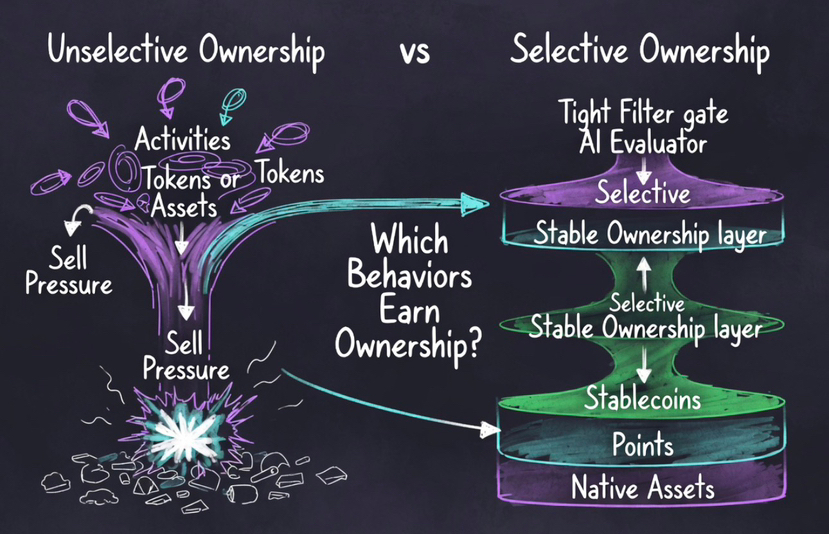
This is where most player-owned economies break.
They assume all activity should convert into value.
More grinding should mean more rewards.
More time should mean more ownership.
But that doesn’t scale.
If everything converts, the system pays out more than it can sustain. If nothing converts, players leave.
So the system has to do something uncomfortable.
It has to choose.
Which behaviors move forward.
Which ones stay contained.
Which ones never get connected to ownership at all.
That’s not a design problem.
That’s an allocation problem.
Stacked turns that allocation into something measurable.
This is where the “return on reward spend” idea becomes real.
Instead of asking how many players completed a mission, the system asks what that mission actually produced.
Did it bring the player back?
Did it push them into deeper loops?
Did it lead to real spending or meaningful interaction?
If not, the system adjusts.
That feedback loop changes how ownership behaves.
Because now, ownership is not just something players receive.
It’s something the system decides to extend based on behavior that sustains the economy.
This is also why the rollout is controlled.
If you’re building a system that filters behavior this tightly, scaling too fast destroys your signal.
You get more activity, but you lose clarity.
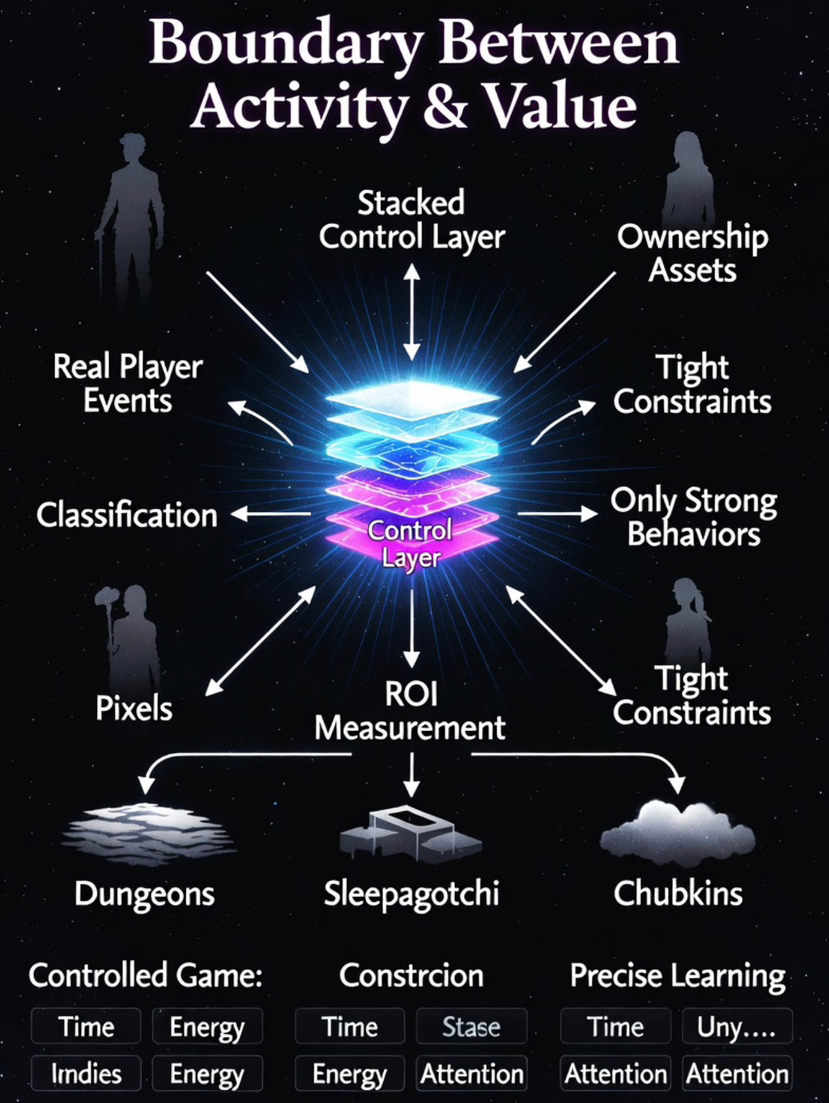
Starting with Pixels, Pixel Dungeons, Sleepagotchi, and Chubkins gives the system a controlled environment.
The team already understands these loops.
They know where players drop off.
They know where bots extract value.
They know which behaviors look active but don’t last.
So every experiment inside this environment produces something usable.
Not just data but direction.
The reward mix plays into this in a way that’s easy to miss.
Most systems try to push everything through one token.
That token becomes reward, liquidity, speculation, and alignment at the same time.
That creates pressure from every side.
Increase rewards, and you create sell pressure.
Reduce them, and engagement drops.
You end up balancing one asset against itself.
Stacked breaks that apart.
Different reward types carry different meanings.
Stable assets represent immediate value.
Native tokens tie into the ecosystem.
Points let the system test behavior without creating external pressure.
That separation gives the system more precision.
It can reward behavior without forcing every payout into the same economic outcome.
When you connect all of this back to ownership, the picture changes.
Ownership isn’t the starting point anymore.
It’s the result of a system that decided a certain behavior was worth carrying forward.
That’s a very different model.
Because now, ownership is not guaranteed.
It’s conditional.
And that’s where the system becomes more stable.
Not because it restricts players.
But because it stops pretending that all activity should become value.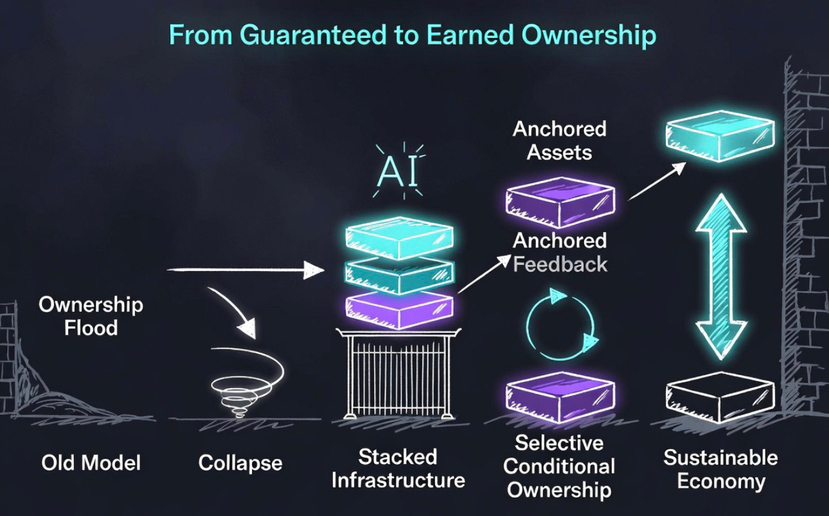
It accepts that most of what happens inside a game can’t be rewarded at the same level.
Some of it has to stay contained.
Some of it has to be filtered out.
Otherwise, the system collapses under its own incentives.
That’s why I keep coming back to the same idea.
Player-owned economies don’t fail because players own too much.
They fail because the system doesn’t know what should be allowed to become owned.
Stacked sits exactly in that gap.
It’s not trying to increase rewards.
It’s trying to decide where rewards and by extension, ownership are actually justified.
If you step back, the shift becomes clearer.
The conversation moves from:
how do we give players ownership?
to something more precise:
which behaviors are strong enough to carry ownership without breaking the system?
That’s less exciting on the surface.
But it’s the only version that survives.
So when I look at Pixels now, I don’t see a game experimenting with player ownership.
I see a system trying to define the boundary between activity and value.
And once that boundary exists, ownership stops being a feature.
It becomes something that has to earn its place inside the economy.