
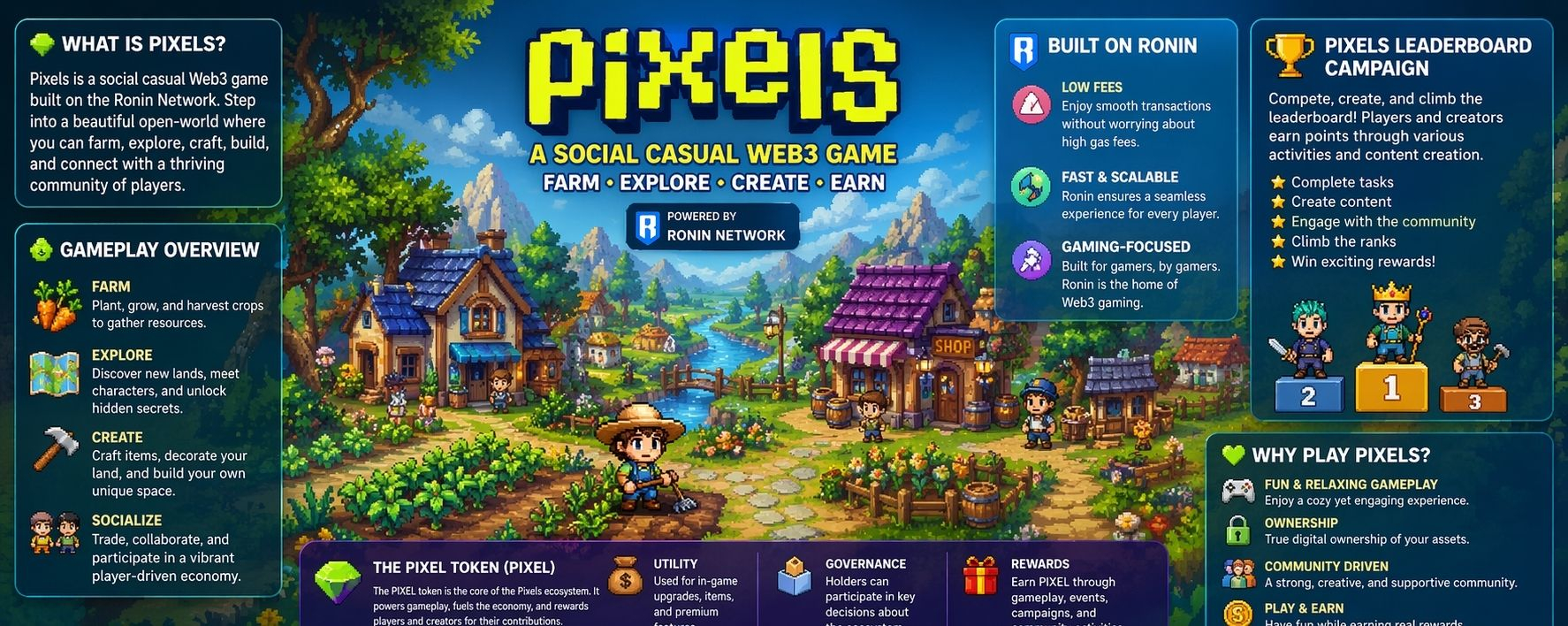
Pixels is a social casual Web3 game built on the Ronin Network, but calling it only a “Web3 game” doesn’t really capture what makes it interesting. At its heart, Pixels is about farming, exploring, creating, collecting, and slowly shaping your own place inside a digital world. It has the familiar comfort of a farming game, but underneath that calm surface, it carries the energy of blockchain ownership, community participation, and a growing token-based economy.
And that mix is exactly why the project has caught attention.
A lot of Web3 games feel like they were designed backwards. First comes the token. Then the marketplace. Then the earning system. Then, somewhere near the end, the actual game appears. Pixels feels different because it starts with something people already understand. You enter a world. You do things. You collect resources. You improve. You come back.
That may sound simple, but simple is not a weakness here. In fact, it might be the project’s biggest strength.
Pixels doesn’t need to overwhelm new players with technical language right away. You don’t have to understand every detail of blockchain gaming to understand the basic feeling of planting, harvesting, crafting, and progressing. The game uses a familiar rhythm, and that makes the Web3 layer easier to accept. Instead of feeling like a crypto product wearing a game costume, Pixels feels more like a game that happens to have crypto running beneath it.
That difference matters.
The world of Pixels is built around steady progress. You start small, learn the systems, interact with the environment, and slowly become more involved. Farming gives the game its foundation, but the project is not only about crops or resources. It’s also about identity, ownership, community, and participation.
The Ronin Network plays a major role in that story.
Ronin is already known for blockchain gaming, especially because of its connection to Axie Infinity. That means Pixels is not trying to grow inside a random blockchain environment where nobody understands gaming. It sits inside an ecosystem where players are already familiar with wallets, tokens, NFTs, digital assets, and reward-based economies.
For Pixels, that gives the project a useful starting point.
It’s like opening a shop in a neighborhood where people already enjoy the kind of product you’re selling. You still have to be good. You still have to earn trust. But at least the audience understands the idea.
At the same time, Ronin also raises the standard. Players in that ecosystem have seen the highs and lows of Web3 gaming. They know hype can be exciting, but they also know hype can disappear quickly. So Pixels has to prove that it is more than a temporary campaign or another token-driven game.
And honestly, that’s the real test.
The farming and exploration side gives Pixels its personality. The Web3 side gives it a wider economic structure. But the project only works if both sides support each other. If the game is fun but the economy feels pointless, the token becomes weak. If the economy is attractive but the game feels boring, players may only stay as long as rewards are available.
Pixels has to live in the space between those two things.
That’s not easy.
The PIXEL token gives the ecosystem a financial and utility layer. It connects to features, rewards, upgrades, memberships, and other parts of the project. But the token should not become the whole reason people care. That’s a trap many Web3 games have fallen into. When users only come to extract value, the game starts to feel less like a world and more like a machine.
Pixels seems strongest when the token feels like an extension of the experience, not a replacement for it.
A player should be able to enjoy the world first. The rewards should add excitement. The ownership should add meaning. The economy should create depth. But the project should never lose the simple feeling that made people enter in the first place.
That feeling is progress.
You do something today, and tomorrow the world looks slightly different because of it. That is a very human kind of satisfaction. It’s why farming games have always worked. They give players small promises and then keep them. Plant this, and it grows. Collect this, and you can build. Spend time here, and your place in the world improves.
In real life, effort doesn’t always feel that clear. You can work hard and still feel stuck. You can spend days doing things that don’t show immediate results. But in games like Pixels, progress becomes visible. It’s simple, maybe even a little comforting.
That’s why the project has emotional appeal beyond just rewards.
The social side is also important. Pixels is not meant to feel like a lonely farm hidden away from everyone else. It is a shared world where players interact, learn, compete, and build a community. This matters because Web3 projects live or die by community energy.
A token can bring attention, but a community brings life.
When players talk about strategies, share progress, create guides, join events, or help newcomers understand the ecosystem, the project becomes more than software. It becomes a place people recognize. Names become familiar. Routines form. Inside jokes appear. People start checking updates not only because they want rewards, but because they feel connected.
That is hard to fake.
And it’s also easy to damage.
If the project becomes too focused on rewards, the community can start to feel transactional. If campaigns encourage low-quality content or spam, the conversation around the game becomes noisy. If the economy becomes confusing or unfair, players lose trust. Pixels has to protect the human side of the project carefully, because that is where long-term loyalty comes from.
The Leaderboard Campaign fits into this bigger picture as a way to activate attention.
A leaderboard gives people a visible reason to participate. It turns ordinary activity into a race. Players and creators can see where they stand, push harder, compare progress, and stay engaged. That kind of competition can create real momentum for a project.
But the campaign should be seen as a doorway, not the whole house.
The best outcome is not just that people join for rewards. The best outcome is that they discover the Pixels ecosystem, understand the game, enjoy the community, and decide to stay after the campaign is over. That is the difference between short-term attention and real growth.
Many Web3 projects are good at attracting crowds. Fewer are good at keeping them.
Pixels has a better chance than many because it has a real game structure underneath the campaign. The project is not only asking people to trade or post. It is inviting them into a world with tasks, progression, creativity, and social interaction.
Still, the risk is there.
Campaigns can bring farmers, bots, and low-effort participants. That happens in almost every crypto ecosystem. Some users will only care about ranking, earning, and leaving. That doesn’t automatically ruin a project, but it does mean Pixels has to design its incentives carefully.
Good incentives reward real participation. Bad incentives reward noise.
For a project like Pixels, quality matters more than volume. A thousand thoughtful players and creators can be more valuable than ten thousand people posting the same empty message. The strength of the ecosystem depends on whether people are actually learning, playing, creating, and contributing.
This is where creators become important.
Pixels is easy to talk about because it has a clear identity. It is a Web3 farming game. It is built on Ronin. It has the PIXEL token. It has social gameplay. It has campaigns. It has a world people can visually understand.
That gives creators something real to explain.
They can create beginner guides, opinion pieces, gameplay breakdowns, token explainers, campaign tutorials, strategy posts, and honest reviews. Good content helps new users enter without feeling lost. It also gives the project more visibility without relying only on official announcements.
In Web3, people often trust community explanations more than polished marketing. A real player sharing what they learned can feel more convincing than a perfect promotional post.
That’s another reason Pixels has potential. The project gives the community enough material to talk about. It isn’t just a ticker symbol. It has a world, a style, a purpose, and a set of activities people can describe in plain language.
That plain-language quality is valuable.
Because let’s be honest, crypto can become exhausting. Too many projects hide behind complicated words. Too many communities act as if confusion is a sign of intelligence. Pixels works better when it stays understandable. Farming, building, exploring, earning, owning, competing — these are concepts people can grasp quickly.
The more natural the experience feels, the stronger the project becomes.
The real promise of Pixels is not only that players can earn. Earning may attract attention, but it cannot carry the whole experience forever. The deeper promise is that players can belong to a digital world where their time, effort, and identity feel meaningful.
That is where Web3 gaming becomes interesting.
Ownership is often discussed in technical terms, but emotionally it is very simple. People like to feel that what they build is theirs. In traditional games, players already say “my farm,” “my character,” or “my items,” even though everything is controlled by the game company. Web3 tries to make that feeling more concrete by connecting parts of the experience to blockchain assets and tokens.
Pixels fits that idea naturally because farming games are already personal.
A farm is not just a menu. It becomes a reflection of time spent. Every upgrade, every collected resource, every completed task adds to the feeling that this little digital place belongs to you in some way. When blockchain ownership is added carefully, it can strengthen that feeling instead of interrupting it.
But again, carefully is the key word.
If Web3 mechanics become too loud, they can break the charm. Nobody wants a relaxing farming game to feel like a financial spreadsheet all the time. Pixels has to keep the balance between economy and atmosphere. The crypto layer should feel useful, not heavy.
That may be the biggest challenge for the project moving forward.
Pixels has to keep improving as a game, not just as a token ecosystem. It needs fresh content, smoother onboarding, fair rewards, strong communication, and reasons for players to return when no campaign is pushing them. The world has to feel alive.
A project cannot survive on first impressions forever.
The good news is that Pixels has a foundation many Web3 games would envy. It has a simple concept, a recognizable style, a gaming-focused blockchain network, a token with ecosystem utility, and an active community. Those pieces do not guarantee success, but they give the project room to grow.
What makes Pixels especially interesting is that it does not feel like it is trying to impress only crypto insiders. It has the shape of something broader. A casual player can understand it. A Web3 user can analyze it. A creator can explain it. A community member can build around it.
That flexibility is important.
The strongest projects are often the ones that different people can approach from different angles. Some may come for farming. Some may come for rewards. Some may come for Ronin. Some may come for content creation. Some may simply be curious.
The job of Pixels is to give all of them a reason to stay.
That is easier said than done, of course. The Web3 gaming market is crowded, impatient, and brutally sensitive to hype cycles. A project can be celebrated one month and forgotten the next. Players have endless options, and crypto users move fast when rewards dry up.
So Pixels needs more than attention. It needs trust.
Trust comes from consistent updates. It comes from fair systems. It comes from listening to the community. It comes from making the game better even when the market is quiet. It comes from proving that the project is not only alive during campaigns.
If Pixels can do that, it can become more than a successful Web3 farming game. It can become an example of how casual gaming and blockchain can work together without making the experience feel forced.
That would be a meaningful achievement.
Because Web3 gaming does not need more projects that talk big and vanish. It needs games that people actually want to open, understand, and return to. It needs worlds that feel human, not just economic. It needs communities that are built on more than reward farming.
Pixels is not perfect, and it doesn’t need to be. What matters is that it has a clear direction. It understands the appeal of simple progress. It gives players something to do. It gives creators something to talk about. It gives the community a place to gather. And through the PIXEL token and Ronin Network, it connects that activity to a wider Web3 economy.
The Leaderboard Campaign may bring new attention, but the project itself is the real story.
A campaign can start the conversation.
A reward pool can bring people in.
A leaderboard can create excitement.
But the world of Pixels has to do the lasting work.
And maybe that’s the most honest way to look at it. Pixels is not just about earning from a game. It’s about whether a digital world can make effort feel meaningful, ownership feel natural, and community feel real.
That is why the project is worth watching.
Not because it promises to change everything overnight, but because it’s building something in a way people can actually understand. A small farm. A growing world. A community with energy. A token with purpose. A game that doesn’t need to shout to be noticed.
Sometimes, that’s enough to start something bigger.