
@Pixels When I first stepped into Pixels, I approached it with the same mindset I’ve used in almost every GameFi project. I was looking for efficiency, trying to understand the fastest loops, the most optimized paths, and the best way to extract value before the usual cycle slows down. On the surface, everything seemed familiar — farming, crafting, trading, upgrading — the kind of structure that usually becomes predictable once you spend enough time with it. But after a while, something didn’t feel right in a way that was hard to explain. The strategies I thought were optimal didn’t keep producing consistent results, and instead of the system feeling broken or random, it felt like it was quietly shifting around me.
That subtle shift is what changed my entire perspective. In most GameFi ecosystems, once you find an edge, you can rely on it. Repetition becomes your advantage, and the system rewards consistency in a very linear way. But in Pixels, repetition didn’t hold the same power. I started noticing that certain actions would slowly lose their value over time, while others — often requiring more awareness or better timing — began to gain importance. There were no obvious announcements or clear indicators explaining these changes, but the difference was real enough to feel. It was as if the system wasn’t just rewarding what I was doing, but evaluating how my behavior fit into the larger ecosystem.
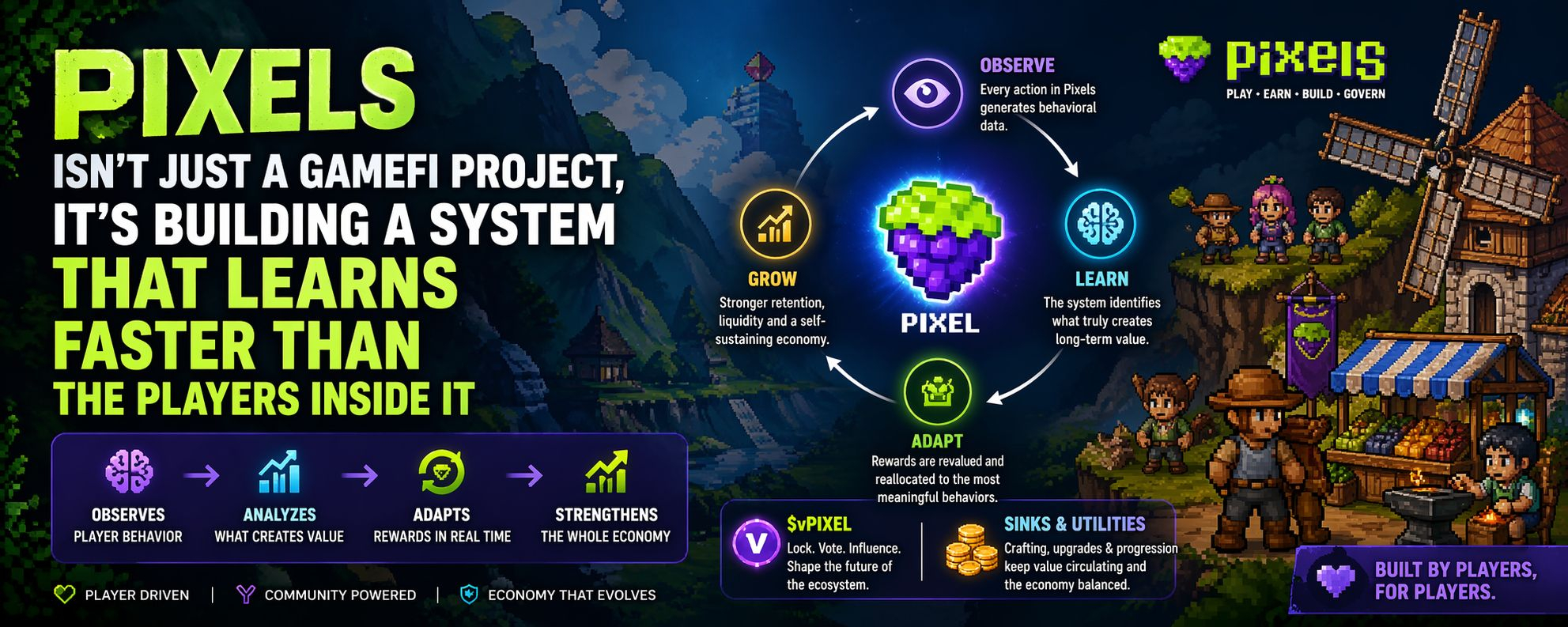
The more I paid attention, the more it started to feel like Pixels wasn’t running on a fixed reward model at all. Instead, it seemed to be continuously re-evaluating where rewards actually mattered. Rather than treating incentives as a simple distribution mechanism, the system appeared to be allocating them with purpose, gradually shifting value toward behaviors that contributed to retention, liquidity, and overall activity within the economy. That creates a completely different dynamic, because it moves the focus away from pure activity and toward meaningful contribution. It’s no longer about how much you do, but how relevant your actions are within the system’s evolving structure.
This realization changed how I approached the game. I stopped trying to maximize output through repetition and started focusing on understanding the environment itself. Instead of asking what works best right now, I began asking why certain actions were becoming more valuable over time. That shift in thinking made the experience feel less mechanical and more strategic. It forced me to stay aware, to adapt, and to pay attention to the direction the system was moving in rather than relying on static patterns. In a space where most systems reward predictability, that kind of uncertainty actually made the experience more engaging.
The introduction of $vPIXEL added another layer that reinforced this idea. Locking tokens didn’t feel like a passive decision anymore; it felt like stepping into a role where I had some influence over how rewards are distributed across the ecosystem. It created a sense that participation wasn’t limited to gameplay alone, but extended into the structure of the economy itself. At the same time, in-game sinks such as crafting costs, upgrades, and progression requirements began to make more sense. Initially, they felt like limitations, but over time, they revealed themselves as necessary mechanisms that keep value circulating within the system rather than constantly flowing outward.
What stood out even more was how the player base itself began to evolve. Instead of a constant cycle of users entering for rewards and leaving when incentives cooled down, I started seeing players adapt to the system in deeper ways. People were specializing, focusing on specific roles, and organizing into more coordinated groups. Guilds became more than just social features; they turned into strategic units that contributed to the overall economy. Creators began building around the ecosystem, adding layers of engagement that didn’t rely on external promotion. Growth didn’t feel forced or artificially driven — it felt like it was emerging naturally from within the system itself.
Of course, none of this removes the fundamental risks that come with any token-based ecosystem. $PIXEL still operates within a broader market where supply, unlocks, and demand have a significant impact. If the system misinterprets what constitutes valuable behavior, or if rewards expand faster than the ecosystem can sustain, the balance can easily break. These are challenges that every GameFi project faces, and Pixels is not immune to them. The difference, however, lies in how the system appears to respond to these risks. Instead of remaining static, it seems to be constantly adjusting, trying to refine how value is distributed before problems become too large to manage.
That ongoing adjustment is what makes Pixels feel fundamentally different. It doesn’t behave like a fixed economy where outcomes can be predicted with enough optimization. Instead, it feels like a system that is gradually learning from the behavior of its players and using that information to reshape itself. Over time, this creates a feedback loop where rewards influence behavior, behavior generates data, and that data feeds back into how rewards are allocated. As this loop strengthens, the system becomes more refined, and the distribution of value starts to feel less random and more intentional.
I came into Pixels expecting to find innovation in mechanics, but what I found was something far more difficult to build — a system that doesn’t just reward participation, but actively learns from it. And if that learning process continues to improve, then the role of the token itself begins to change. Instead of leading the system, it starts reflecting what the system has already optimized. At that point, success is no longer just about playing efficiently; it’s about understanding how the system is evolving and positioning yourself within that evolution.
In the end, Pixels doesn’t feel like a game I’m trying to solve. It feels like a system I’m trying to understand. And that difference, subtle as it may seem, is what makes it far more complex — and far more interesting — than anything I initially expected.
NFA — DYOR
