
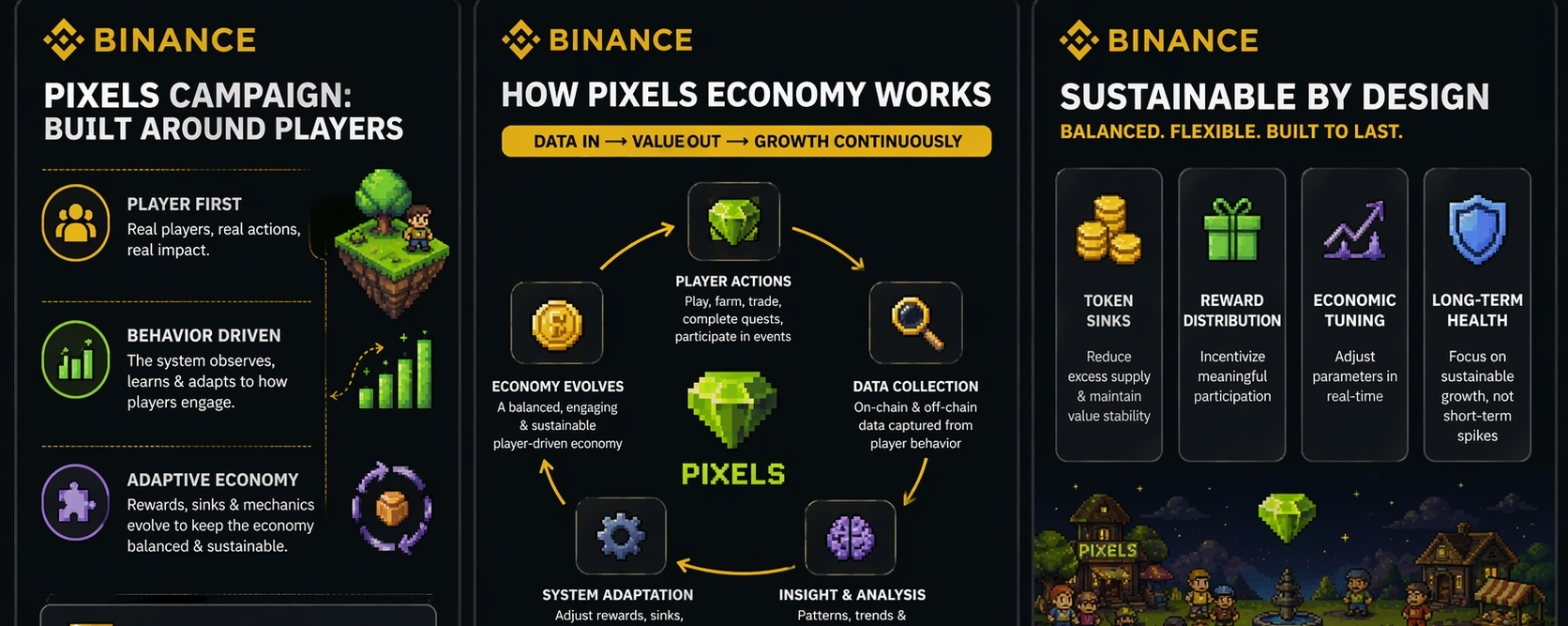
At first glance, Pixels looks like a simple free-to-play farming game.👀
You log in, complete tasks, craft items, and slowly progress through the system.
There’s no strong pressure to invest, no complicated onboarding, and everything feels designed for easy participation — especially for small users.
But after spending some time in the ecosystem, it starts to feel like there’s more happening beneath the surface.
A Different Kind of Player Retention
In many GameFi projects, user activity follows a predictable pattern.
When rewards are high, participation increases. When incentives slow down, users gradually leave.
However, Pixels shows a slightly different trend.
Even without aggressive hype or strong price movement, players continue to stay active. They keep logging in, exploring the game, and adjusting their strategies over time.
This suggests that engagement is not driven only by rewards, but also by how the system is structured.
Reward Distribution That Feels More Intentional
One interesting aspect of Pixels is how rewards are distributed.
Instead of simply rewarding basic activity, the system appears to favor actions that contribute more meaningfully to the ecosystem — such as participation in trading, crafting, land usage, or community interaction.
This creates a more balanced environment where:
Active participation is encouraged
Useful contributions are recognized
Long-term engagement becomes more valuable
It doesn’t feel completely random or overly inflated.
As players interact with the system, they indirectly influence how value flows within it.
The Role of $PIXEL in the Ecosystem
The $PIXEL token plays a central role in connecting gameplay with economic value.
It is used across multiple layers, including:
In-game transactions
Progression systems
Access to certain features
Participation in governance-related mechanics
While it still follows general market conditions like any other token, its utility inside the game adds an extra layer of purpose.
Additional Layer with Pixel
The introduction of PIXEL adds another dimension to the ecosystem.
Through staking mechanisms, users can take a more active role in how rewards and incentives are structured.
This shifts users from being passive participants to more engaged contributors within the system.
At the same time, in-game sinks like crafting costs, upgrades, and other resource requirements help maintain balance by reducing excessive token outflow.
Growth Beyond Just Marketing
Another notable aspect is how the ecosystem grows.
Instead of relying only on external promotion, Pixels benefits from internal activity:
Players forming guilds
Users specializing in different roles
Community-driven interactions
This kind of organic growth can be more sustainable over time, as it is supported by actual user engagement rather than short-term attention.
A Balanced Perspective
It’s important to note that Pixels is still part of the broader GameFi space.
This means it is not free from common challenges such as:
Token supply pressure
Market volatility
Changing user interest
However, its structure suggests an attempt to improve how in-game economies function, especially in terms of engagement and reward efficiency.
Final Thoughts
Pixels may look simple at the beginning, but its ecosystem reflects a more thoughtful design approach.
By combining accessible gameplay with layered economic mechanics, it creates an experience that appeals to both new users and more experienced participants.
Rather than focusing only on short-term incentives, it seems to emphasize steady engagement and meaningful participation.
