

Pixels has a quiet kind of strength, but I do not say that lightly. I have watched too many crypto projects dress up weakness as patience, recycle the same promises, and call every quiet period accumulation. Most of the time, silence is just silence. Sometimes it is worse. Sometimes it is the sound of users leaving without making a scene.
But Pixels is not something I would throw into the dead pile too quickly.
Not yet.
The project still has a pulse, and that matters more than people think. It is not the loud kind of pulse that shows up in hype posts, green candles, or sudden waves of attention. It is slower than that. More annoying to measure. You have to look at behavior, not slogans. You have to watch who keeps showing up when the market is tired, when rewards are less exciting, when the easy crowd has moved on to the next shiny thing.
That is where Pixels gets interesting.
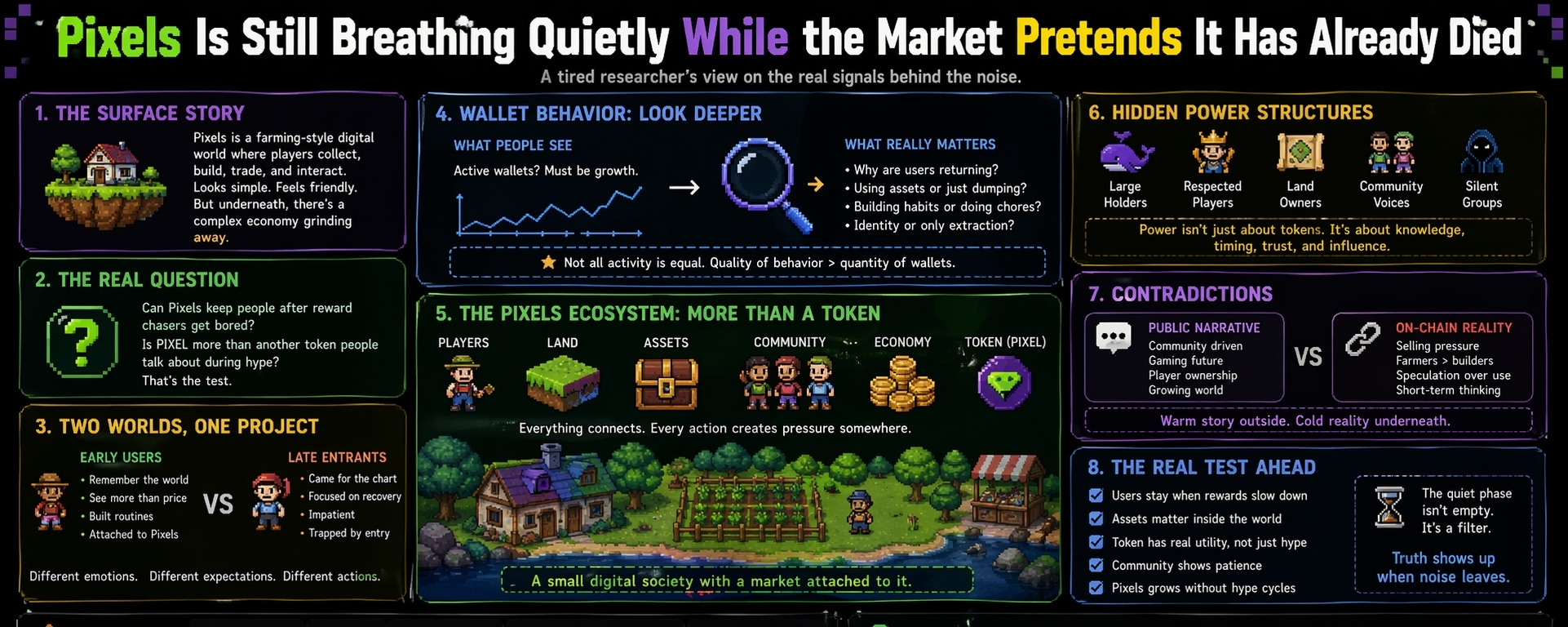
On the surface, Pixels looks simple enough. A farming-style digital world. Players move around, collect, build, trade, earn, and interact. It has that soft visual layer that makes people underestimate what is actually happening underneath. But underneath the cute design, there is an economy grinding away. People are making decisions. Wallets are moving. Assets are being held, sold, used, ignored, or quietly stacked. That is where the real story sits.
I do not care much for the clean version of the story.
The clean version says Pixels is a community-driven crypto gaming project with players, ownership, and a growing world. Fine. That is the brochure.
The rough version is more useful. Pixels is a test of whether a crypto game can keep people after the reward-chasers get bored. It is a test of whether users are actually attached to the world, or whether they are only there because there might be something to extract. It is a test of whether PIXEL can become more than another token people talk about when the chart wakes up.
That is the part I keep coming back to.
Because I have seen this pattern before. A project launches with energy. The crowd arrives. Everyone suddenly has conviction. The same people who could not explain the product yesterday are writing threads about long-term vision today. Then price cools. Rewards slow. Announcements stop landing. The room gets quieter. The believers remain, or at least some of them do. The tourists leave first. Then the disappointed holders start recycling the same complaints. Then the project either finds a real base or slowly becomes a ghost with branding.
Pixels is somewhere in that uncomfortable middle.
And honestly, that is the only place worth studying.
The easy phase is gone. That part is clear. Pixels is no longer riding the clean excitement that comes with being new, fresh, and misunderstood. Now it has friction. The community has memory. Some people are tired. Some are underwater. Some still believe, but with less noise than before. And some are only waiting for a decent exit so they can stop pretending they care about gameplay.
That sounds harsh, but it is normal.
Every crypto project eventually separates into emotional classes. Pixels is no different.
There are early users who remember the project before the token became the main conversation. They see more than price. They remember the world, the social layer, the land, the habits, the small routines that made the thing feel alive. For them, Pixels is not just a ticker. It is a place they spent time in.
Then there are the late entrants. Different mood entirely. They came in when the story was already easier to sell. Maybe they bought because the project had attention. Maybe they thought gaming was coming back. Maybe they believed the chart had more room. Now they are not reading the ecosystem the same way. They are reading their loss.
That changes everything.
A quiet week feels different when you are early and patient.
It feels brutal when you are late and trapped.
So when Pixels goes quiet, one group sees breathing room. Another sees neglect. One group asks what the project is building. The other asks why price has not moved. One group still talks about the game. The other keeps checking whether the token can recover.
Both groups are real. Both affect the market.
I pay attention to that split because markets do not move on data alone. They move on fatigue. They move on resentment. They move on people finally giving up. And sometimes, after enough of that exhaustion gets flushed out, the project becomes cleaner to watch.
Not safer.
Cleaner.
There is a difference.
Wallet behavior matters here, but only if you stop treating wallet activity like some holy number. I have no patience left for people pointing at active wallets as if that alone proves demand. A wallet can mean a loyal player. It can mean a farmer. It can mean a bot. It can mean someone clicking through tasks because the reward still beats doing nothing. It can mean one person spread across too many accounts. Crypto gaming metrics are messy. Always have been.
So I look for quality of behavior.
Are people coming back because they care about Pixels, or because the reward system still gives them something to squeeze?
Are assets being used inside the world, or are they just waiting to be dumped?
Are players forming habits, or are they completing chores?
Is there identity here, or only extraction?
Those questions are ugly, but they are necessary.
Because if Pixels is only a reward machine with better art, then the long-term problem is obvious. Users come in, drain value, sell into the market, and leave behind more supply than belief. That model can look alive for a while. It can even look active. But it has no soul and usually no floor.
A real game economy needs stickiness. Not the fake kind people mention in pitch decks. Actual stickiness. The kind where users return without needing to be bribed every time. The kind where land, assets, reputation, and routine start to matter. The kind where people feel like leaving means losing more than just a possible payout.
That is what I am watching for in Pixels.
And I am not fully convinced yet.
That is important to say.
Pixels has signs of life, yes. It has a recognizable world. It has a community that has already gone through some market grind. It has a name people still remember in crypto gaming. Those are useful things. But none of them automatically solve the harder issue. The hard issue is whether all that attention can turn into durable demand instead of temporary motion.
A project can be alive and still be a poor asset.
People forget that.
The game can have players. The community can have energy. The brand can be known. And the token can still bleed if the economic design keeps pushing value outward. That is the uncomfortable part with projects like Pixels. The public story is warm. Community, ownership, play, digital land, social activity. Nice words. But the market story is colder. Who earns? Who sells? Who absorbs? Who is left holding when rewards become pressure?
That is where the contradiction sits.
Pixels looks friendly from the outside, but the economy underneath is not friendly. No economy is. There are early movers, late buyers, land-focused players, quiet holders, sellers, social leaders, reward hunters, and people who understand the system far better than the casual crowd. They are not all equal, no matter how much community language tries to flatten everything.
Power inside Pixels is not only about token size either.
That is what makes it more complicated.
A large holder can affect price. Sure. But a respected player can affect mood. A landowner can understand production patterns better than someone who only watches the chart. A quiet group can position early while everyone else argues in public. A community voice can calm people down or push them toward panic without ever touching the market directly.
This is why I do not look at Pixels like a simple token.
It behaves more like a small digital society with a market attached to it.
And small societies always have hidden layers.
The loud version of the community is usually the least useful one. Everyone sounds brave when price is moving. Everyone says they are here for the long term when the market is rewarding them for saying it. The truth comes out when the chart is dull, the updates feel slow, and people are tired of pretending that every minor change is a major signal.
That is the phase Pixels is in now.
Less glamour. More grind.
That can be good. Or it can expose weakness.
I am looking for the moment this actually breaks. Not because I want it to fail, but because every project reaches a stress point where the story has to become real. Pixels has to prove that it is not only surviving on memory. It has to prove that users are still there for reasons stronger than rewards. It has to prove that the world itself has weight. It has to prove that PIXEL is not just floating above the game as a speculative layer people tolerate during hype and blame during downturns.
The real test, though, is not whether people talk about Pixels.
Talk is cheap. Crypto has an endless supply of it.
The test is whether people keep doing things when there is no applause.
Do they return?
Do they build?
Do they hold assets because they matter inside the world?
Do they care when nobody is watching?
Do they stop treating the project like a temporary job?
That last one matters more than most people admit. A lot of crypto games become labor markets wearing game skins. Players do tasks, collect rewards, optimize time, sell output, and move on when the rate is no longer worth the effort. There is nothing wrong with earning, but if earning is the only reason people stay, the project is always one reward adjustment away from losing its crowd.
Pixels has to avoid that trap.
Maybe it can.
Maybe it cannot.
I do not like pretending certainty where there is none.
What I do know is that the market has already become tired around projects like this. The gaming narrative has been recycled too many times. People were promised massive adoption, deep economies, player ownership, and all the usual phrases. A lot of those promises aged badly. So now every project in this category has to carry the weight of everyone else’s disappointment.
Pixels is carrying that weight too.
That is unfair in some ways, but markets are not fair. They are lazy, emotional, and usually late. If a sector burns people badly enough, even decent projects get treated like leftovers until they prove otherwise.
Pixels is not being judged in a clean room. It is being judged in a room full of exhausted traders who have seen too many gaming tokens fade after the first wave of excitement.
That is why the quiet period matters.
If Pixels was still surrounded by nonstop hype, I would trust it less. Noise makes everything harder to read. It attracts tourists. It creates fake conviction. It turns every update into content and every small feature into a forced bullish argument. When the noise fades, you can finally see what is left.
What is left with Pixels?
Some real users, from what I can tell.
Some tired holders.
Some people who still understand the game better than the market does.
Some pressure.
Some risk.
Some reason not to look away completely.
That is not a clean bullish case. It is not supposed to be.
The better question is whether the quiet base is strong enough to survive the next round of friction. More supply pressure. More boredom. More impatient holders. More comparison with whatever new project the market decides to chase next. Pixels does not need to win attention for one week. It needs to survive the grind long enough for its actual ecosystem to matter again.
And that is harder.
The name still has value. That helps. People remember Pixels. It is easy to understand. It has a world people can point to. It is not some abstract protocol with a whitepaper nobody reads. There is an actual environment, a social layer, a reason for people to form habits. That gives it something to work with.
But having something to work with is not the same as winning.
The project still has to turn recognition into retention. Retention into demand. Demand into a healthier economy. And it has to do that without leaning forever on hype cycles, because hype cycles are unreliable and usually cruel. They show up late, inflate expectations, and leave a mess behind.
Pixels should be watched during the boring parts.
That is where the truth leaks out.
Watch how people behave when rewards are not exciting. Watch whether assets keep moving with purpose. Watch whether the community becomes calmer or more desperate. Watch whether discussion returns to the actual project instead of only the price. Watch whether holders start acting less reactive. Watch whether new participants arrive quietly, before the noise comes back.
Those signals will not feel dramatic at first.
They never do.
By the time everyone agrees something has changed, the change is usually old.
That is why I keep watching Pixels from the side, not with blind belief, not with the easy optimism people sell when they want exit liquidity, but with the tired patience of someone who knows most projects fail slowly before anyone admits it.
Pixels is still here.
That is something.
Now the question is whether it is still here because people are attached to the world, or because the market has not finished letting go.