
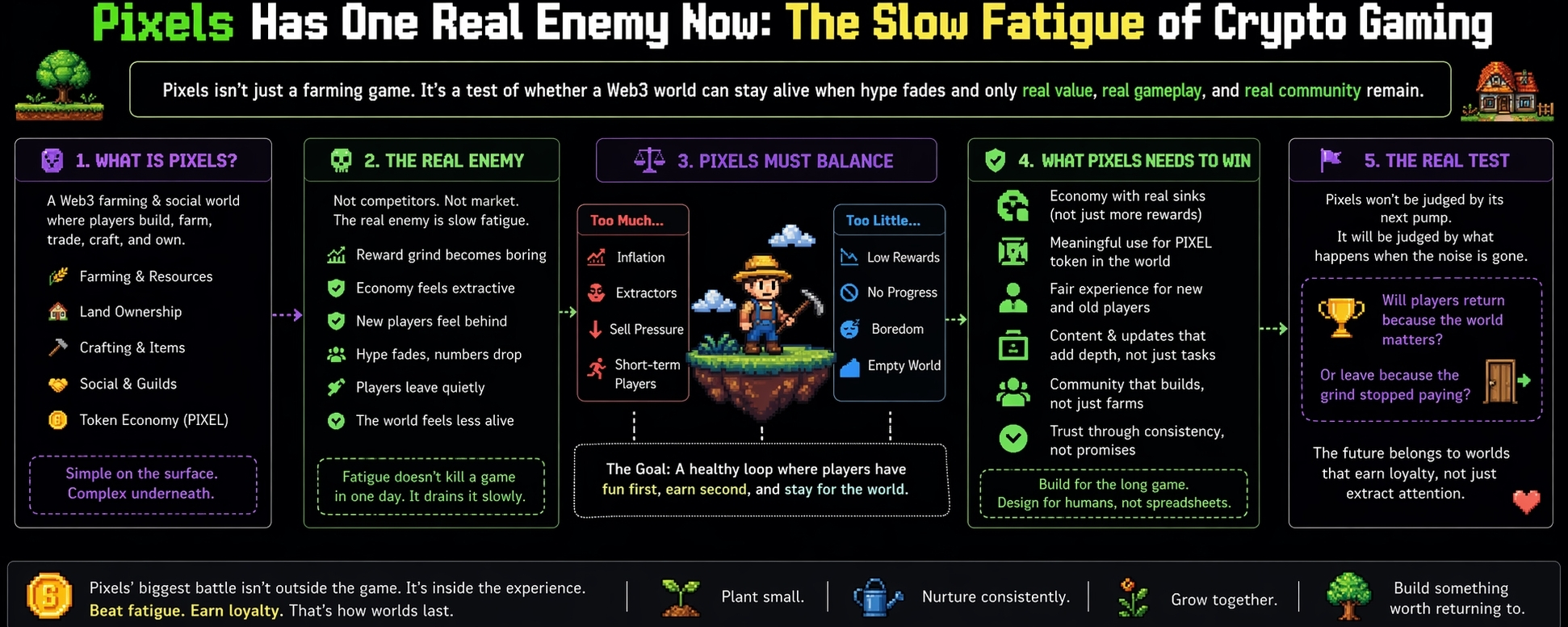
Pixels is one of those projects I don’t want to judge from the first screen. Thefarming looks simple, maybe even harmless, but I’ve seen enough crypto games to know the softest surface can hide the hardest math. What matters is not whether Pixels looks friendly. What matters is whether the project can survive its own economy after the noise wears off.
That is usually where things break.
Not at launch.
Not during the loud phase.
Not when everyone is posting screenshots and pretending the grind is fun because the rewards still feel worth chasing.
It breaks later, when the easy attention leaves and the project has to stand there without the market clapping for it.
Pixels is interesting because it sits right in that uncomfortable place now. It is not a brand-new idea floating on pure curiosity. It is not some untouched project with a clean story and unlimited belief around it. It has history. It has expectations. It has people watching the token. It has players who care about the game. It has others who only care about what they can pull out of it.
That mix is always messy.
I’ve seen this pattern too many times. A crypto game starts with energy. Then the reward loop becomes the whole identity. Players stop asking whether the game is good and start asking whether the output is worth the time. The community slowly changes tone. Less excitement. More calculation. More complaints. More people pretending they are “long-term” while watching the exit door.
Pixels has to avoid becoming that.
The project cannot just be a farming loop with a token attached to it. That is not enough anymore. Maybe it was enough in the earlier days of Web3 gaming, when everyone still wanted to believe that ownership alone could make a game feel alive. But that phase is tired now. Really tired.
People have been burned.
They remember the old promises. They remember the charts. They remember the reward systems that looked smart until the new users stopped arriving. They remember games that called every user a community member while quietly depending on those same users to absorb inflation.
So when I look at Pixels, I’m not asking, “Can this pump?”
That question is too small.
I’m asking whether Pixels can keep people inside its world when the reward is no longer doing all the talking.
That is the real test.
A project like Pixels has an advantage, at least on the surface. Farming makes sense. Routine makes sense. Coming back every day to collect, improve, craft, or move something forward is a natural habit. It does not need to be explained through ten layers of jargon. You do a small thing. You wait. You return. You do another small thing.
That part works.
Or it can work.
But here’s the thing: crypto has a way of ruining simple things by making every action feel financial. A crop stops being a crop. It becomes yield. A task stops being a task. It becomes efficiency. A player stops being a player. They become a wallet with habits.
That is where I start watching closely.
I’m looking for the moment Pixels either protects the game from the economy or lets the economy eat the game.
Because once the economy becomes louder than the world, the world gets smaller. The art still exists. The land still exists. The items still exist. But the player’s mind is somewhere else. They are calculating. They are comparing. They are checking whether the grind still pays.
And when the grind stops paying, they vanish.
Not all of them. But enough.
Pixels cannot build only for the people who vanish.
It needs players who return because the world still feels like it has weight. Not because every click is profitable. Not because some temporary campaign throws rewards at them. Not because the token chart gives them a reason to pretend they love farming.
Because the world itself feels worth entering.
That sounds simple. It is not.
Crypto game economies are nasty little machines. Every reward creates pressure somewhere. Every token given out eventually asks a question. Who absorbs this? Who wants this? Who needs this? Who is buying the thing that someone else is earning?
If the answer is always “new players,” the clock is already ticking.
Pixels needs better answers than that.
The project has to make PIXEL feel useful without making it feel forced. That line is thin. Too much token pressure and the game starts feeling like a toll road. Too little token use and the asset becomes decoration for traders. Somewhere in the middle is an actual economy, but most projects never reach it. They either overbuild the financial layer or pretend utility exists because a roadmap says so.
I’m not interested in roadmap language anymore.
I want to see behavior.
Do players spend because it makes sense?
Do they hold because there are real reasons inside the world?
Do landowners matter without making everyone else feel like background labor?
Do new users have a path that does not feel like showing up late to someone else’s party?
That last one matters more than people admit. A lot of Web3 games quietly become hostile to newcomers. The early users own the best assets, the best positions, the best knowledge, and the best earning routes. New players enter, look around, and feel the weight of being late.
Then the project calls it “ecosystem maturity.”
No. Sometimes it is just friction wearing a nicer shirt.
Pixels has to be careful there.
The name itself gives the project a useful metaphor, almost too obvious but still true. One pixel is nothing. A small dot. Easy to ignore. But enough of them together create the picture. Pixels the project works the same way. A crop, a task, an item, a piece of land, a player action, a small upgrade. None of it looks dramatic alone.
That is probably good.
Crypto already has enough drama.
What Pixels needs is not more noise. It needs the boring stuff done well. Balance. Clarity. Fair reward pacing. Less unnecessary friction. Better reasons to return. A world that does not feel like it was designed only for people who joined early or people who treat every mechanic like an extraction route.
The boring stuff is where projects survive.
Funny how that works.
The loud things get attention, but the boring things keep the lights on.
I don’t care much for polished claims about community either. Every project has a community until the chart bleeds long enough. Then you find out who was actually there for the world and who was only renting conviction.
Pixels is already past the stage where empty excitement is enough. That may be uncomfortable, but it is healthier. The project has to earn belief now. Slowly. Through updates that actually improve the experience. Through economic decisions that do not insult the player. Through communication that does not sound like it was washed through five marketing filters.
Players can smell that now.
They know when a project is dressing up weakness as patience. They know when rewards are being adjusted because something is wrong but nobody wants to say it directly. They know when “long-term sustainability” means “we paid out too much and now we need to slow the bleeding.”
The tired users are often the smartest ones.
They have seen the recycling.
Same promises. Same diagrams. Same soft words about ownership and future utility. Same sudden silence when numbers stop looking good.
Pixels cannot afford to become part of that pile.
The better path is quieter. Less pretending. More discipline.
I would rather see Pixels move slowly and protect the world than chase temporary excitement and damage the economy. I would rather see the project say no to easy reward inflation than buy two weeks of attention with three months of consequences. I would rather see a smaller, steadier player base than a huge wave of extractors who leave the moment the math changes.
That is not romantic. It is just survival.
And survival is underrated in crypto gaming.
The farming rhythm helps here if Pixels uses it properly. Farming is not supposed to feel like a slot machine. It is supposed to feel like patience. You plant, wait, return, adjust, improve. The emotional hook is not speed. It is continuity.
That could be Pixels’ strongest identity.
Not hype.
Continuity.
But continuity only works if the player believes the world will still matter tomorrow. If the game constantly shifts around reward pressure, if the economy feels unstable, if every update seems designed to patch yesterday’s imbalance, players stop relaxing into the routine. They start bracing.
Bracing is bad.
Nobody wants to live inside a game they have to financially defend themselves from.
I keep coming back to the same concern: can Pixels make ownership feel meaningful without making the whole experience feel heavy?
That is where many projects fail. They confuse ownership with obligation. They give users assets, then slowly make those assets feel like work. Land becomes responsibility. Items become calculations. Tokens become anxiety. The player is no longer playing. They are managing exposure.
Pixels has to resist that.
The game should feel light enough to enter and deep enough to stay. That is hard. Too light, and people drift away. Too heavy, and only the grinders remain. And grinders are useful, yes, but they are not enough to make a world feel alive.
A world needs casual players too.
It needs people who do not optimize everything.
It needs people who hang around, decorate, trade casually, join events, talk, experiment, waste time.
Waste time is important. Real games let people waste time and still feel satisfied. Crypto games often punish that because every action gets measured against possible return.
That mindset drains the soul out of a project.
Pixels will have to fight that drain constantly.
I’m not saying the project has failed. I’m saying this is the part where the easy language stops helping. Pixels has enough of a base to matter, but enough pressure to be tested. The token cannot carry the whole story. The farming loop cannot carry the whole story either. The economy, the world, the player path, the reward design, the land structure, the social layer — all of it has to hold together.
And it has to hold together while users are tired.
That is the part people forget.
This market is not fresh. The audience is not innocent. Crypto gaming is not walking into a room full of believers anymore. It is walking into a room full of people who have heard the pitch before and are already reaching for the door.
Pixels has to give them a reason not to leave.
Not a slogan.
A reason.
Maybe that reason is routine. Maybe it is ownership that feels useful without being exhausting. Maybe it is a social world that becomes sticky in small ways. Maybe it is better balance, cleaner systems, fewer empty promises, and a project team that understands that trust is built in boring increments.
I don’t know yet.
That is the honest answer.
I’m watching for the moment Pixels either becomes a real long-term game economy or slips into the same old reward-chasing loop dressed in friendlier colors.
The screen will not tell us first.
The loop will not tell us first.
The first sign will be quieter than that — in what players keep doing when the noise is gone.