
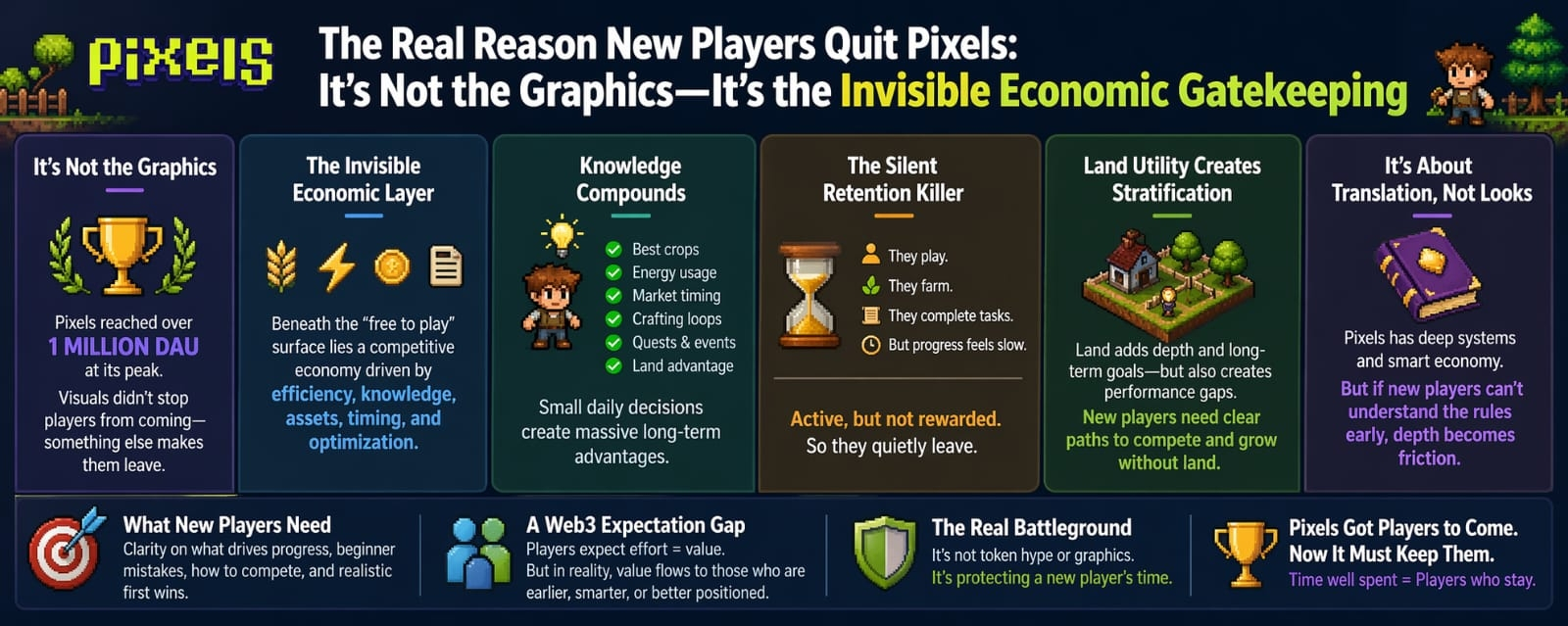
When I see people discuss why new players quit Pixels, the most common explanation is usually the simplest one: bad graphics, repetitive farming, or gameplay that looks too casual.
I think that misses the real story.
If visuals were the true problem, Pixels would never have reached the scale it did. At its peak, the game reportedly crossed 1 million daily active users, making it one of the most recognized names in Web3 gaming. That kind of traction doesn’t happen if players are instantly turned away by art style alone.
To me, the bigger issue is something less obvious and far more important:
Invisible economic gatekeeping.
Pixels is free to play on the surface. Anyone can jump in, start farming, complete tasks, and explore the world. But underneath that accessibility is a more competitive layer driven by efficiency, knowledge, asset access, timing, and optimized decision-making.
That hidden layer is where many new players quietly lose interest.
A new user entering Pixels today is not stepping into an empty game world. They are entering an economy that has already been studied, optimized, and mastered by early players.
Experienced users often understand:
Which crop rotations generate better returns
How to maximize energy usage
Which resources are overpriced or underpriced
The best crafting loops
How land ownership changes productivity
Which quests are worth doing first
When events temporarily shift market demand
A beginner usually knows none of this.
So they think they are joining a farming game, while in reality they are joining a functioning player economy.
That difference matters more than most people realize.
Many new players assume progress will come from effort. They believe that if they spend enough time playing, they will naturally move forward.
But in Pixels, effort without efficiency can feel punishing.
An experienced player with optimized routines can often create more progress in 30 minutes than a beginner creates in several hours of random play. That doesn’t always feel fair to the newcomer, even if the system itself is technically working as designed.
This creates one of the most dangerous retention problems any game can face:
The player feels active, but not rewarded.
They log in.
They farm.
They complete tasks.
They spend time.
Yet their visible progress feels slow.
Meanwhile, they watch other players move faster, earn more, or operate more efficiently. Many won’t complain publicly. They simply stop logging in.
That is how silent churn happens.
One of the most interesting systems inside Pixels is land utility. In theory, it adds depth, ownership, customization, and long-term goals. It gives committed players reasons to invest in the ecosystem.
But it also creates stratification.
Players with productive land, efficient layouts, better access points, or stronger infrastructure can often outperform players starting with nothing. Again, that does not mean the feature is bad. It means the beginner experience becomes harder if the game does not clearly explain how a non-land player can still compete and grow.
Most new players do not resent stronger users.
They resent not understanding the rules.
That distinction is important.
In many traditional games, the advantage gap is obvious. Better gear, higher level, stronger weapons. A beginner can see why they are losing.
In Pixels, the advantage gap is often informational.
The strongest currency can be knowledge.
Knowing what to plant today.
Knowing what to sell now.
Knowing what to hold.
Knowing which task wastes time.
Knowing where bottlenecks are forming.
Knowing how event incentives affect pricing.
Each decision looks small on its own.
But over days and weeks, those small decisions compound into major differences in progress.
This is why some players describe Pixels as “slow at first, rewarding later.”
To me, that usually means the game rewards understanding more than raw effort.
That model can work but only if onboarding is strong enough to bridge the gap.
The challenge becomes even bigger because Pixels exists in Web3.
Players entering Web3 games often carry very different expectations than players entering traditional games. They hear about tokens, rewards, ownership, and earning opportunities. Naturally, many assume that effort will directly translate into value.
So when they discover that value often flows to players who are earlier, smarter, more efficient, or better positioned, frustration arrives quickly.
This is not greed.
It is expectation mismatch.
And expectation mismatch is one of the fastest ways to lose new users.
Pixels is not unique here. Almost every economy-driven multiplayer game faces the same cycle.
The first wave learns through discovery.
The second wave learns through guides.
The third wave enters a solved meta.
By that stage, margins are lower, competition is sharper, and experimentation is less rewarding.
That means onboarding quality becomes one of the most important growth levers in the entire product.
If I were evaluating Pixels purely from a retention perspective, I would focus less on graphics upgrades and more on economic clarity.
New players need to understand quickly:
What actually drives progress
Which beginner mistakes waste time
How free players can compete
Which loops suit casual users vs optimized users
How to create momentum early
Where realistic first wins come from
Those answers matter more than prettier trees or smoother animations.
Many critics say Pixels needs better graphics.
My view is different.
Pixels needs better translation.
Its systems are deeper than they first appear.
Its economy is smarter than many assume.
Its progression can be more strategic than casual observers realize.
But if new users cannot see that depth early, then depth turns into friction.
And friction destroys retention faster than visuals ever will.
Despite all of this, Pixels still deserves respect.
Very few Web3 games ever reached mainstream-level activity. Fewer still created daily habits strong enough to attract over 1 million DAU at scale. That proves Pixels solved something many projects never did:
It got people to come back.
Now the harder phase begins.
Keeping them.
Long-term success from here likely depends less on token excitement and more on how well the game protects a new player’s time.
That is the real battleground.
I don’t believe new players quit Pixels because it looks simple.
I believe many quit because the economy is more complex than it first appears and the game does not always make that complexity understandable soon enough.
When players feel their time has value, they stay.
When they feel locked out by invisible systems, they leave.
That is the real reason worth paying attention to.
