The economic engine of any enduring virtual world relies on the management of scarcity. In titles like World of Warcraft or RuneScape, the controlled flow of high-value resources dictates the pace of progression and the health of the internal market. Pixels has recently applied this logic to its most fundamental infrastructure by officially freezing the minting of new land NFTs for the foreseeable future.
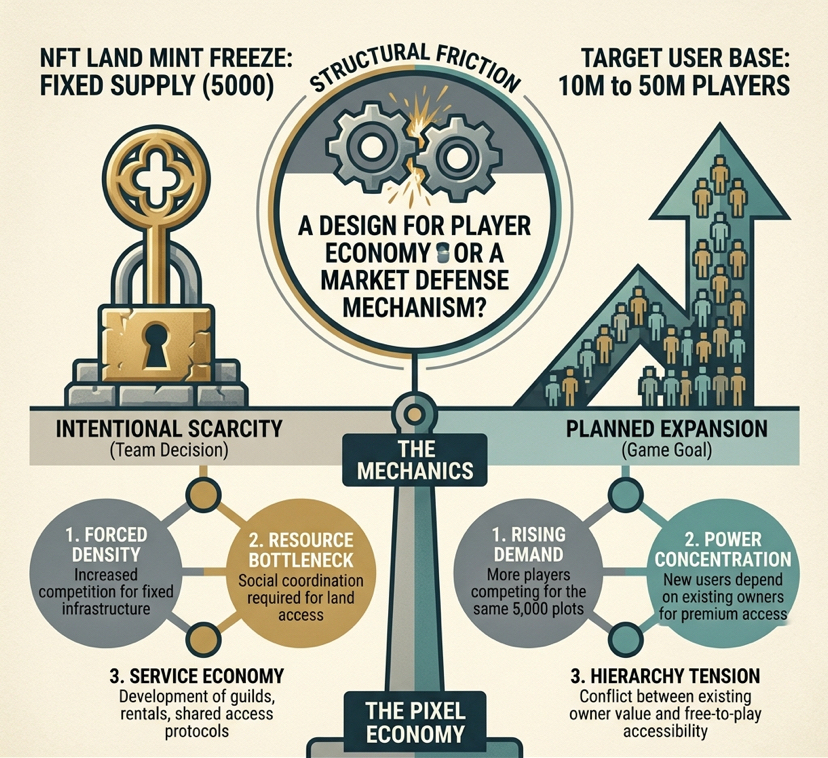
This decision creates an immediate structural tension: the team is committed to a fixed supply of land while simultaneously aiming to scale the player base from ten million to fifty million users. This is not a roadmap delay but a deliberate architectural choice that forces the ecosystem into a state of artificial density.
When land supply remains static as the population expands, each plot evolves from a private asset into a shared productive infrastructure. Mechanically, this shifts the focus from simple ownership toward the development of service economies. We are seeing the emergence of informal rental agreements, guild-managed resource hubs, and shared access protocols.
The land becomes a bottleneck that necessitates social organization. This mirrors the geographic constraints found in EVE Online, where non-reproducible sectors of space forced players to build complex logistical empires. While Pixels operates within a different genre and technical framework, the underlying incentive remains the same: value is derived from the coordination required to exploit a finite map.
However, this commitment to scarcity introduces a significant structural friction regarding accessibility. By protecting the weight of existing land, the model inherently concentrates economic power. New participants entering without significant capital find themselves relegated to a tenant class, dependent on the permissions and pricing set by early adopters.
In a game marketed on its accessibility, this creates a hierarchy that complicates the traditional free-to-play promise of equity. The central ambiguity remains: is this land freeze a design masterstroke intended to foster a robust player-driven economy, or is it a market defense mechanism for existing holders? The mechanics suggest that both interpretations are currently true.