
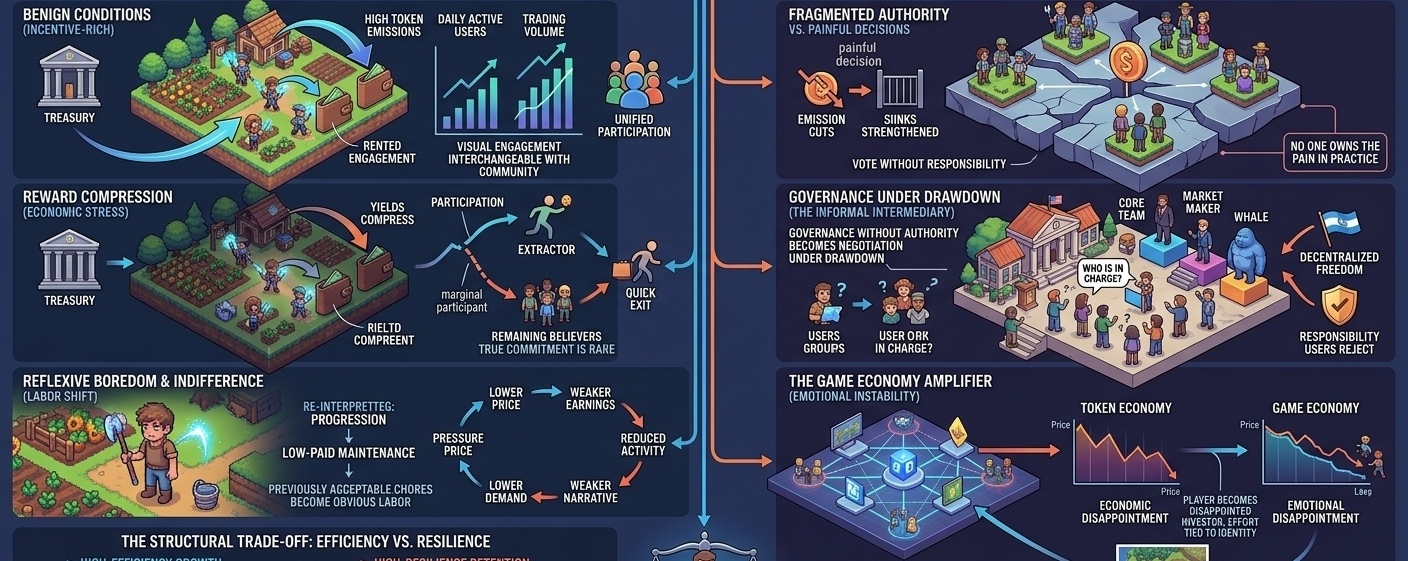
I keep returning to the same question whenever I study systems that promise to remove intermediaries: what breaks first when coordination meets real economic stress? With PIXEL, the answer is not usually the game loop, the chain, or even the token rails. What breaks first is the assumption that participation and commitment are the same thing. In benign conditions, daily activity, wallet counts, trading volume, and social energy can look interchangeable. Under stress, they separate instantly. Players who were counted as community become sellers, farmers become extractors, and holders become optional. A coordination system built around visible engagement often discovers too late that engagement was rented. Pixels grew rapidly after migrating to Ronin and attracted large user numbers, which made it an important network-level success story. But scale achieved during incentive-rich periods does not reveal who remains when yields compress.
The first structural pressure point is emission dependence disguised as culture. I have watched many markets confuse repeated behavior with durable preference. If users return because rewards offset friction, the protocol has not solved coordination; it has subsidized it. That distinction matters most when token price weakens. In systems like Pixels, the token functions as coordination infrastructure: it synchronizes actions, prices time, and rewards desired loops. But once token purchasing power declines, previously acceptable chores become obvious labor. Actions that once felt like progression are reinterpreted as low-paid maintenance. This is where design language loses to labor economics. Communities often insist users are there for fun, identity, or belonging. Some are. Yet the marginal participant—the one who makes metrics look healthy—is usually there because the exchange rate made the routine tolerable. When price falls, sentiment doesn’t “change”; compensation does.
This creates a reflexive problem most observers underestimate. Lower token price reduces user earnings, weaker earnings reduce activity, lower activity reduces narrative strength, weaker narrative reduces demand, and demand weakness pressures price again. None of this requires panic. It can happen through boredom and arithmetic alone. I have seen markets collapse more often from indifference than fear. If a protocol relies on continuous fresh entrants to absorb emissions while existing users monetize rewards, then attention becomes a balance-sheet input. Once attention rotates elsewhere, internal culture is asked to fund what external demand previously funded. It usually cannot.
The second pressure point is property rights without enforcement power. Decentralized systems often distribute assets, status, or governance claims broadly, but they cannot compel coordinated sacrifice during downturns. In traditional firms, management can cut budgets, restructure incentives, or absorb losses centrally. In tokenized systems, authority is fragmented precisely where painful decisions become necessary. If emissions should be reduced, some constituency loses income. If sinks should be strengthened, another group bears cost. If progression should be slowed to preserve scarcity, active users feel punished. Everyone can vote in theory, but no one owns the pain in practice.
That is the hidden cost of minimizing intermediaries. You remove the actor people resent in good times and discover you also removed the actor who could impose coherence in bad times. Governance without authority becomes negotiation under drawdown. Participants who benefited from decentralization as freedom may reject it as responsibility. This is why many token communities become strangely centralized during crises—not formally, but behaviorally. Users begin looking to founders, market makers, core teams, or influential whales to act as unofficial intermediaries. The protocol says no one is in charge; stress reveals everyone hopes someone is.
Pixels is especially interesting because gaming adds a second economy on top of the token economy. The user is not only investor or farmer, but also player. That sounds like resilience, yet it can amplify instability. A player who feels economically disappointed often becomes emotionally disappointed too, because effort was tied to identity and time spent. In finance, people can quietly exit a position. In games, they also exit a place. Social worlds can empty faster than spreadsheets predict because departures are contagious. One guild leaves, then another questions staying. Empty maps become public evidence of weakening belief.
The clear structural trade-off is efficiency versus resilience. High emissions, liquid rewards, and fast onboarding can create explosive growth. They reduce coordination friction and accelerate network effects. But the same efficiency can hollow out commitment because participants learn to optimize extraction pathways rather than long-term attachment. Slower systems with less generous rewards may look inferior during bull phases, yet they sometimes retain users better because expectations were never priced as income streams.
The uncomfortable question is whether many users ever wanted decentralized ownership at all, or whether they simply wanted a monetized pastime while markets were generous. That question is hard to ask because it challenges the flattering story every ecosystem tells itself. People say they came for community, sovereignty, and aligned incentives. Sometimes they came because numbers were going up.
I do not think the fate of a coordination system is decided by code quality or branding. It is decided when participants must choose between staying useful and staying solvent. That moment turns abstract values into line items. With PIXEL, as with many tokenized environments, the deepest test is not whether people join when rewards are visible, but whether they continue coordinating once belief is no longer profitable.