
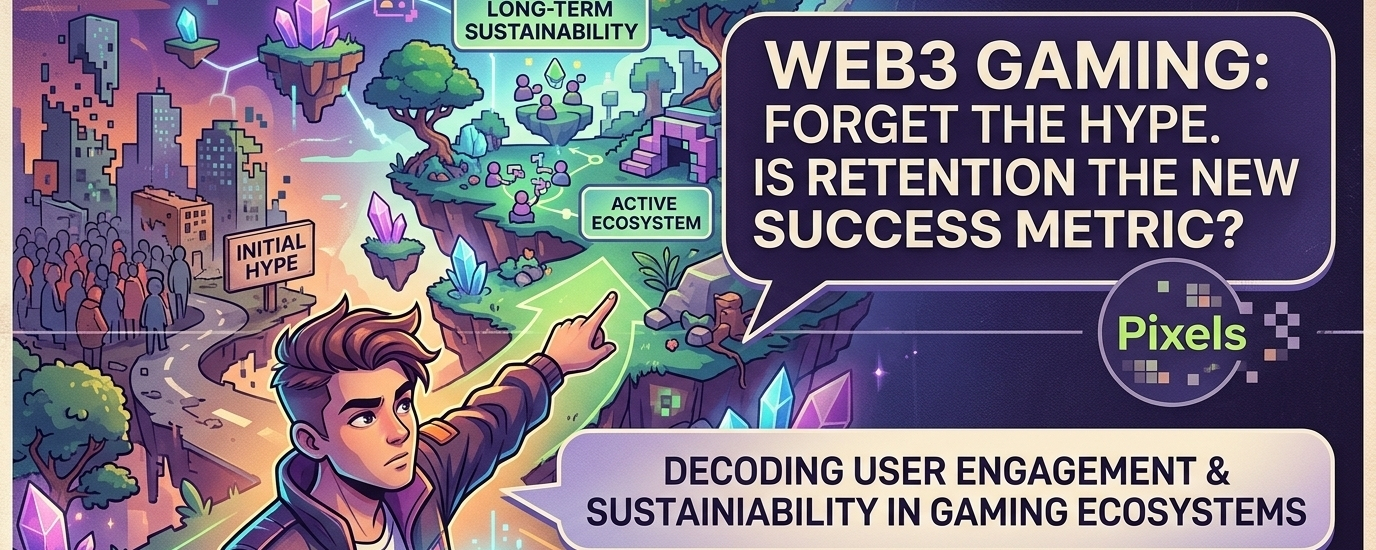
There was a time when I believed that most Web3 gaming projects just needed the right market conditions to succeed. If the timing was good and attention was strong, I assumed the ecosystem would naturally grow from there.
But after observing multiple cycles, that assumption started to break down. The same pattern kept repeating — strong launch, high engagement early on, and then a slow decline in activity that eventually weakened the entire system.
What stood out to me wasn’t the speed of the decline, but how consistent the pattern was. It wasn’t random. It was structural. Many projects are designed to attract users, but not necessarily to retain them.
That realization completely changed how I evaluate new projects. Instead of focusing on how strong the start is, I look at whether there are mechanisms in place to keep users engaged over time. Without that, even the most promising ecosystems tend to fade.
When I look at @Pixels from this perspective, the focus shifts to user behavior rather than initial attention. Can players remain active? Do they have reasons to keep interacting within the system? Is the environment structured in a way that encourages ongoing participation?
These are difficult questions, but they are also the ones that matter most.
This is where $PIXEL becomes part of a larger narrative. Its role depends on the strength of the ecosystem. If users stay and continue interacting, the token reflects that activity. If they leave, it loses relevance along with the system itself.
I’m not assuming outcomes here, but I do think @Pixels is at least addressing the right problem — retention. And in Web3 gaming, that’s often the difference between short-term attention and long-term survival.