
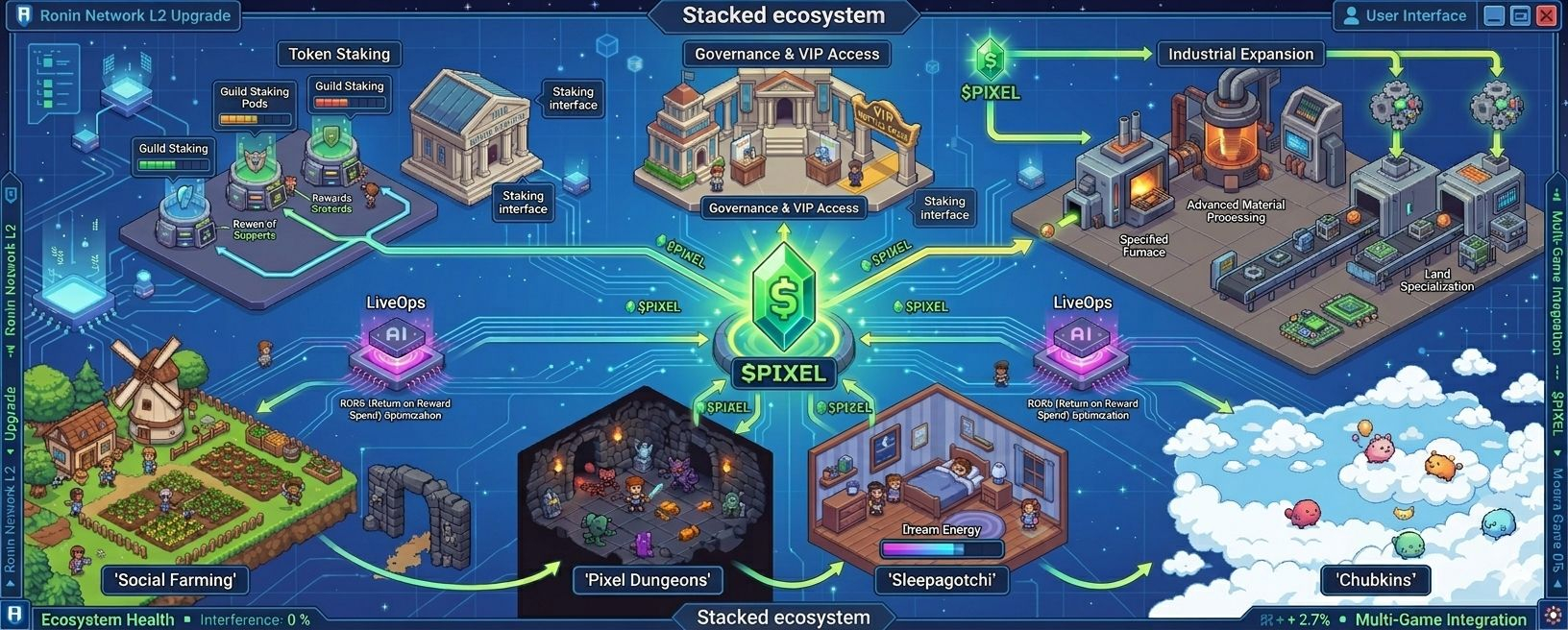
As the Ronin Network transitions to a ZK-based Layer-2, the conversation around the $PIXEL token is shifting from simple in-game utility to industrial-scale scalability. This transition, combined with the project’s RORS (Return on Reward Spend) metric, is creating a sustainable blueprint that other GameFi projects would do well to study.
The "Stacked" Industrial Expansion
A look at the latest architecture reveals a pivot toward data-driven gaming. Pixels isn’t just adding mini-games; it is stacking utility. The expanded industrial complexes depict advanced material processing and land specialization, indicating that $PIXEL is now a critical resource for high-level progression across multiple integrated titles like Sleepagotchi and Chubkins. This model aggregates liquidity into a single token, combating the fragmentation common in other metaverses.
Why It Matters
The technical update signals a shift from hype-based play-to-earn models to professional, live-service economies. By creating deep, cross-platform sinks for $PIXEL, the project ensures that as the ecosystem health (tracked via R&D performance) improves, the core token utility scales proportionally. Pixels is not just surviving the crypto gaming winter; it is building the machinery for the next cycle.
#PIXEL #RoninNetwork #GameFi #Web3Gaming #BinanceSquare #CryptoUpdate