

I was scrolling late again, the kind of scrolling where your brain is tired but your thumb refuses to stop. Same posts, same energy, same recycled excitement about things that sound big but feel empty if you think about them for more than ten seconds. New AI coins, new chains, new “revolutions.” It all starts blending together after a while.
Somewhere in that noise, I landed back on Pixels.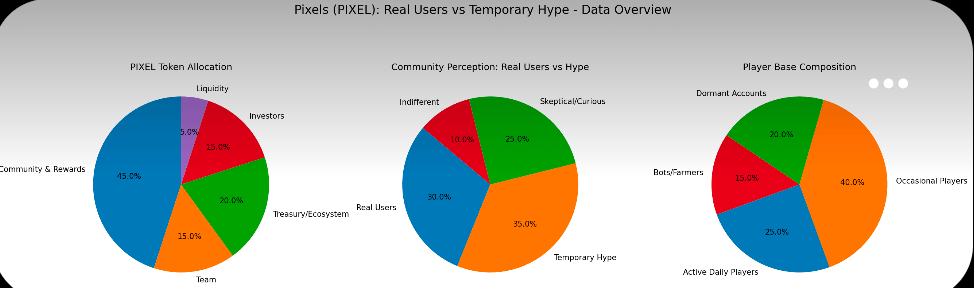
Not because someone was aggressively shilling it. Not because it was trending like crazy. More like… it just kept showing up quietly. And that caught my attention more than any loud marketing ever could.
Because right now, most of crypto feels like a performance. Everyone is trying to sound early, sound smart, sound ahead of the curve. But very few things are actually being used in a real, messy, human way.
Pixels is different in a small but important way. It’s not pretending to be something massive. It’s just a simple game. You farm, you explore, you craft things. That’s it. No complicated pitch, no overengineered story.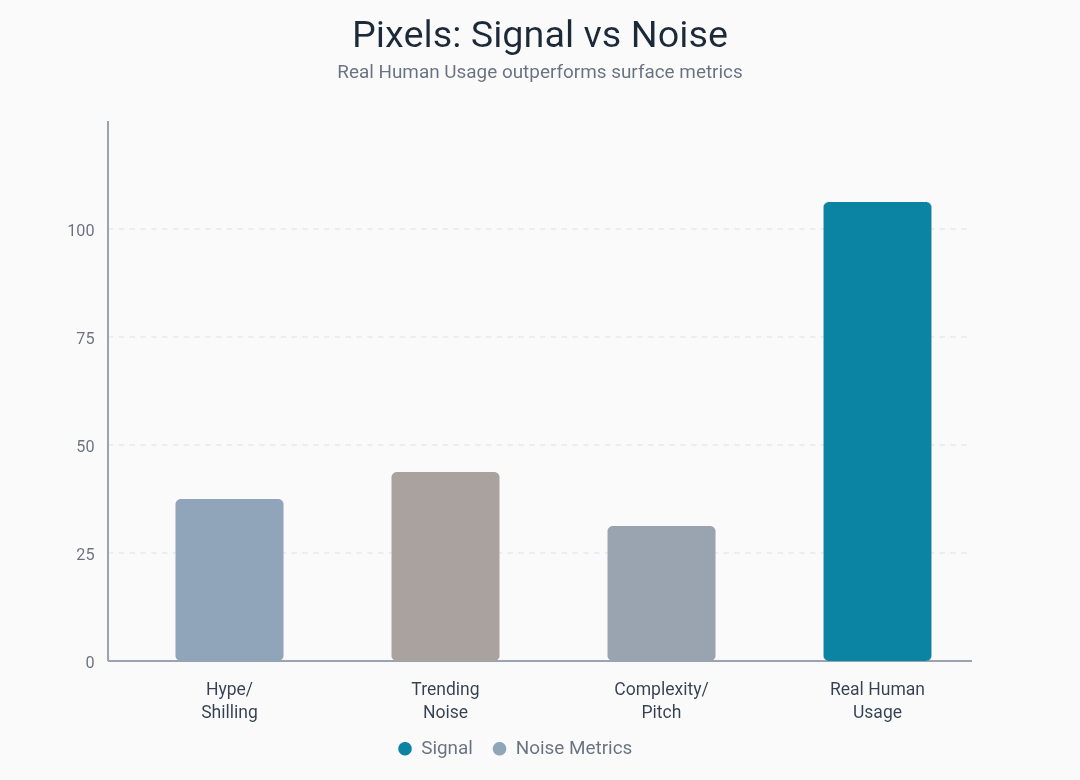
And weirdly, that simplicity is what makes it interesting.
Because simple things are easier for people to stick with.
If you look at how people actually behave, they don’t want complicated systems. They want something they can come back to without thinking too much. Something that feels like a habit, not a task.
That’s what Pixels seems to be aiming for. Not a deep, intense gaming experience. More like a place you casually return to, do a few things, maybe interact with others, then log off.
That sounds basic, but in crypto, basic is rare.
Most projects overcomplicate everything. They build systems that look impressive on paper but fall apart when real users show up. Because real users don’t behave the way designers expect them to.
They find shortcuts. They farm rewards. They ignore anything that doesn’t benefit them immediately.
And that’s where most “innovative” projects quietly fail.
Not because the tech is bad, but because the user behavior doesn’t match the vision.
Pixels is actually dealing with that reality. People are using it. Not perfectly, not consistently, but enough to create real pressure on the system.
And pressure is what reveals the truth.
It’s built on Ronin, which already has experience handling large user activity from games. That matters more than people think. A lot of newer chains look good until they face actual demand. Then things slow down, fees spike, or systems break in ways nobody predicted.
Ronin has already been through some of that chaos. So Pixels isn’t starting from zero in terms of infrastructure.
Still, having a solid base doesn’t solve everything.
The token side, PIXEL, is where things get complicated. Like always.
At first, there was excitement. Prices moved, attention came in, people rushed to be early. That’s the usual pattern. But after that initial phase, things slow down. And that’s when the real test begins.
Are people still here when the easy rewards are gone?
Because in crypto, a lot of users aren’t really users. They’re participants in a short-term opportunity. They come in, extract value, and leave.
Games suffer from this even more. If people are only playing to earn, they stop playing the moment it’s not worth it anymore.
Pixels is trying to avoid becoming just another “play-to-earn” cycle. It’s trying to be something people actually engage with beyond the rewards.
But that’s not easy.
You can’t force people to care about a game. You can only design something that gives them a reason to stay.
And right now, it feels like Pixels is somewhere in the middle. Not failing, but not fully proven either.
There is real activity, which is a good sign. But activity alone isn’t enough. It needs consistency. It needs users who come back because they want to, not just because they’re being paid to.
Then there’s the issue of liquidity.
If the token doesn’t hold value or at least feel stable, everything connected to it starts feeling weaker. People lose motivation faster. The whole experience starts to feel temporary.
And crypto users can sense that quickly.
Another challenge is attention. This space moves fast. Really fast. Something new shows up every week trying to grab focus. And most people don’t have the patience to stick with one thing for long.
Pixels is competing not just with other games, but with the entire crypto timeline.
That’s a tough environment to survive in.
There’s also a deeper problem that most people don’t talk about enough: optimization.
The moment users figure out the best way to earn or progress, they stop exploring. They stop experimenting. Everything becomes about efficiency.
That’s when a game starts feeling less like a world and more like a routine job.
Pixels hasn’t fully escaped that risk. No Web3 game really has.
But at least it’s facing real user behavior instead of pretending it doesn’t exist.
And that’s why I keep coming back to it in my mind.
Not because I think it’s guaranteed to succeed.
But because it’s one of the few projects that feels like it’s actually being used, not just talked about.
There’s a big difference between those two things.
Most of crypto right now is still stuck in ideas. Whitepapers, roadmaps, promises. Pixels is already in the phase where people are interacting with it, shaping it, sometimes breaking it.
That’s where real learning happens.
I also think it says something about the current state of the market. Maybe we don’t need more complexity. Maybe we don’t need more layers and new terms every week.
Maybe we just need things that people can actually use without thinking too hard.
Pixels fits into that idea, even if it’s not perfect.
And it’s definitely not perfect.
There are still big questions.
Can the economy hold up long-term?
Will users stay when incentives decrease?
Can it evolve without losing its simplicity?
And maybe the biggest question: does the wider market even care about this kind of product?
Because narratives control attention. And attention controls everything else.
Right now, gaming in crypto isn’t the hottest narrative. That could change, or it might not.
That uncertainty matters.
Personally, I don’t see Pixels as some guaranteed success story. I also don’t see it as just another failed experiment.
It feels like something in progress. Something that’s testing ideas in real time, with real users, in a way that most projects avoid.
And that alone makes it worth watching.
Not hyping. Not blindly supporting. Just… watching.
Because in a space full of noise, sometimes the quiet projects tell you more about reality than the loud ones.
Pixels is one of those quiet signals.
It might grow into something bigger.
It might slowly lose momentum and fade out.
Or it might just exist in that middle space, where it never fully “wins” but still influences what comes next.
I honestly don’t know.
And maybe that’s the most honest place to end up right now.
It could work.
Or people could get bored, move on, and never come back.
And in crypto, both outcomes feel equally normal.