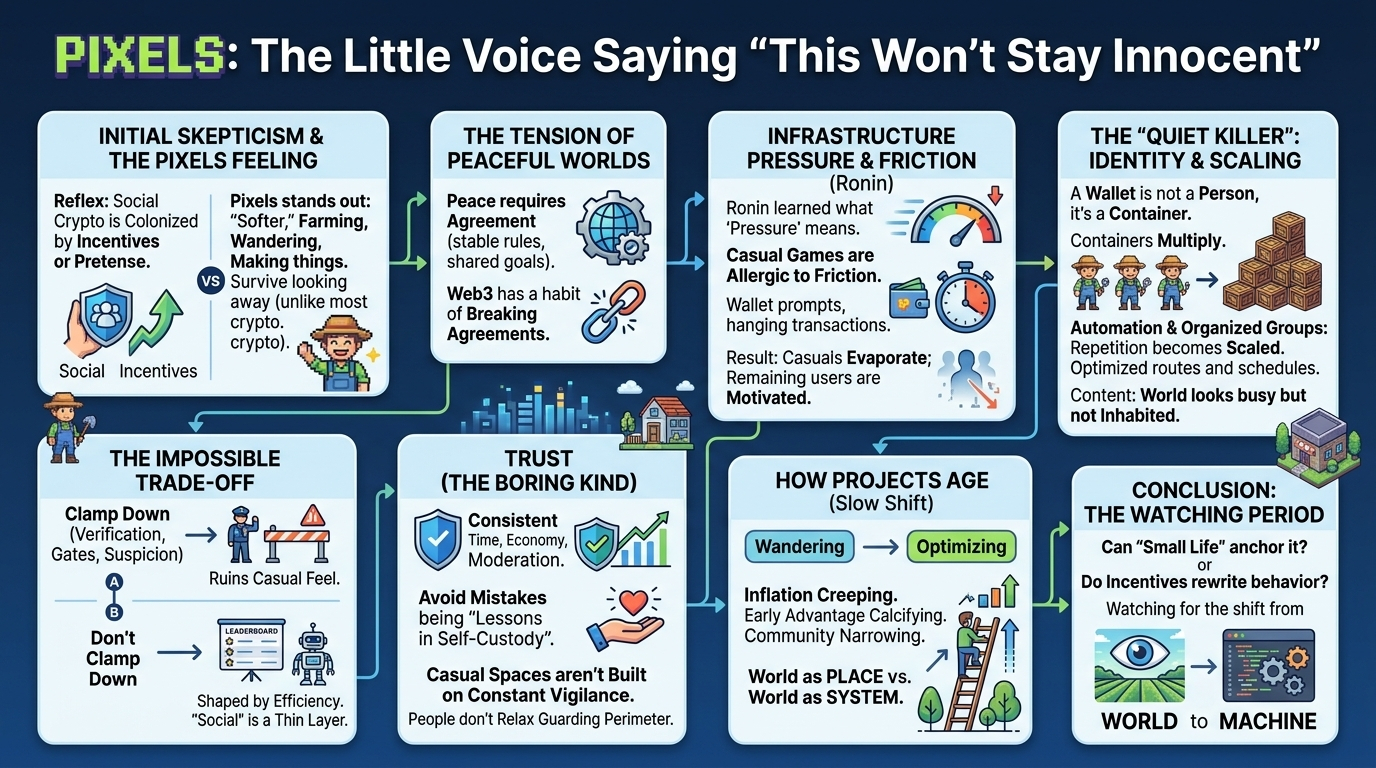
I didn’t take it seriously at first because I’ve developed this reflex after a few turns of the wheel. If something in crypto is described as “social” and “casual,” I assume it’s either (1) about to get colonized by incentives, or (2) already colonized and we’re just pretending it’s still a game. That’s not fair to Pixels, but it’s the air we breathe.
And Pixels is undeniably softer than most things that float across my feed. Farming, wandering, making things, bumping into people. It’s the kind of loop that would be forgettable in a normal market, which is maybe why it stands out here. Crypto projects usually don’t allow forgettable. They need you staring at them. Pixels seems to survive people looking away, which is a weird compliment.
Still, I keep coming back to the same uncomfortable thought: a peaceful world is basically an agreement. An agreement that the rules are stable enough, the floor doesn’t move, and the people around you are playing roughly the same game you are. Web3 has a habit of breaking agreements by accident.
Ronin sits underneath Pixels, and I can’t pretend that doesn’t shape my read. Ronin feels like infrastructure that’s been forced to learn what “pressure” actually means. Not theoretical stress tests. Real ones. The kind where normal users don’t care about your roadmap they care that their stuff is accessible and the thing works when they have 20 minutes before bed. A casual game is allergic to friction. Not big, dramatic failure, even. Small friction. The kind that makes you hesitate. A wallet prompt at the wrong moment. A transaction that hangs long enough for you to wonder if you misclicked. A day where the network feels slightly off and suddenly the “cozy routine” becomes “why am I doing this.”
Maybe that’s too harsh but I’ve watched how quickly casual audiences evaporate when the plumbing starts making noise. The users who remain tend to be the ones with a reason to remain. And that’s where the tone shifts.
I keep coming back to identity because it’s the quiet killer of social games on-chain. A wallet is not a person; it’s a container. Containers multiply. In a farming world, repetition is the point, so repetition becomes the first thing people scale. Multi-accounts. Automation. Organized groups optimizing routes and schedules. None of it needs to be “evil” to be corrosive. It just changes the world’s texture. You start feeling like you’re surrounded by activity that isn’t quite human. The world looks busy, but it doesn’t feel inhabited.
That’s where things start to feel uncomfortable because any response is a trade. If you clamp down with verification, you introduce gates and steps and suspicion exactly what a casual game is trying to avoid. If you don’t clamp down, you’re effectively telling normal players: this place will be shaped by whoever can repeat the loop the most efficiently. And then “social” becomes this thin layer of friendliness on top of a competitive engine.
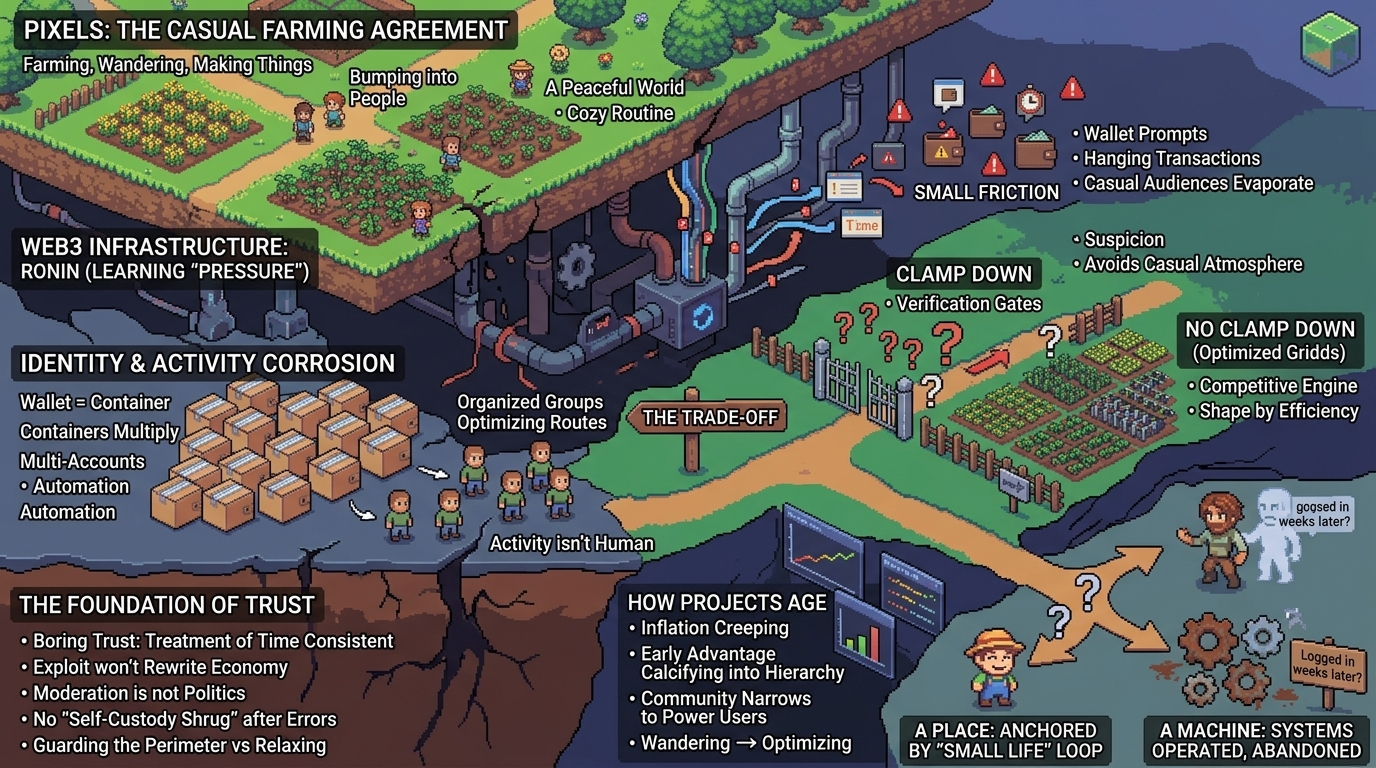
And there’s trust, the boring kind that doesn’t trend. Not “trust the code.” Trust that the system will treat your time consistently. Trust that an exploit won’t rewrite the economy overnight. Trust that moderation won’t turn into politics. Trust that if you make a mistake phished link, wrong approval, lost access you won’t be met with a shrug disguised as a lesson about self-custody. Casual spaces can’t be built on constant vigilance. People don’t relax while guarding the perimeter.
I keep coming back to how projects age. Not launch-day metrics. The slow stuff: inflation creeping in, early advantage calcifying into hierarchy, the community narrowing into power users, the quiet shift from wandering to optimizing. Under pressure, do people still treat Pixels like a place, or do they start treating it like a system to operate?
I can’t tell yet which direction it leans. Maybe the “small life” loop is enough to anchor it. Maybe the incentives eventually teach everyone to behave differently, no matter how pretty the fields are. I’m still watching for the moment when the world stops feeling like a world and starts feeling like a machine if that moment even has a timestamp, or if you only notice it later, when you realize you haven’t logged in for weeks and don’t really know why.