
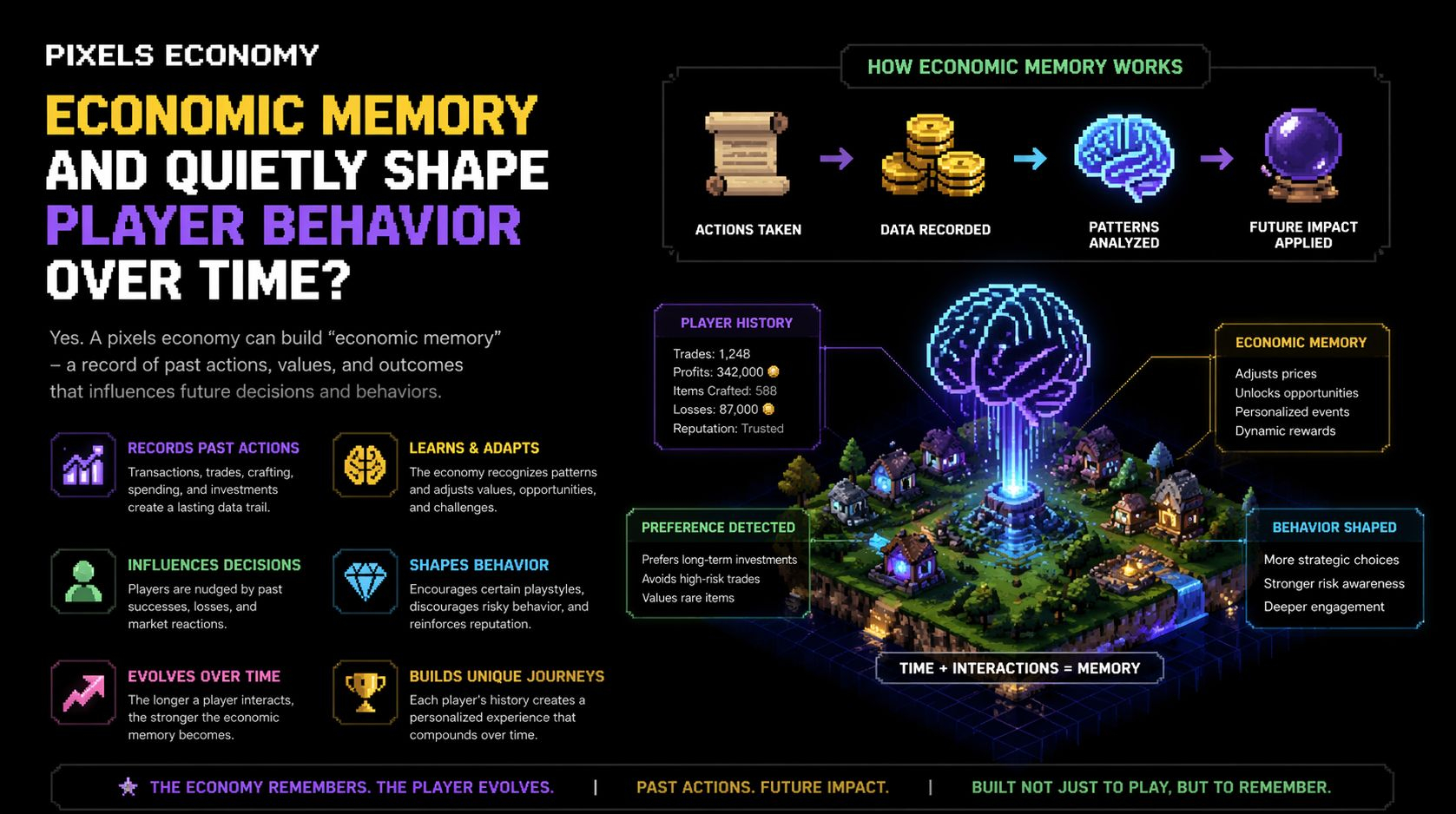
I think the confusion comes from the fact that Pixels looks simple at first. You farm, craft, trade, upgrade—nothing unusual. Most explanations stop there and treat it like a system you just optimize.
But that explanation starts to feel thin once you spend more time with it. It tells you what people do, but not why things start to feel different as time goes on.
Because they do shift.
Early on, everything feels open. You can try anything and it doesn’t really matter if it’s inefficient. But after a while, certain choices begin to feel more “right.” Not because the game tells you, but because the environment quietly changes around you.
And that’s where it starts to feel like the system has some kind of memory.
Not a literal memory—nothing is sitting there recording your past decisions. It’s more subtle than that. The past lingers in things like prices, in what players have already invested in, in the strategies people collectively settle on. Even if you don’t see it directly, you feel it when you play.
So the system carries its history forward without ever saying it does.
What makes it interesting is that no one is being forced into anything. You can still choose your own path. But over time, it becomes harder to ignore what’s already been established. The more the system settles, the more it quietly nudges you toward certain decisions—not by blocking alternatives, but by making them feel less worth it.
So instead of controlling behavior directly, it changes what feels like a reasonable choice.
That’s where the tension comes in. On one hand, it still feels like a game about individual freedom—you’re just playing your own way and trying to be efficient. On the other hand, the economy starts organizing itself. Some paths become dominant, some players specialize, and certain strategies just work better than others.
Both things are true at the same time, which is why it feels hard to pin down.
So maybe the real question isn’t just whether Pixels creates “economic memory.” It’s whether that slow buildup of past behavior starts shaping the future so much that the system stops feeling open.
Because at some point, you’re not just playing a system anymore. You’re stepping into a world that’s already been shaped by everyone who came before—and that changes what the game actually is, even if the rules never changed.
