
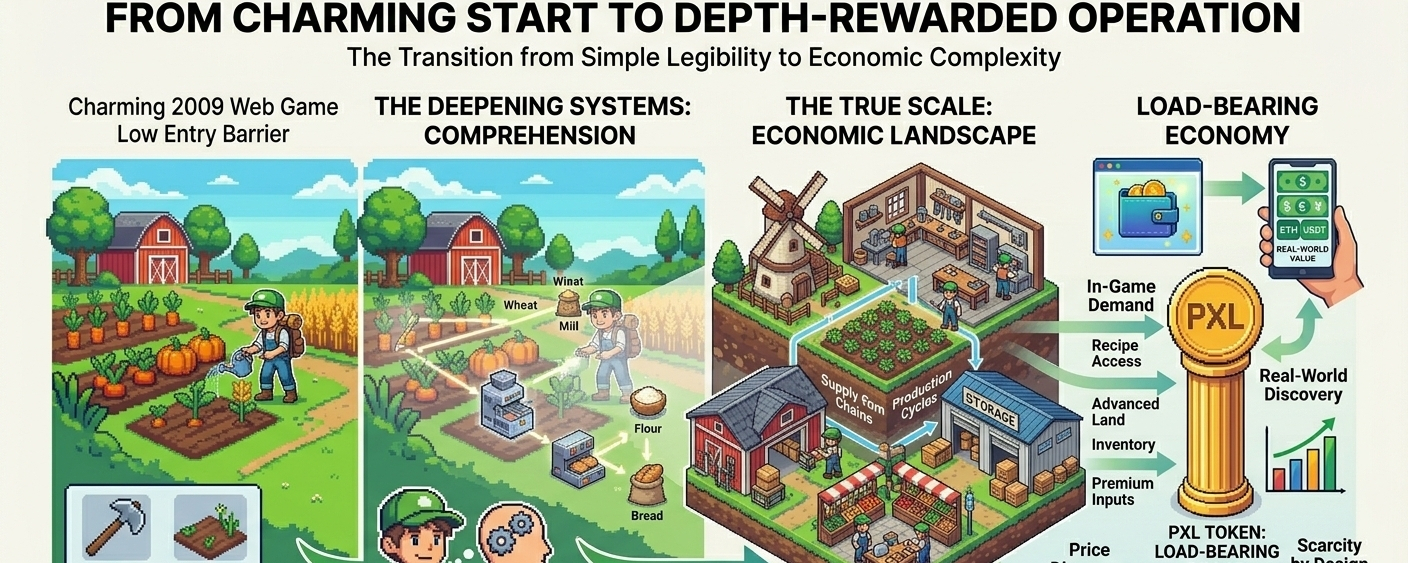
Guys... I believe that's the positive trick Pixels pulls on you... You load it up for the first time and see the soft colors, the tiny character, the little plot of land waiting to be worked... It looks like a browser game from 2009. You think you understand what it is.
After spend a few days inside it and the picture changes. You start to see the supply chains — raw materials becoming processed goods, processed goods becoming finished products, finished products finding buyers who needed exactly that thing... You start to see the land as capital. The time you spend as labor. The crops you harvest as inventory with a market price attached.
I think... at some point you stop playing a game and start running a small operation.
That's what the surface hides. Pixels isn't simple — it's legible. The entry point is low, the art style is friendly, the onboarding doesn't ask you to understand blockchain before you can plant your first seed. But underneath that accessibility is an economy with real moving parts. Input costs, production cycles, price discovery, scarcity by design. The mechanics that feel casual are quietly precise.
And the $PIXEL token isn't decoration. It's load-bearing. The economy needs it to function — to access recipes, to unlock the layers of the game that reward serious players, to participate in the parts that generate real output. Demand for it comes from within the game, not from traders watching a chart. That's a different kind of token than most of what this space produces.
Why pixel seems to me real at early?
Because I think the best economies are ones you can walk into without a map and still find your footing. Pixels does that. But it also rewards people who study the terrain... Who understand where value is created and how to position themselves inside it. Simple on the surface is a feature, not a flaw. It's how you get people in the door. The depth is what keeps them there. And the ones who figure that out early tend not to leave.