
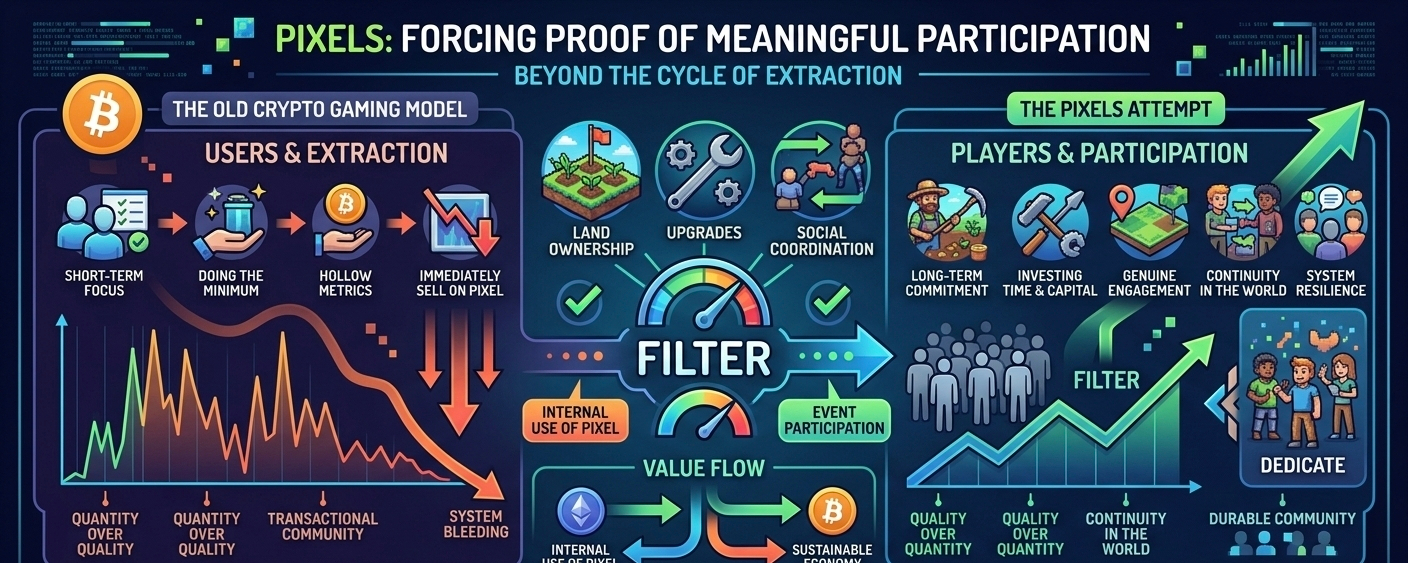
There’s a version of crypto gaming I’ve seen too many times to take seriously anymore. It starts loud. Numbers look good. Wallets show up. Tasks get completed. Tokens move. People post screenshots like something real is happening. For a while, it even feels convincing. You can almost believe the game has found its rhythm. Then the same thing always happens. The rewards get predictable. The system gets mapped. The users who came for extraction settle into a routine. And slowly, what looked like activity starts revealing itself as something thinner—not participation, just repetition with a payout attached. That’s the cycle most projects never escape.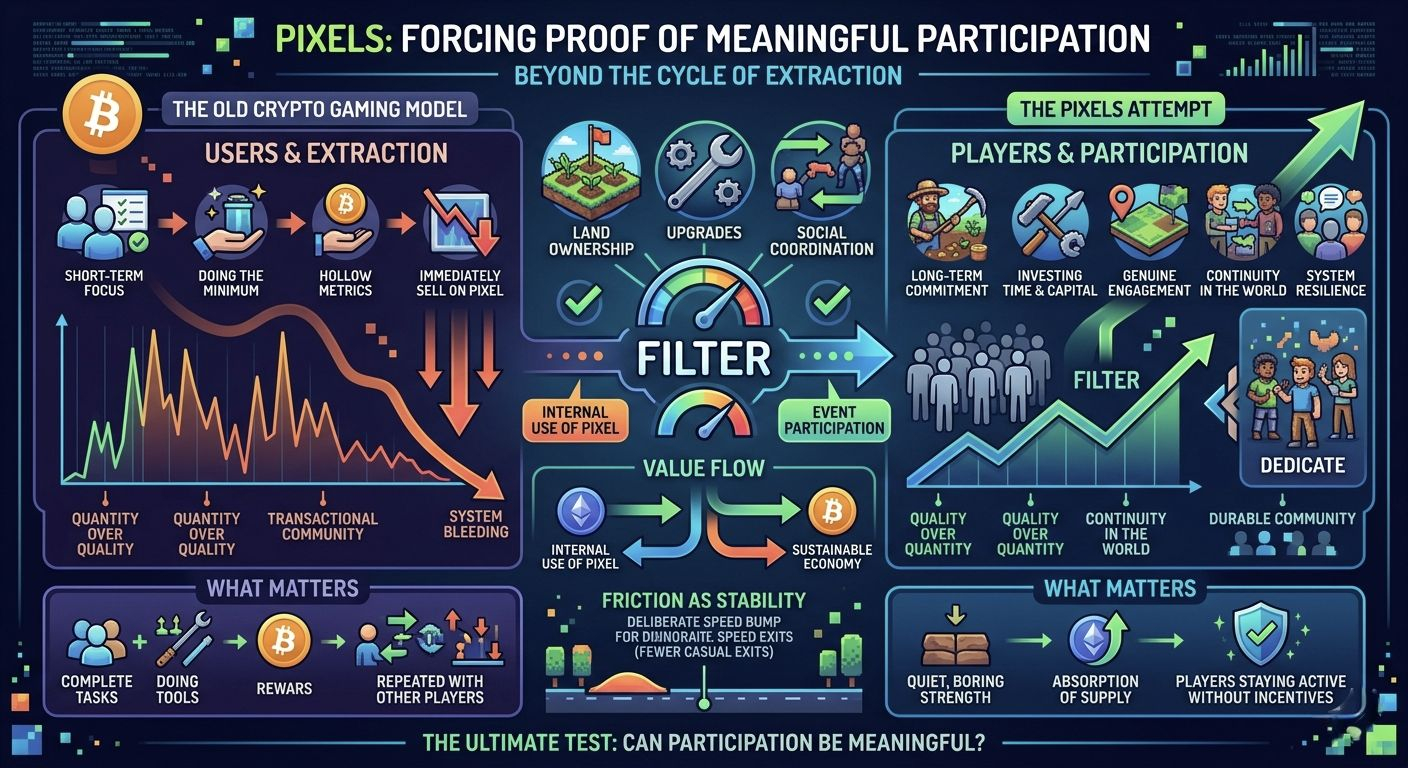
What makes Pixels interesting to me is not that it avoids this problem. It doesn’t. It’s facing the exact same pressure. The difference is that it seems to acknowledge the problem earlier than most and is actively trying to design around it. At the center of that effort is one uncomfortable idea: not all activity deserves to be rewarded equally.
Where most crypto games get it wrong is in how they define growth. The old model was simple, and honestly, lazy. Bring users in. Give them tasks. Attach rewards. Call it growth. For a while, it works. You get volume, engagement, and a surface-level sense of momentum. But underneath that, the system is quietly training users to behave in one very specific way: do the minimum required to extract value. That’s not a community. That’s a loop.
I’ve watched this pattern play out across multiple cycles. The metrics look alive, but the intent behind the activity is hollow. Wallet movement gets mistaken for demand. Task completion gets labeled as engagement. Reward claims get dressed up as loyalty. And eventually, the system starts leaking. Rewards flow out faster than value flows back in. The game becomes a checklist. The token becomes a pressure point. The community becomes transactional. Pixels feels like it’s trying to interrupt that pattern—not by removing rewards, but by questioning who those rewards should actually go to.
What stands out to me isn’t the farming, the visuals, or even the token itself. It’s the filter. Pixels seems to be experimenting with a quieter, harder question: how do you separate presence from participation? Because those are not the same thing. A wallet that logs in, completes a task, and leaves is not contributing the same way as someone who keeps returning, invests time into land or assets, trades within the ecosystem, participates in events, builds continuity, and adds weight to the world. Most systems treat these users the same because it’s easier. Pixels is at least trying not to.
That sounds obvious when you say it out loud, but in practice it’s where almost everything breaks. Make the filter too loose, and extraction behavior dominates. Make it too strict, and real players feel punished. Make it too complex, and people stop understanding what the system actually wants. There’s no clean solution here—just constant adjustment.
One thing I’ve become more sensitive to over time is where value actually flows inside these systems. Not what gets announced. Not what gets promised. What actually happens after rewards are distributed. That’s where the truth sits. In Pixels, the important question isn’t how much PIXEL is earned. It’s what happens next. Does it move back into the game? Does it get used for upgrades, land, items, or social activity? Does it support other players or parts of the ecosystem? Or does it immediately exit into the market? Because if the flow is mostly one-directional outward, then the system is just bleeding in slow motion.
It can still look healthy from the outside. Users, volume, updates, engagement—all the right signals. But internally, it starts to feel like quiet extraction. Pixels seems aware of this risk. The way rewards, staking, and friction are structured suggests an attempt to slow that leakage and tie capital more closely to behavior. Not perfectly, but intentionally.
I’ve seen staking framed as a bullish signal too many times to accept it at face value anymore. Locked tokens don’t automatically mean belief. Sometimes they just mean delay. A lockup can be conviction, strategy, or simply a waiting room before exit. The difference is what users are doing while they’re locked in. If someone stakes PIXEL and disappears, that’s not participation. That’s passive positioning. If they stake and remain active—playing, building, contributing, interacting—then staking starts to mean something more. It becomes a bridge between capital and behavior, and that is harder to fake.
Another detail that stands out is the presence of friction, especially around liquidity and movement. In most crypto systems, instant entry and exit are treated as features. And in isolation, they are. But in game economies, that same flexibility often becomes a weakness. When users can move in and out with zero resistance, they behave accordingly—short-term, opportunistic, detached. A small amount of friction doesn’t trap users, but it does change the tone. It makes decisions slightly heavier. It introduces pause where there would otherwise be reflex. Pixels appears to be experimenting with that balance. Not to block exits, but to make them less casual.
Still, friction alone doesn’t solve anything. If the underlying experience isn’t strong enough, people will leave anyway—just more slowly. This is where crypto gaming usually gets exposed. Tokens can attract attention. They can even sustain activity for a while. But they can’t manufacture attachment. At some point, the question becomes simple: would people still show up if the rewards were less aggressive?
That’s where the difference between users and players becomes obvious. A user calculates effort versus reward. A player returns because the world itself has value. Pixels doesn’t escape this test. It’s heading straight toward it. The system can filter, adjust incentives, and optimize flows, but eventually the game has to carry some of the weight. If it doesn’t, the economy becomes work disguised as play.
On the market side, it’s easy to overread price. Thin liquidity can make small moves look meaningful. Short bursts of attention can create the illusion of validation. And downturns can look like structural failure when they’re just flow meeting a shallow order book. That’s why I don’t treat price as the primary signal. What matters more is whether liquidity stabilizes during quiet periods, whether supply gets absorbed without constant volatility, and whether users continue interacting when nobody is watching. That kind of quiet, boring strength is usually a better indicator of whether something is actually working.
The same applies inside the game. The useful data is not always loud. Are players still showing up after the reward cycle cools? Are they building, upgrading, trading, coordinating, and returning? Are they treating Pixels like a place, or just a payout route? That difference decides almost everything.
If there’s a real compliment here, it’s this: Pixels is trying to solve a hard problem instead of avoiding it. It’s not just asking how to bring users in. It’s asking how to make their presence meaningful. That’s a more uncomfortable path. Reward systems will always attract extraction behavior. The more efficient the system, the faster that behavior adapts. There’s no permanent fix—only constant refinement.
The challenge for Pixels is to keep narrowing the gap between people who are there for the system and people who are there for the world. If that gap stays wide, the economy leaks. If it narrows, something more durable can start to form.
I’m not looking for a big moment where everything suddenly clicks. Crypto is good at producing those, and they don’t mean much on their own. What I’m watching for is slower, quieter evidence: fewer empty users cycling through, more internal use of PIXEL, cleaner reward flows, less immediate sell pressure, and players staying active without needing constant incentives. None of that is flashy, but it’s the kind of behavior that suggests a system is starting to hold.
Pixels doesn’t need to prove that crypto games can attract users. That part has already been solved many times. What it’s being forced to prove—whether intentionally or not—is something much harder: can a crypto game make participation actually mean something? Not just showing up. Not just clicking. Not just extracting. But contributing in a way the system can recognize, reward, and sustain. If that filter holds, the economy has room to breathe. If it doesn’t, then Pixels becomes another familiar outcome—where the game was real enough, but the incentives were louder.
