
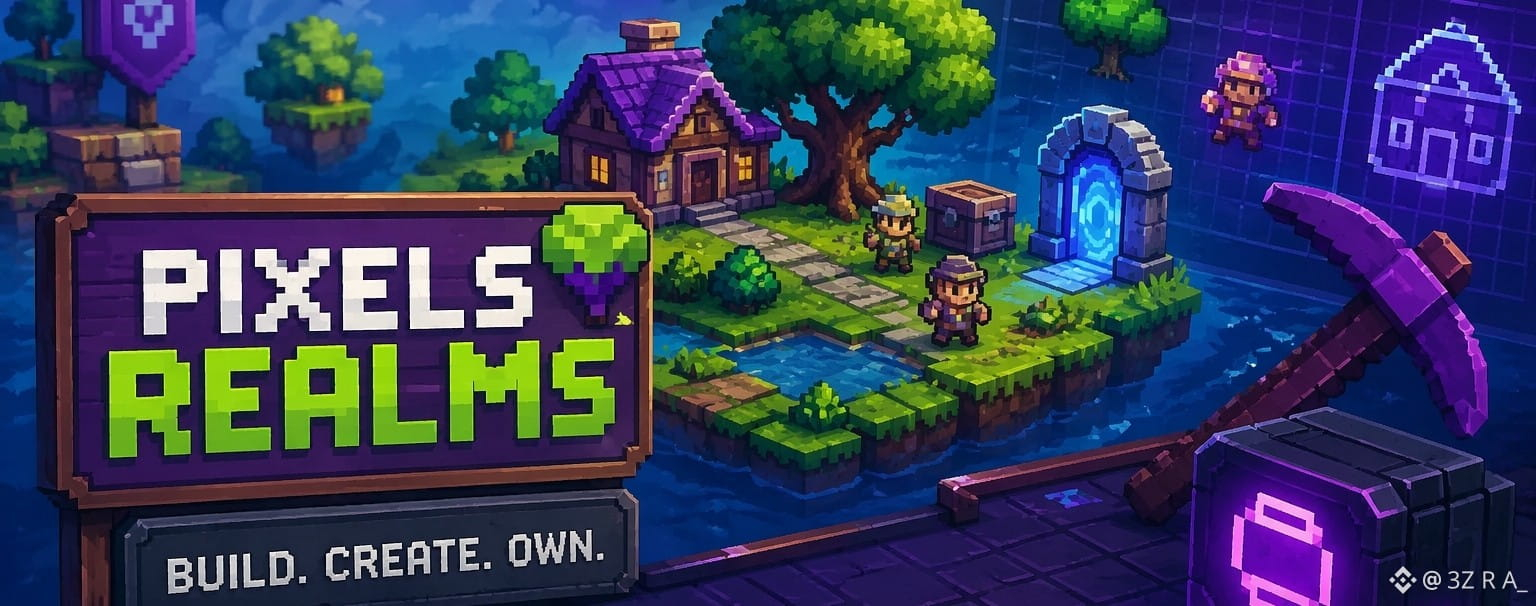
Not because it looked complicated. Not because it felt risky. Just… because the moment I started really looking at it, it stopped feeling like a feature and started feeling like something much bigger.
At first, it sounds simple. People can build their own spaces. Custom worlds, different environments, places where communities can hang out and do their own thing. It feels like a creative add-on. Something extra on top of the main game.
But the more I sat with it, the more that explanation stopped making sense.
Because this is not just about players building things inside a game. It is about Pixels letting other people build on top of it.
And that is a very different direction.
Most games, even in Web3, still work the same way. The team builds everything. New updates, new mechanics, new areas. Players just interact with what is given to them. Even when customization exists, it usually stays limited. You can decorate, maybe tweak a few things, but you are not really shaping the system itself.
Realms feels like it is stepping outside of that.
The moment you realize other projects can plug in, bring their own tokens, their own communities, even their own economies into these spaces, it starts to feel less like a game expanding and more like a platform forming.
And that shift is easy to miss if you are only looking at it from the surface.
Because technically, yes, it is a building tool. There is a scripting layer coming. More flexibility, more control, more ways to create. But the deeper part is not what you can build.
It is why you would keep building.
That is the question that stayed with me.
Because a lot of games let you create things. We have seen that before. People build maps, houses, custom areas. It is fun for a while. Then most of it gets abandoned.
A platform is different.
A platform makes you feel like what you are building actually matters. Like it can grow. Like it can attract people. Like it can turn into something that has its own value, not just something you made once and forgot.
So I kept thinking… if someone builds a Realm that people actually enjoy spending time in, what happens next?
Do they benefit from that attention?
Do they grow with it?
Or does it just stay a cool feature that people visit and move on from?
Because that answer decides everything.
If builders have a real reason to stay, to improve, to invest time into what they are creating, then this turns into something much bigger than just user-generated content.
It turns into an ecosystem where people are not just playing, they are contributing in a way that compounds.
And that is where it starts to get interesting.
Pixels already has multiple communities connected through NFTs acting as avatars. Each one of those communities is not just a group of players. It is a group of people who already share attention.
Now imagine one of them builds a space their community actually wants to use.
They are not just adding content. They are bringing their entire audience into the system. Activity increases. Interactions increase. And suddenly growth is not just coming from the core game anymore.
It is coming from everywhere.
That is how platforms scale.
Not by doing everything themselves, but by giving others a reason to build alongside them.
Still… this is where it becomes real.
Because the idea is strong. The direction makes sense. But none of it works without the right incentives. If builders do not feel rewarded, they will not stay. If they do not stay, nothing compounds.
So the whole thing depends on whether Pixels can turn this from a building tool into a place where builders actually see long-term value.
And I think that is the part most people are not paying attention to yet.
Right now, most players still see Pixels as a game. They are focused on farming, crafting, earning. What is happening underneath that is quieter.
But sometimes, the quieter layers are the ones that matter more later.
And Realms… feels like one of those layers.