
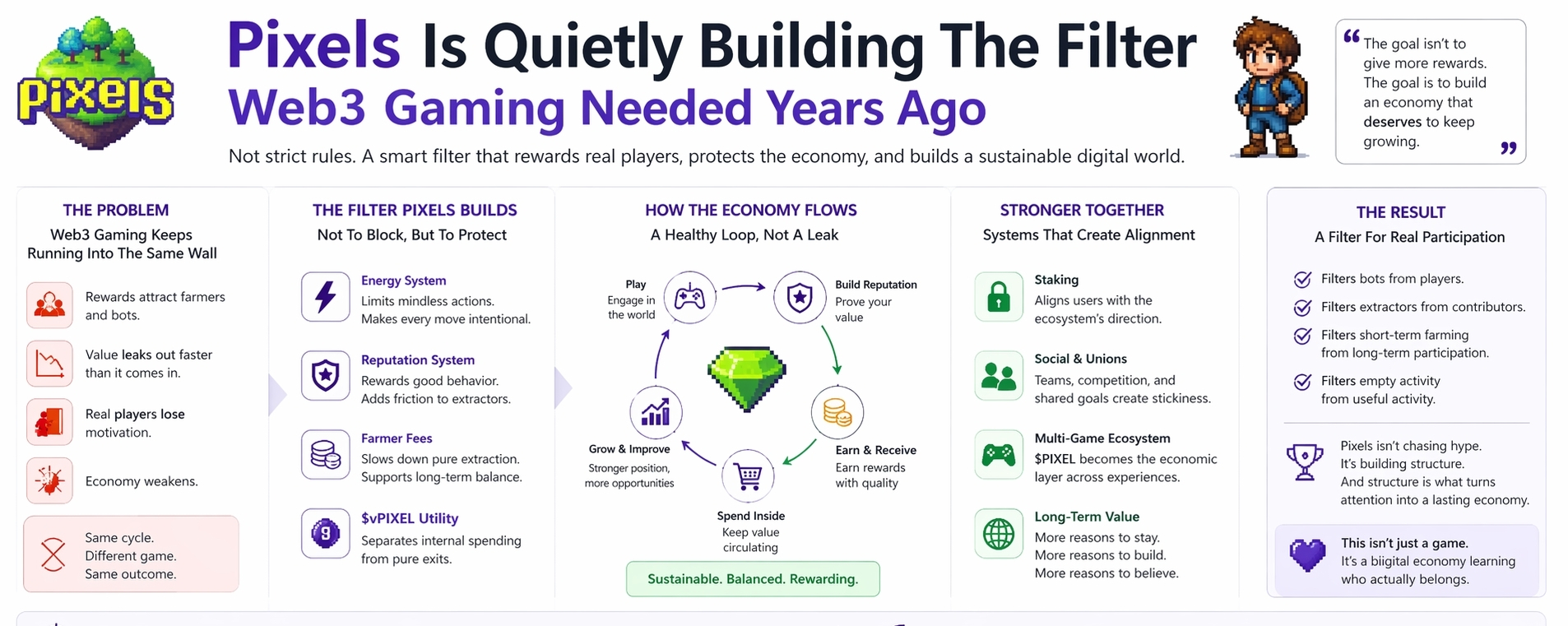


Pixels is one of those projects I keep coming back to, not because it is loud, but because it is trying to fix the part of Web3 gaming that most teams only pretend to understand.
I’ve seen this cycle too many times.
A game comes out. Everyone calls it the next big thing. Rewards start flowing. Farmers arrive before real players even understand the loop. Bots find the weak spots. The token gets treated like an ATM. The economy starts leaking from every side. Then the same people who were screaming about adoption suddenly disappear when the chart starts looking tired.
That is the usual grind.
So when I look at Pixels, I’m not asking whether the game looks cute or whether farming feels fun for a few days. That is surface-level stuff. I’m asking something more boring, and honestly more important.
Can this thing survive attention?
Because attention is not always good. In crypto, attention can be poison if the economy is not ready for it. More users can mean more pressure. More rewards can mean more sellers. More activity can still be empty if the system cannot tell the difference between someone playing and someone draining.
That is where Pixels becomes interesting to me.
The project seems to understand that a digital economy cannot reward every action equally. That sounds simple, but most crypto games failed exactly there. They treated activity as value. They rewarded movement without asking whether the movement was useful. They saw wallets. They saw volume. They saw daily users. Then they called it growth.
I don’t trust that anymore.
I’ve watched enough charts bleed out after “strong user growth” to know better.
Pixels feels like it is trying to build a filter before the noise gets too loud. Not a hard wall. Not some heavy system that kills the user experience. More like friction placed in the right areas, so the economy can breathe instead of being farmed to death.
That is the part I keep watching.
The filter is not there to make life difficult for real users. At least that is not how I read it. It is there because every open economy attracts extractors. Always. If there is value, someone will try to pull it out with the least effort possible. That is not hate. That is just how crypto works. People find the shortest path between rewards and exit liquidity.
Pixels is trying to make that path less comfortable.
And honestly, that might be one of the only ways a Web3 game survives.
Energy is a good example. A lot of players will see energy as a limit and complain about it. Fair enough. Nobody likes being slowed down when they want to grind. But unlimited grinding is exactly how these economies turn into recycling machines.
Click. Earn. Withdraw. Sell. Repeat.
That loop looks active from the outside, but inside it is hollow. It does not build loyalty. It does not build identity. It does not build a real player base. It just creates constant pressure until the system starts cracking.
Energy adds friction to that.
It makes actions feel less disposable. You have to choose where your effort goes. You cannot just spam the same behavior forever and expect the economy to absorb it. That matters, because when value can be created without limits, value usually stops feeling valuable.
I know that sounds obvious.
Most teams still ignore it.
They want big numbers fast. More players, more transactions, more reward claims, more screenshots for the community. Then later, when the token is tired and the real users are frustrated, they start talking about sustainability like it was always part of the plan.
Pixels seems to be thinking about sustainability earlier.
That does not mean it will work. I’m not here to pretend anything is guaranteed. Crypto punishes that kind of confidence. But I would rather watch a project that is trying to control the leak than one that celebrates the leak as growth.
Reputation is another piece that makes me pay attention.
This is where the economy starts asking a harder question. Not just “are you active?” but “what kind of active are you?”
That distinction matters.
A wallet can be active and still be useless to the long-term health of a project. A player can grind and still add nothing except sell pressure. A user can show up every day and still only be there because the rewards are easy. Crypto metrics hide this all the time. The dashboard looks healthy until you realize most of the activity has no loyalty behind it.
Reputation is a way to create memory inside the system.
Your behavior starts to follow you.
That is uncomfortable for pure farmers, but healthy for an economy. A real player who spends time, builds progress, interacts with the world, and stays through slow periods should not be treated the same as someone who appears only when the reward tap is open.
I like that idea because it feels more honest.
The market is tired of pretending every participant is equal. They are not. Some users strengthen the loop. Some users drain it. Some are neutral. Some only arrive when there is something to take.
A good economy needs to know the difference.
Pixels is trying to build that difference into the game itself, instead of relying on hype, announcements, or community policing.
That is harder.
It is also more useful.
Fees are where things get a little more divisive. People hate fees. I get it. Fees feel like drag. They feel like the project putting its hand in the middle of your exit. And if fees are used lazily, they can become nothing more than a tax on users who already did the work.
So I’m careful here.
I’m not going to blindly praise fees just because they sound sustainable.
The real question is where the value goes and what behavior the fee changes. If the fee only frustrates users, it becomes dead weight. If it pushes the economy away from pure extraction and back toward participation, then it has a purpose.
That is the line I’m watching.
With Pixels, the fee structure looks like part of a broader attempt to slow down one-way value movement. That is important because one-way movement kills these games. When rewards constantly leave and nothing meaningful comes back in, the token becomes a drainpipe. You can dress it up with nice art and soft language, but the mechanics will still show up on the chart eventually.
A fee can create balance if it makes users think twice before treating the system like a short-term farm.
Not because leaving should be impossible.
That would be a red flag.
But because leaving should not always be the easiest and most rewarded action in the entire economy.
That is where a lot of games got it wrong. They made extraction smooth and participation optional. Then they wondered why everyone extracted.
Pixels seems to be pushing in the opposite direction.
Stay active. Build reputation. Spend inside the world. Stake. Participate socially. Improve your position.
That is the loop it wants.
And yes, that sounds less exciting than “massive upside” or “next gaming giant.” But I’ve become more interested in boring loops that actually hold together than flashy loops that collapse after the first rush.
The internal value lanes also matter.
A single-token economy can become messy fast. One token gets used for rewards, spending, speculation, farming, liquidity, exits, and narrative. That is a lot of weight for one asset to carry. Most cannot carry it for long. Every new reward becomes a future sell. Every new campaign becomes temporary attention. Every “utility” announcement becomes another recycled talking point unless people actually need to use the token inside the system.
Pixels appears to be separating some of that pressure.
That is not glamorous.
It is useful.
When an economy has different lanes for different types of value, it has more room to manage behavior. Some value can stay inside the world. Some can support spending. Some can reward deeper alignment. Some can move through staking. This does not magically solve everything, but it gives the system more tools than simply printing rewards and hoping the market absorbs them.
Hope is not a strategy.
I’ve seen too many teams run on hope.
The better question is whether the project can create enough reasons for value to keep circulating internally. Not locked forever. Not trapped. Just moving in ways that are not always straight toward the exit.
That is the quiet strength Pixels is trying to build.
The economy is not only about earning. It is about what happens after the earning.
Do users spend?
Do they return?
Do they care about their reputation?
Do they feel attached to their progress?
Do they have a reason to stay when rewards are not the loudest part of the story?
That last one is the hardest.
Anyone can attract users during a rewards campaign. Keeping them after the campaign gets boring is where the truth shows up.
That is why the social layer matters more than people think.
Players do not stay in games only because numbers go up. They stay because they have a place. A group. A routine. A little bit of status. Something they do not want to lose. Sometimes it is progress. Sometimes it is competition. Sometimes it is just the feeling that leaving would mean falling behind.
Pixels is trying to build around that feeling.
Groups, contribution, competition, switching costs, shared goals — these things create stickiness in a way pure reward farming never can. They make the game less isolated. They turn activity into something other people can see. That matters because social pressure is one of the strongest retention tools in gaming.
But here’s the thing.
Social systems can also become empty if the economy underneath is weak. If users are only grouped together to farm more efficiently, then it is still extraction with extra steps. The real test is whether the social layer creates actual attachment, not just coordinated reward hunting.
That is where I’m looking for the break.
I want to see whether players stay because they care, or whether they only stay because the next reward window is still open.
That difference will decide a lot.
The reason I keep calling Pixels a filter is because every important part of the project seems to be moving toward the same question.
Who is real here?
Not real in the identity sense. I do not care about that. I mean real in economic behavior.
Who plays when the market is boring?
Who spends instead of only withdrawing?
Who builds reputation?
Who joins the social layer and actually contributes?
Who treats the game like a world instead of a faucet?
That is the kind of filtering Web3 gaming needed years ago.
Instead, most projects chose noise. They chose big reward pools. They chose influencer waves. They chose short-term charts. They chose the fastest way to look alive.
Then the silence came.
Pixels feels more patient than that.
Again, not perfect. I do not want to oversell it. The market has a way of punishing clean theories. Every mechanic that looks smart on paper still has to survive real users, real incentives, real stress, and real sell pressure. Players will always find the weak points. Farmers will always test the edges. If there is a loophole, someone will grind it until it becomes visible.
That is crypto.
So I’m not looking for a perfect economy.
I’m looking for an economy that can adjust without losing its shape.
That is a different standard.
Pixels has the pieces to do that. Energy creates limits. Reputation creates memory. Fees create friction. Internal spending creates circulation. Staking creates alignment. Social layers create attachment. None of these pieces alone is enough. Together, they start to look like a system that is at least aware of the problems it is trying to solve.
That awareness matters.
A lot of teams build like they have never seen a project fail before. They repeat the same old reward structure, change the branding, add some nicer art, call it a new era, and then act shocked when users behave exactly the way incentives told them to behave.
Pixels seems less naive.
That is probably the best compliment I can give it.
It feels like a project built by people who know users will try to extract value, so the economy has to be designed with that reality in mind. Not with fantasy user behavior. Not with the idea that everyone is loyal. Not with some soft belief that community alone will protect the token.
Community helps.
Mechanics decide.
And the mechanics here are what I’m watching.
The project’s biggest risk is also obvious. If the friction becomes too heavy, real players may feel punished. If rewards feel too controlled, users may lose interest. If reputation feels unfair, people will complain. If fees feel like a trap, trust can weaken. If social competition becomes too grindy, casual users may step back.
This is the hard part.
A filter has to be strong enough to block abuse, but not so heavy that it blocks life.
That balance is fragile.
Pixels has to keep proving it can manage that balance while scaling the economy. It is one thing to design filters when the system is still manageable. It is another thing to keep them working when attention rises, incentives get bigger, and every weak spot gets attacked by people who are not there for the game.
That is the moment I care about.
Not the announcement.
Not the hype cycle.
The stress test.
When the market gets noisy again, when users rush in, when rewards get more attention, when everyone starts calling it obvious after ignoring it for months — that is when we will see whether the filter actually works.
Until then, I’m watching the structure more than the excitement.
Because excitement is cheap.
Every cycle has excitement. Every cycle has confident threads, clean graphics, big claims, and people acting like they found the one project that solved everything. Then reality arrives slowly. Liquidity thins. Rewards get sold. The community gets quieter. The team starts adjusting mechanics under pressure. The people who were loudest move on to the next thing.
That is why I do not get impressed easily anymore.
Pixels is interesting because it is not only asking for attention. It is trying to shape the behavior that comes with attention. That is harder and less glamorous, but it is the part that matters if the project wants to last longer than the usual reward cycle.
The game itself may look simple. That is fine. Simple is not the problem.
The problem is when the economy is simple in the wrong way.
Pixels looks simple on the surface, but underneath, there is a lot of quiet economic sorting happening. Users are being pushed toward better behavior. Value is being redirected. Extraction is being slowed. Participation is being measured. Social pressure is being added. Spending is being encouraged inside the system instead of always pointing outward.
That is not a perfect formula.
It is at least a serious one.
And in Web3 gaming, serious is already rare.
I think the biggest mistake people make with Pixels is judging it only by the visible gameplay loop. Farming, tasks, rewards, upgrades — yes, that is there. But the deeper question is whether these actions create a durable economy or just another cycle of recycled emissions.
That is where I think the project deserves more attention.
Not because it is guaranteed to win.
Because it is working on the problem that actually matters.
Most games do not die because nobody clicked. They die because too many people clicked for the wrong reasons.
Pixels is trying to make the reasons matter.
That is the filter.
And maybe that is why I keep checking back in, even when the market feels tired and most gaming narratives feel like old noise wearing new clothes.