I didn’t fully understand what @Pixels was doing at the start.
Like most people, I approached it the simple way. Log in, use energy, plant crops, craft items, sell, repeat. It looked like a familiar loop, something we’ve seen many times across GameFi. The assumption was straightforward. Put in more time, get more rewards.
But that assumption starts breaking the moment you spend real time inside the system.
Because what looks like a farming game on the surface is quietly evolving into something much deeper. And if you keep playing it like a simple loop, you eventually hit a wall that doesn’t make sense until you step back and look at how everything connects.
That’s where Pixels begins to shift from a game into a structured economy.
The key difference is this. Progress in @Pixels is no longer tied directly to how much you do. It’s tied to how well you understand and maintain your position inside the system.
That sounds subtle, but it changes everything.
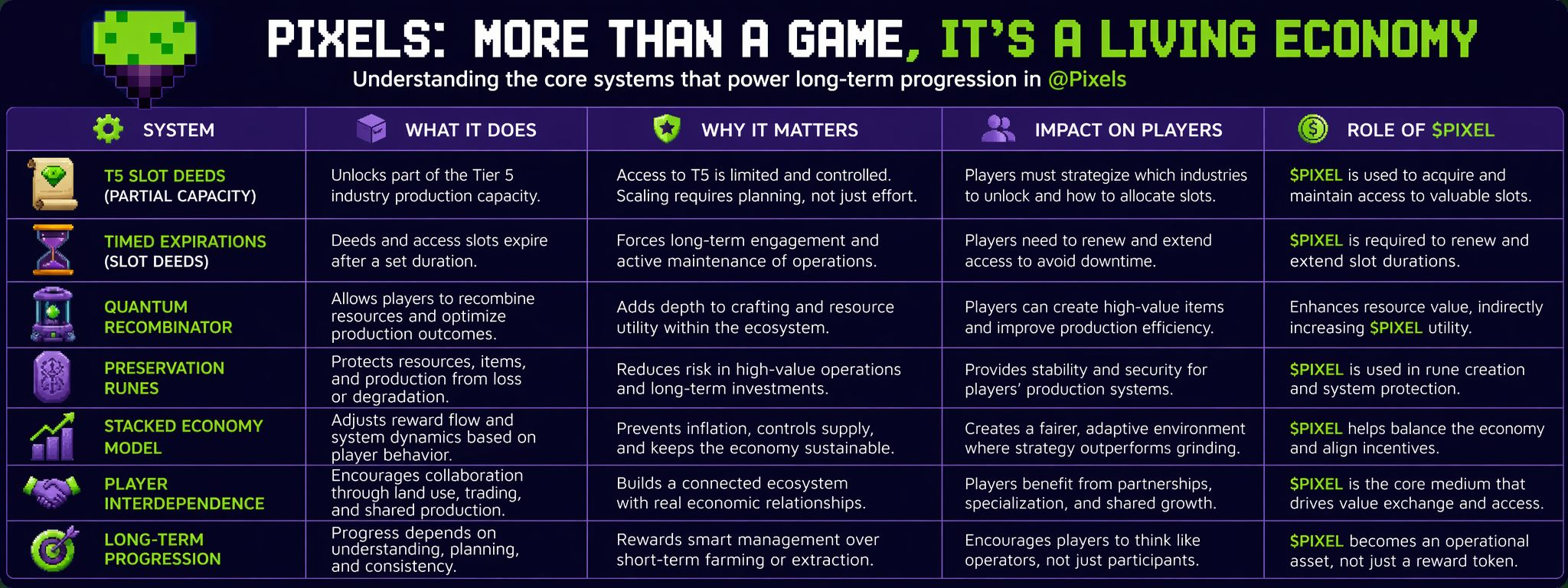
The introduction of Tier 5 systems is where this becomes obvious. T5 is not just another level of content. It changes the entire logic of progression. Access to T5 industries is limited, controlled, and intentionally constrained. You cannot simply place unlimited production. You need T5 Slot Deeds, and even those do not give full access. Each deed unlocks only a portion of capacity, which means scaling requires planning, not just effort.
And then comes the second layer. These slots are not permanent.
They expire.
That one mechanic alone forces a completely different type of behavior. Instead of building once and running forever, players now have to maintain their production systems over time. If you ignore upkeep, your entire structure slows down or collapses. That pressure is constant, and it changes how you think about every decision.
This is where most players start realizing that activity is not the same as progress.
You can be active every day and still fall behind if you are not managing access correctly.
Then the system adds another layer through the Quantum Recombinator.
At first, it looks like just another crafting station. But it plays a much larger role. It allows players to recombine resources, refine outputs, and more importantly, create items like Preservation Runes that are directly tied to maintaining T5 access.
Now the loop is no longer just about producing items.
It becomes a cycle of maintaining your own infrastructure.
You produce to sustain your system, and you sustain your system to continue producing.
That circular dependency is what turns a simple game loop into an economic system.
And right in the middle of all this sits $PIXEL.
Earlier, $PIXEL looked like a reward token. Something you earn through gameplay and potentially sell. That model is common across many Web3 games, and it usually leads to the same outcome. Players farm, extract value, and exit.
But Pixels is actively pushing against that pattern.
$PIXEL is no longer positioned purely as an output. It is becoming a requirement.
You need it to maintain access, to extend capacity, to interact with higher-level systems. It becomes part of your operational cost rather than just your reward. That shift is critical because it changes player behavior from extraction to participation.
Instead of asking how much they can earn, players start asking how long they can sustain their position.
That’s a very different mindset.
Another interesting part of pixels is how it handles reward flow. Most GameFi systems tie rewards directly to activity. The more you play, the more you earn. Over time, that creates inflation and reduces long-term sustainability.
Pixels approaches this differently.
It separates off-chain activity from on-chain value. A lot of in-game actions happen in a controlled environment where rewards do not immediately translate into extractable tokens. This allows the system to decide when and how value is released into the economy.
That level of control reduces sudden supply shocks and helps balance the ecosystem over time.
It also introduces something that most games lose quickly. Uncertainty.
Not every action guarantees a clear outcome. Not every path leads to immediate optimization. And that’s important because it keeps the system from collapsing into a single dominant strategy.
Once a game reaches that point, it stops being a game and becomes a script that everyone follows.
Pixels is trying to avoid that by constantly adjusting how rewards, access, and progression interact.
The result is a system where efficiency still matters, but it is no longer the only thing that matters.
Timing matters.
Positioning matters.
Access matters.
And most importantly, continuity matters.
You are not just trying to optimize a loop anymore. You are trying to keep your entire setup running over time.
That’s where the Stacked system starts to make more sense.
Instead of static reward distribution, the system behaves more like a live economy that reacts to player behavior. If one strategy becomes too dominant, the system can adjust. If certain resources become overused, the dynamics shift.
This creates a moving target where players need to adapt instead of repeating the same actions forever.
It also explains why some players progress faster even when they appear less active. They are not necessarily doing more work. They are making better decisions about where to position themselves in the system.
That’s a very different kind of skill compared to traditional grinding.
There is also an important social layer developing inside @Pixels.
With limited production capacity and NFT land playing a role, not every player needs to own everything. Some players focus on production, others on resource gathering, others on trading or coordination. Landowners can allow others to use their plots and earn a share of the output.
This creates interdependence between players.
And that’s usually a sign of a healthier economy.
Because value is not just created individually. It flows between participants.
Over time, this can lead to more stable structures like guilds, partnerships, and coordinated production systems.
And again, pixel sits at the center of that flow.
It connects different parts of the system, from access control to resource management to long-term progression.
The more the system evolves in this direction, the less it behaves like a typical play-to-earn model and the more it resembles a managed digital economy.
What stands out is how gradual this transition has been.
Nothing feels forced.
The game still looks simple on the surface, which is why many players underestimate what is happening underneath. But the deeper you go, the more you realize that every new mechanic is reinforcing the same idea.
This is not about short-term rewards.
This is about building something that lasts.
If pixels continues along this path, it could redefine how Web3 games approach economic design. Instead of rewarding raw activity, it rewards understanding, planning, and consistency.
That’s harder to master, but it’s also more sustainable.
And it creates a different kind of engagement.
Not just players chasing rewards, but participants managing systems.
That’s a much stronger foundation long term.
Right now, most people are still interacting with Pixels as if it’s a farming game.
But the ones paying attention can already see the shift.
It’s becoming something closer to an economy where your role is not just to play, but to operate within a structure that keeps evolving.
And once that clicks, the entire experience changes.