

Stable (STABLE) has climbed more than 25% over the past seven days, settling around $0.033-$0.034 with a market capitalization of $734 million as of April 24, 2026.
Key Takeaways:
STABLE surged over 25% in 7 days, hitting a $734M market cap at ~$0.033
Trading volume spiked 250%+ past $80M, likely amplified by a short squeeze
Major upgrades include USDT-native gas fees and public testing of the StablePay wallet
A 888M+ token unlock in early April adds an important risk factor to watch
The move coincides with a string of technical upgrades and growing institutional attention toward the network, which is built specifically as a settlement layer for digital dollar transactions - not a general-purpose blockchain competing with Ethereum or Solana.
The most operationally significant update is the USDT0 Native Gas upgrade. Previously, users had to wrap tokens into gUSDT to cover network fees - a friction point that added unnecessary steps to basic transactions. The upgrade eliminates that requirement entirely, making USDT the single token for both transfers and gas payments. Alongside this, the project's consumer-facing wallet, StablePay, has entered public testing - a product designed for fast, low-cost retail payments that would drive real transaction volume through the network rather than speculative activity alone.
Perhaps more telling of where the project is headed is its new "guaranteed blockspace" offering for enterprise clients - a feature that gives high-volume institutions predictable capacity for operations like treasury management and cross-border settlement. That kind of offering is rare among Layer-1 networks and speaks directly to traditional finance firms that can't operate on best-effort infrastructure.
What the Chart Shows
On the 4-hour timeframe, STABLE executed a sharp V-shaped recovery off an ascending trendline that has held since February. Price broke cleanly above both the SMA 50 at $0.027 and the SMA 100 at $0.0266 - levels that had acted as resistance during the consolidation phase. The MACD line is running above its signal line with a growing histogram, while RSI sits at approximately 63-64, a range that reflects sustained buying pressure without yet entering overbought territory.
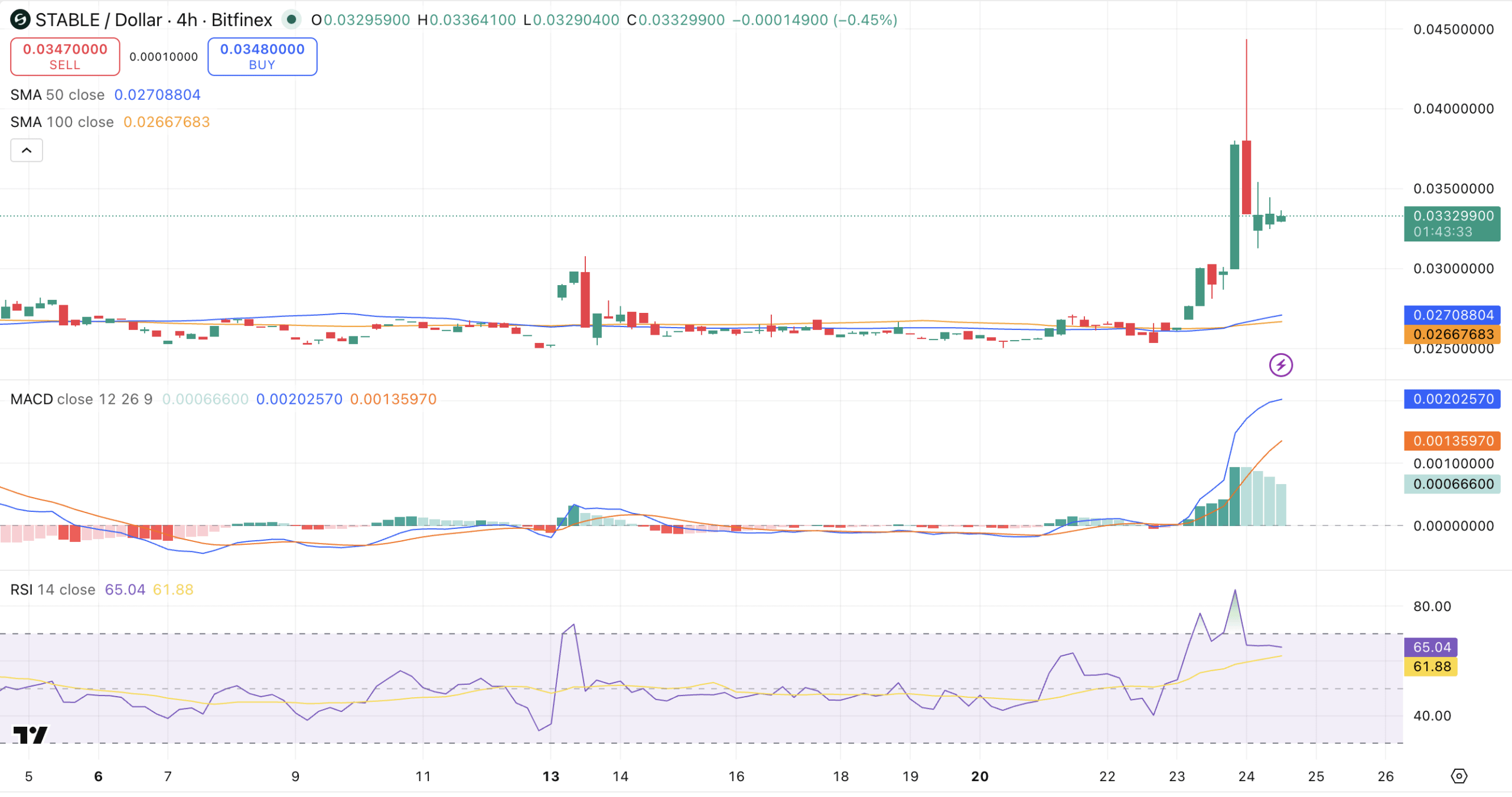
Trading volume crossing $80 million - a 250%+ spike from normal levels - is not typical of organic retail accumulation alone. When that kind of volume accompanies a rapid price recovery through technical resistance, it usually reflects forced position closures as well. Traders short the token face mounting losses as price climbs and are compelled to buy back at higher levels, which compounds the upward move. The current structure carries the hallmarks of a short squeeze layered on top of genuine fundamental catalysts.
The broader market context matters here too. Capital has been rotating out of large-cap assets and into specialized Layer-1 infrastructure plays, and STABLE has been one of the stronger performers in that category - partly because its use case is narrow and legible in a way that most general-purpose chains are not.
The Yield Model
Unlike the majority of Layer-1 projects, STABLE pays staking rewards in USDT rather than in its native token. Because gas fees across the network are denominated in USDT, validators and stakers receive a share of actual fee revenue - not newly minted tokens that dilute existing holders. The model more closely resembles a fee-sharing structure than traditional inflationary staking, which removes one of the more common concerns around long-term token value erosion.
Some exchanges have run promotional staking campaigns with yields as high as 500% APR for STABLE during the mainnet expansion period, but those figures are campaign-specific and short-lived. Sustainable yield is directly tied to how much transaction volume runs through the network over time - which is exactly what the StablePay launch and institutional blockspace initiative are meant to address.
What to Watch
A token unlock of approximately 888.89 million STABLE tokens - around 4.2% of the circulating float - was scheduled for early April 2026. Unlock events of this scale create potential selling pressure as early backers or team members gain the ability to trade their allocations. How the market absorbed that supply is a relevant factor when assessing whether the current rally has a stable demand base underneath it, or whether price is running ahead of what on-chain fundamentals currently support.