
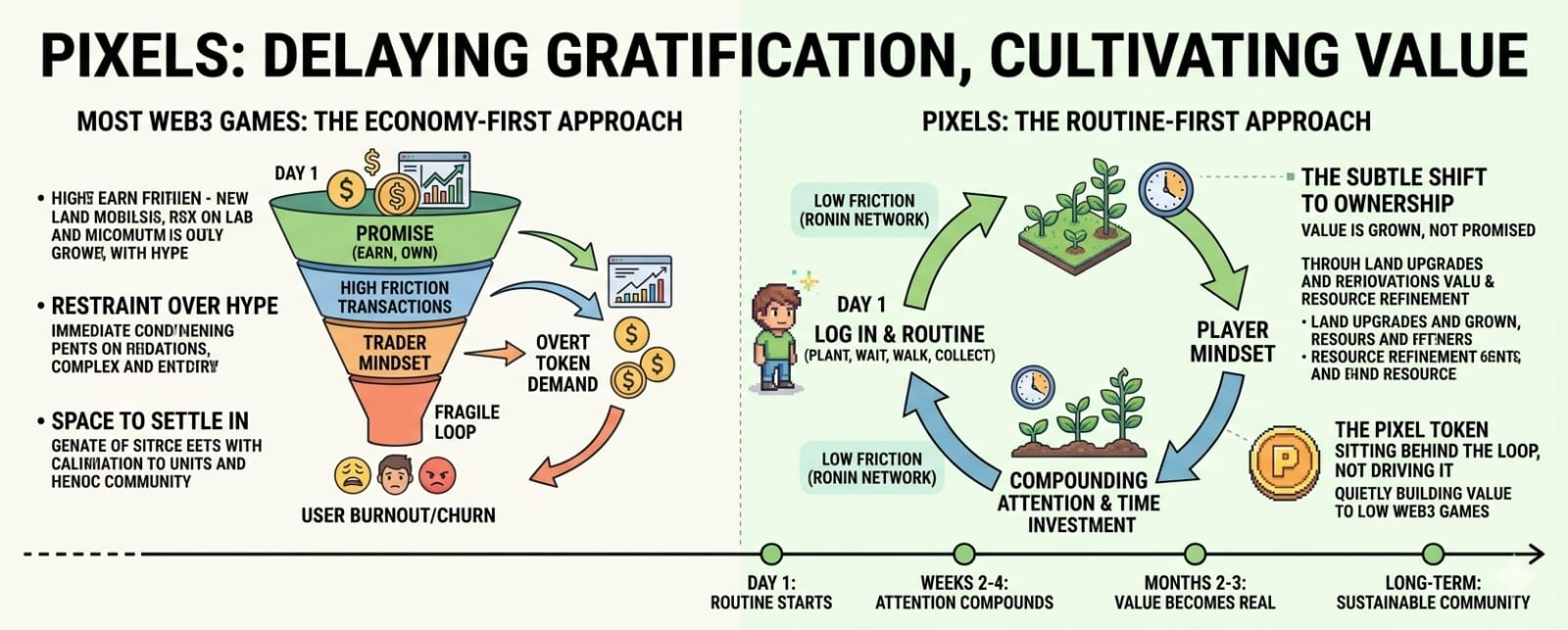
Most Web3 games start with a promise. Earn this. Own that. Make money here. And usually, that promise shows up before the game even has a reason to exist. Pixels takes a different route. It doesn’t open with the economy — it opens with routine.
You log in, and nothing dramatic happens. You plant. You wait. You walk around. You collect. It feels slow on purpose. Built on the Ronin Network, the game removes a lot of the friction that usually makes blockchain games feel like work. Actions are smooth, cheap, almost invisible. That matters more than people think, because when every click doesn’t feel like a transaction, you stop thinking like a trader and start acting like a player.
The PIXEL token exists, but it doesn’t scream for attention. It sits behind the loop instead of driving it. That’s where Pixels feels different. The value doesn’t hit you immediately. It builds quietly. You upgrade your land, refine your resources, stack small wins. Over time, your effort starts to take shape as something real — not because the game told you it has value, but because you can see the difference between where you started and where you are now.
A better way to understand Pixels is to think of it like tending a small garden you didn’t expect to care about. At first, it’s just something to pass time. Then you come back the next day. Then again. Not because you’re chasing rewards, but because you’ve already invested attention into it. That attention compounds. And somewhere along the way, it turns into value.
This is where most Web3 projects get it wrong. They try to sell ownership upfront. Pixels delays that realization. You don’t feel like an owner on day one. You grow into it. The land, the items, the progression — they only start to matter after you’ve spent enough time to care. That shift is subtle, but it changes everything about how the economy feels.
Of course, it’s not perfect. The loop can drag. The balance between players earning and enjoying is fragile. And like any system tied to a token, there’s always pressure underneath the surface. But Pixels doesn’t pretend those tensions don’t exist. It builds around them instead of hiding them.
What stands out is the restraint. It doesn’t try to overwhelm you with features or force urgency. It gives you space to settle into it. That’s rare in a space that usually pushes speed, hype, and constant movement.
In the end, Pixels proves a simple point that most projects overlook: real value in Web3 doesn’t come from what you’re promised — it comes from what you’re willing to return to, again and again, until it quietly becomes part of your routine.