
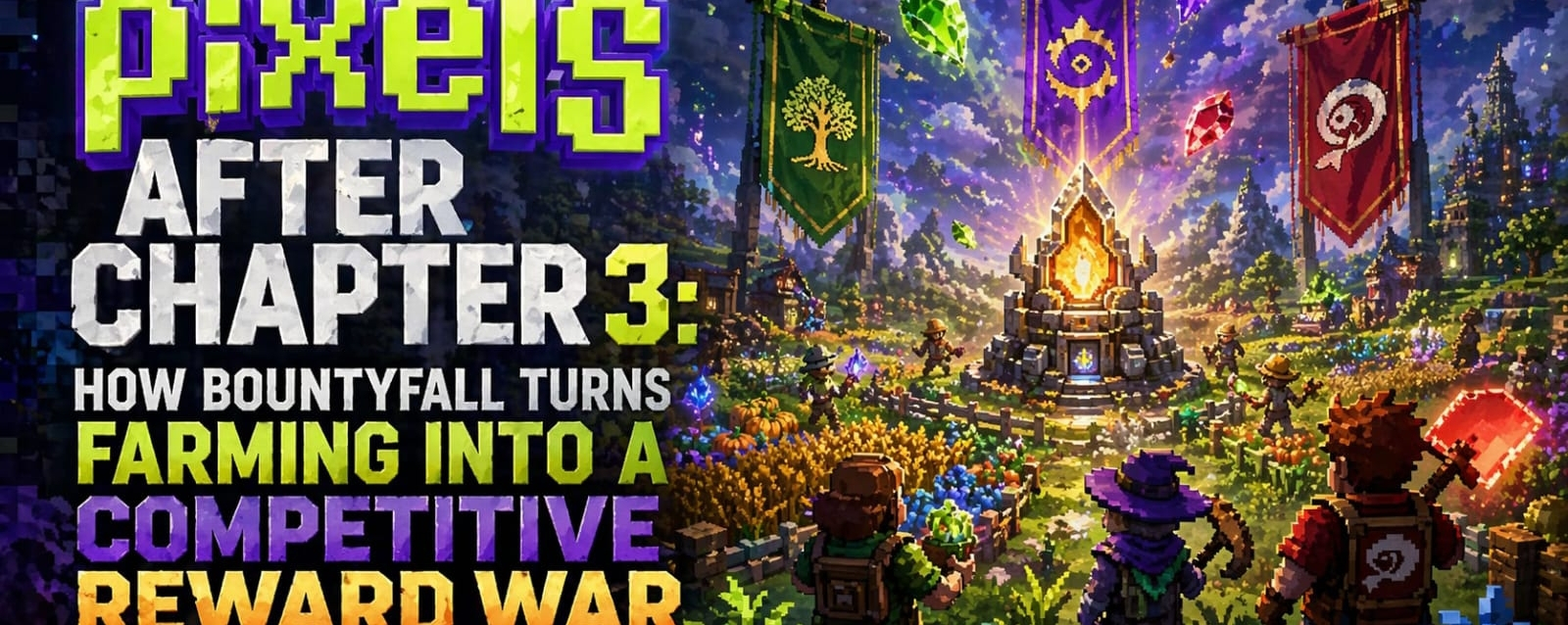
When I think about Pixels after Chapter 3, I feel that Bountyfall is a big change for the game. It does not feel like a normal seasonal event made only to keep players busy. It feels like Pixels is becoming a deeper game, where farming is still important, but teamwork, planning, timing, and rewards now matter much more.
Before Chapter 3, Pixels already had a strong style. People knew it for farming, crafting, land use, taskboards, energy use, and slow progress inside a shared world.
That was the main charm of the game. Players could log in, complete tasks, improve their farms, craft items, and slowly grow. But Bountyfall adds a new layer to this. Now I am not only thinking about my own farm or my own rewards. I am also thinking about my Union, the other Unions, the Hearth, sabotage, and how every small action can affect the full season.
This is why Chapter 3 feels important to me. Pixels did not remove its farming style.
It made farming more competitive. The game still feels familiar and calm, but now there is more pressure behind every action. Every resource has more value. Every contribution can help a Union move forward. Every bad decision can waste effort. This makes the game feel more alive.
Bountyfall brings three Unions: Wildgroves, Seedwrights, and Reapers. Each Union has its own style, and each one is connected to a special Yieldstone. Wildgroves use Verdant Yieldstones, Seedwrights use Flint Yieldstones, and Reapers use Hollow Yieldstones. These Yieldstones are not just normal items. They are the main power of the competition. Players use the right Yieldstones to make their own Union’s Hearth stronger. The main goal is to push the Hearth Health to 100% before the other Unions.
At first, this sounds simple. Help your Union, fill the Hearth, and try to win. But when I look deeper, it becomes more interesting. Players can get Yieldstones through normal taskboard activity using the Infinifunnel. Land owners can also make Yieldstones through the Yieldstone Press after crafting Yield Reactors. This is a smart system because it connects different types of players. A casual player can still help. A land owner gets more use from land. A grinder has a reason to stay active. A competitive player has something to plan. It does not feel like only one type of player controls the event.
The most interesting part for me is sabotage. In many farming games, the gameplay is simple and repeated. You plant, harvest, craft, sell, and repeat. Most of the time, you are only building your own progress. But Bountyfall allows players to use the wrong Yieldstone against another Union’s Hearth. This damages their progress. This one feature changes the whole feeling of the event. Now the game is not only about growing. It is also about slowing down your rivals.
I do not see sabotage as a random attack feature. I see it as a smart choice. If I use my resources to damage another Union, I cannot use those same resources to help my own Union.
So I have to think carefully. Is my Union close to winning? Is another Union moving too fast? Should I attack now, or should I keep building my own Hearth? These choices make Bountyfall feel more like a real competition instead of a simple reward event.
This is also where I see trading logic inside the event. In trading, I do not only look at buying or selling. I also think about risk, timing, strength, protection, and when the setup is no longer good. Bountyfall feels similar. Adding Yieldstones to my own Hearth feels like building a strong position. Sabotaging another Union feels like stopping a rival from moving ahead. Power Offerings feel like adding more strength when things are going well. Defence Offerings feel like protecting your side before problems come. That is why I think the strongest Unions will not only be the ones with the most players. The strongest Unions will be the ones that know the right time to move.
The Offering system makes this even better because it pushes players to work together. Power Offerings can make a Hearth stronger, while Defence Offerings can protect it from sabotage. But one player cannot do everything alone. Union members have to contribute together before the timer ends. If they complete the Offering in time, the Hearth levels up. If they fail, the resources are wasted. This creates real pressure. It also shows the difference between a Union that is only active and a Union that is truly organized.
This is one of the biggest changes Bountyfall brings to competitive play. It makes teamwork more important.
A player who understands timing can be more useful than someone who only throws resources without thinking. A group that knows when to attack, when to defend, and when to push forward can have a big advantage. This kind of teamwork makes the event feel more meaningful.
The reward system also feels better than a normal leaderboard event. Bountyfall does not reward players only for joining a winning side and doing nothing. Players have to contribute. The winning Union gets the biggest part of the reward pool. The second-place Union still gets a smaller part. The third-place Union gets starter Yieldstones for the next season. I like this because even the losing side still gets something useful for the next round.
This is important because many Web3 games have had the same problem for a long time. Too many games reward people for doing very little. Players join, farm rewards, sell them, and leave. That creates weak communities and weak game economies. Bountyfall feels better because it pushes players to take part in the game in a real way. Deposits matter. Sabotage matters. Offerings matter. Seasonal activity matters. Rewards feel connected to real effort, not just joining.
Union switching is another detail that makes sense. Players can change Unions, but it costs $PIXEL and has a cooldown. This may look like a small thing, but it is important. Without this cost, players could jump to the strongest Union near the end of the season and try to get rewards without helping from the start. The cost and cooldown make switching a serious choice. It helps keep the competition fair and makes commitment more meaningful.
For me, the biggest strength of Bountyfall is that it gives daily actions more purpose. A taskboard is no longer just a daily checklist. A crafted item is no longer just another item. A Yieldstone is no longer just a resource. Everything connects to the Union race. This makes the world feel more active because players are not only farming for themselves. They are farming for their Union, for the season, and for a shared goal.
I also think Bountyfall helps Pixels move toward a better reward model. Instead of only giving rewards to bring short-term attention, it creates a system where rewards are tied to activity, teamwork, and competition. This is a healthier direction. If players stay only for rewards, they may leave when rewards become smaller. But if the competition itself becomes fun, then the game has a stronger reason to keep players.
What I respect most is that Pixels still feels like Pixels. Chapter 3 does not turn it into a totally different game. It keeps farming, crafting, and the cozy world, but it gives players a stronger reason to care about every action. That balance is important. The update does not feel forced. It feels like a natural next step for the game.
In my view, Bountyfall turns farming into strategy. It turns resources into real choices. It turns rewards into something players must earn through real contribution. This is exactly what competitive Web3 gaming needs more of. Not only bigger reward pools, but better reasons to play.
Pixels after Chapter 3 feels more mature to me. It feels like the project is learning how to connect fun gameplay with smart reward design. Bountyfall may not be perfect, and future seasons may need balance changes, but the direction is strong. It shows that Pixels is not only trying to keep players busy. It is trying to make players think, work together, compete, and feel responsible for the result.
That is why I see Bountyfall as more than a seasonal feature. I see it as a sign of where Pixels can go next. If the team keeps building systems like this, Pixels can move beyond the old play-to-earn style and become a real player-driven economy. Farming will still be at the center, but now farming has more weight, pressure, and strategy behind it. That is what makes Chapter 3 feel like a real step forward.